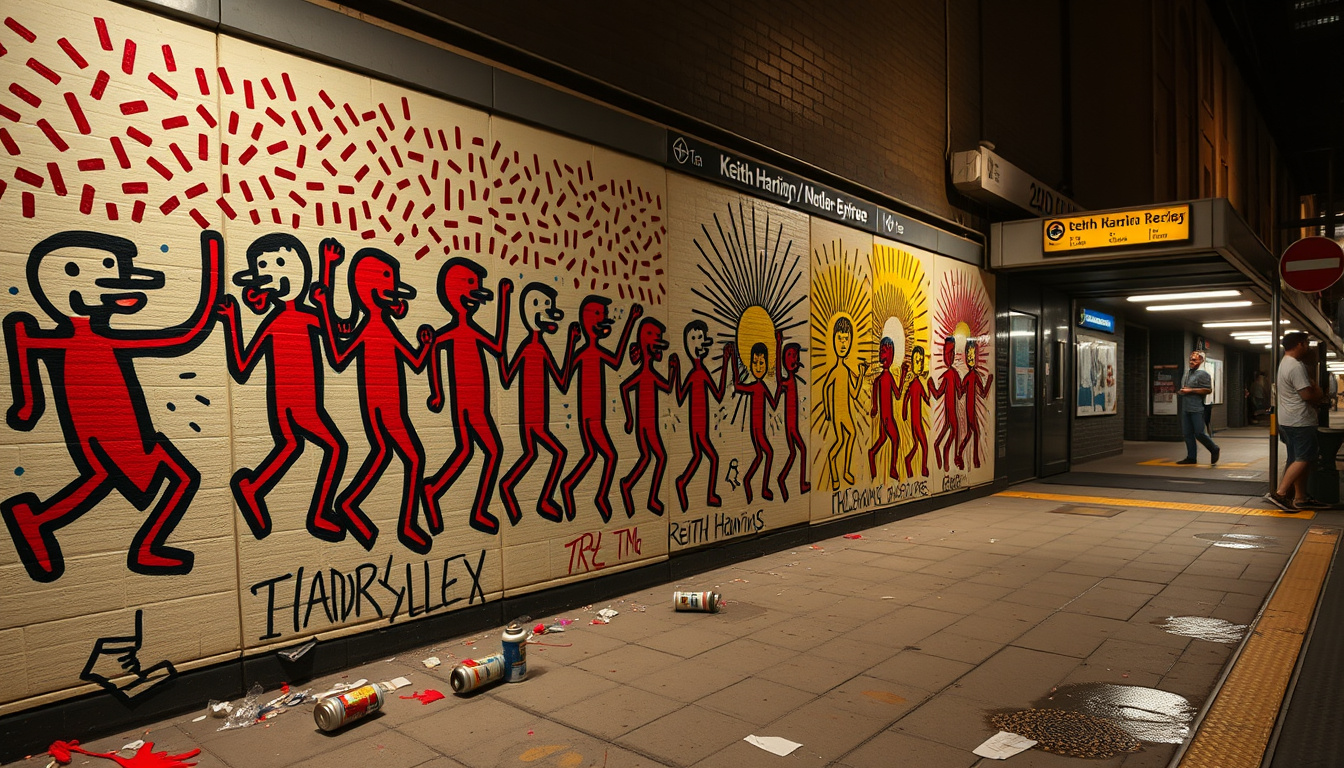
Keith Haring didn’t wait for a gallery to make his mark: the radiant crawling babies and barking dogs in bold black lines became his public signature on New York City subway stations, where he drew with chalk on blank ad panels. By the time he died at just 31, Haring had created a visual language that spoke directly about AIDS, apartheid, and social injustice — and that language is still speaking today.
Born: May 4, 1958, Reading, Pennsylvania ·
Died: February 16, 1990, New York City, age 31 ·
Known for: Bold line drawings, subway chalk art, social activism ·
Most famous work: Crack Is Wack (1986) mural and Radiant Baby icon ·
Foundation: Keith Haring Foundation, established 1989
Quick snapshot
- Born May 4, 1958, in Reading, Pennsylvania (Britannica biography)
- Raised in Kutztown, Pennsylvania (Keith Haring Foundation’s official biography)
- Moved to New York City in 1978 to study at the School of Visual Arts (The Broad’s Keith Haring profile)
- The exact name of his art style is not universally agreed upon — it’s called Pop Art, Street Art, or Graffiti Art (Artnet’s artist biography)
- His religious beliefs are not formally documented; he referenced Christian imagery but no confirmed affiliation (Artnet’s artist biography)
- 1980: Began subway chalk drawings (Tate’s guide to graffiti art)
- 1986: Painted Crack Is Wack mural (Keith Haring Foundation’s official biography) (Tate’s guide to graffiti art)
- 1988: Diagnosed with AIDS (Tate’s guide to graffiti art) (Tate’s guide to graffiti art)
- Feb 16, 1990: Died at age 31 (The Broad’s Keith Haring profile) (Tate’s guide to graffiti art)
- Keith Haring Foundation continues charitable work (Keith Haring Foundation’s official biography) (PBS American Masters biography)
- Retrospectives and exhibitions at major museums worldwide (The Broad’s Keith Haring profile) (PBS American Masters biography)
- Legacy influences street art, fashion, and LGBTQ advocacy (PBS American Masters biography)
The essential details of Haring’s life fit into a single snapshot.
| Attribute | Detail |
|---|---|
| Full name | Keith Allen Haring |
| Date of birth | May 4, 1958 |
| Place of birth | Reading, Pennsylvania, U.S. |
| Date of death | February 16, 1990 |
| Cause of death | AIDS-related complications (Tate’s guide to graffiti art) |
| Education | School of Visual Arts, New York (1978-1980) (The Broad’s Keith Haring profile) |
| Known for | Bold line drawings, public murals, social activism |
| Foundation | Keith Haring Foundation (est. 1989) (Keith Haring Foundation’s official biography) |
Why is Keith Haring so famous?
Haring’s fame didn’t come from gallery openings — it came from the subway. In the early 1980s, he started drawing with white chalk on the blank black advertisement panels in New York subway stations, creating hundreds of small, spontaneous pieces that commuters encountered every day (Britannica biography). This was public art for people who weren’t looking for it, and it worked.
Early life and influences
- Born on May 4, 1958, in Reading, Pennsylvania (Britannica biography)
- Raised in Kutztown, Pennsylvania, as the oldest of four siblings (Keith Haring Foundation’s official biography)
- His father taught him to draw cartoons from Walt Disney and Dr. Seuss (The Broad’s Keith Haring profile)
- Moved to New York City in 1978 to study at the School of Visual Arts (The Broad’s Keith Haring profile)
Haring absorbed the energy of New York’s downtown art and graffiti scenes in the early 1980s (Wikipedia’s Keith Haring entry). He was the oldest of four kids, grew up drawing cartoons, and arrived in New York just as the city’s street culture was exploding.
Subway drawings and public art
- Began creating chalk drawings on blank subway advertisement panels in 1980
- His fluid, uniform lines and repeating imagery became instantly recognizable (The Broad’s Keith Haring profile)
- Best-known motifs include the barking dog and radiant baby (Tate’s guide to graffiti art)
The subway became his studio. He’d ride the trains, find empty panels, and in minutes produce a drawing that thousands would see. The implication: Haring understood that accessibility — not exclusivity — was the real engine of cultural influence.
Activism and social messaging
- Addressed topics like AIDS, apartheid, and drug abuse in his work
- Painted the Crack Is Wack mural (1986) in Harlem as an anti-drug statement
- His work featured a distinctive style that helped define the 1980s (PBS American Masters biography)
Haring never separated art from politics. When he saw the crack epidemic devastating communities, he painted a giant mural. When the AIDS crisis hit, he addressed it directly. The pattern: he used his visual language to say what needed to be said, in plain sight.
The implication: Haring made public access the foundation of his fame, not an afterthought.
What is Keith Haring’s style of art called?
There’s no single agreed-upon label for Haring’s style, but most critics place him at the intersection of Pop Art, street art, and graffiti. Artnet describes him as a “Neo-Pop and Graffiti artist” (Artnet’s artist biography), while Britannica notes that he popularized “some strategies and impulses of graffiti art” (Britannica biography).
Pop Art and Street Art fusion
- His style is often described as a fusion of Pop Art, street art, and graffiti
- He worked across public spaces, museums, streets, and subways (The Broad’s Keith Haring profile)
- Categorized as Neo-Pop and Graffiti artist (Artnet’s artist biography)
Key visual elements: bold lines, bright colors, simplified figures
- Hallmark: bold black outlines, bright solid colors, simplified dancing figures
- Fluid, uniform lines and intricate compositions (The Broad’s Keith Haring profile)
- He described his own work as “a kind of visual language”
Influence of graffiti and cartooning
- Influenced by Walt Disney and Dr. Seuss cartoons taught by his father (The Broad’s Keith Haring profile)
- Borrowed the immediacy of graffiti but made it accessible to everyone
- His style helped define the 1980s aesthetic (PBS American Masters biography)
The trade-off: Haring’s style is so accessible that it’s sometimes dismissed as “mere” illustration. But that accessibility is precisely what made him powerful. He created a visual shorthand that anyone could read, regardless of education or background.
What happened to Keith Haring?
In 1988, Haring was diagnosed with AIDS (Tate’s guide to graffiti art). He didn’t retreat from public life. Instead, he increased his output, using his work to confront the epidemic head-on.
Diagnosis and illness
- Diagnosed with AIDS in 1988
- Continued creating art and advocating for AIDS awareness
- Painted Unfinished Painting (1989) as a commentary on the AIDS crisis
His response and activism
- Established the Keith Haring Foundation in 1989 (Keith Haring Foundation’s official biography)
- Painted works addressing AIDS, apartheid, and social injustice
- Refused to let illness silence his voice
Death and legacy
- Died on February 16, 1990, in New York, New York, at age 31 (Britannica biography)
- Cause of death: AIDS-related complications (Tate’s guide to graffiti art)
- He was an art world celebrity and pop culture icon between 1980 and 1990 (PBS American Masters biography)
Haring’s response to his diagnosis — producing more, not less — turned his final years into a masterclass in using art as activism. For anyone facing a terminal diagnosis, his example offers a powerful template for leaving something behind.
That output is the point: Haring turned his diagnosis into a reason to make more work, not less.
Was Keith Haring LGBTQ?
Yes. Haring was openly gay and had a long-term relationship with Juan Rivera. His sexuality directly influenced his art, which frequently explored themes of love, sexuality, and intimacy.
Haring’s identity and relationships
- Was openly gay
- Had a long-term relationship with Juan Rivera
- Included same-sex imagery in his work
- Was an active LGBTQ advocate
His relationship with Juan Rivera
- Rivera was his partner and later his caregiver during his illness
- Their relationship was a significant part of Haring’s personal life
- Haring’s work frequently depicted same-sex couples in loving poses
Impact of his sexuality on his work
- Explored themes of love and sexuality in his art
- Included same-sex imagery that was progressive for the 1980s
- His work became a symbol of LGBTQ visibility and pride
The pattern: Haring didn’t just happen to be gay — he made art about it. At a time when the AIDS crisis was fueling homophobia, he put same-sex love and desire in public spaces where everyone could see it.
What is Keith Haring’s most famous piece of art?
Haring created thousands of works, but three stand out as his most recognized: the Crack Is Wack mural, the Radiant Baby icon, and Unfinished Painting.
Crack Is Wack mural
- Painted in 1986 in Harlem, New York City
- One of his most recognized public works
- An anti-drug statement painted on a handball court
Radiant Baby icon
- His most iconic recurring symbol
- Represents hope, energy, and innocence
- Appears across countless works and merchandise
Unfinished Painting
- Created in 1989
- A poignant commentary on the AIDS crisis
- Depicts a partially painted canvas, symbolizing lives cut short
The Radiant Baby — a symbol of hope and new life — was Haring’s most repeated image, even as he confronted his own death from AIDS. That contradiction is central to understanding his work: he painted joy and mortality in equal measure.
The paradox runs through his best-known images: the symbol of new life and the confrontation with death emerged from the same hand.
Keith Haring: Timeline
The timeline below compresses his life into a decade of intense output.
| Date | Event |
|---|---|
| May 4, 1958 | Keith Haring born in Reading, Pennsylvania (Britannica biography) |
| 1978 | Moved to New York City to study at the School of Visual Arts (The Broad’s Keith Haring profile) |
| 1980 | Began creating chalk drawings on blank subway advertisement panels in New York (Britannica biography) |
| 1982 | First solo exhibition at Tony Shafrazi Gallery (Artnet’s artist biography) |
| 1986 | Opened the Pop Shop in New York; painted Crack Is Wack mural in Harlem (Keith Haring Foundation’s official biography) |
| 1988 | Diagnosed with AIDS (Tate’s guide to graffiti art) |
| 1989 | Established the Keith Haring Foundation; painted Unfinished Painting (Keith Haring Foundation’s official biography; Tate’s guide to graffiti art) |
| February 16, 1990 | Died of AIDS-related complications at age 31 (Britannica biography) |
The pattern: Haring compressed an entire artistic movement into barely a decade, and the timeline stops only because his life did.
Quotes and perspectives
“The best reason to paint is that there’s no reason to paint.”
— Keith Haring, from interviews
“He was the most generous person I’ve ever known. He gave everything to his work and to the people around him.”
— Juan Rivera, Haring’s partner, describing their relationship
“Keith Haring’s work bridged the gap between street art and fine art in a way that nobody else had done. He made art for everyone.”
— Jeffrey Deitch, curator and friend, on Haring’s impact
Haring became an art world celebrity and pop culture icon between 1980 and 1990 (PBS American Masters biography). His legacy lives on through the Keith Haring Foundation, which continues to support children’s programs and AIDS research. Haring’s public-art model changed the terms of engagement: make it public, make it bold, and say something that matters.
For fans of 1980s culture and music icons who died young, exploring David Bowie’s Final Years: Cause of Death, Family, and Blackstar offers a parallel story of artistry in the face of mortality. Meanwhile, the Lil Peep Death, Relationships & Legacy: Top Questions Answered article shows how Haring’s visual language — especially the Radiant Baby — continues to influence musicians across generations.
mutualart.com, haring.com, artincontext.org, encyclopedia.com, fr.wikipedia.org, insiktsbladet.se
For a comprehensive overview of his life and work, readers can explore Keith Harings biography and legacy on a dedicated platform.
Frequently asked questions
What does the Radiant Baby symbol represent?
The Radiant Baby represents hope, energy, and innocence. It is Haring’s most iconic recurring motif, appearing in countless works as a symbol of new life and positive energy.
Is Keith Haring considered a graffiti artist?
Haring is often categorized as a graffiti artist, but he is more accurately described as a Neo-Pop and street artist who popularized some strategies of graffiti art (Britannica biography). His work bridges street art and fine art.
How did Keith Haring die?
Haring died on February 16, 1990, from AIDS-related complications at age 31 (Tate’s guide to graffiti art).
Where can I see Keith Haring’s art in public?
The Crack Is Wack mural in Harlem, New York City, is one of his most famous public works. Other murals exist in cities around the world, and his works are displayed in museums including The Broad, Tate, and the Museum of Modern Art.
What is the value of Keith Haring’s art today?
Haring’s works sell at major auction houses including Christie’s for substantial sums, with some pieces fetching millions of dollars. His art continues to appreciate, and his estate is managed by the Keith Haring Foundation.
Did Keith Haring have children?
No, Keith Haring did not have children. He was openly gay and in a long-term relationship with Juan Rivera.
What did Keith Haring do before becoming famous?
Before his subway drawings brought him fame, Haring studied at the School of Visual Arts in New York City. He was influenced by cartoons from Walt Disney and Dr. Seuss, which his father taught him as a child (The Broad’s Keith Haring profile).
The through-line: Haring made his life as visible as his art, and that openness is part of why both still resonate.

Oliver Jack Carter Cooper is a staff writer for EveningLedger.uk, covering UK news, politics, business and culture. He works under Editor-in-Chief Edward Langley and Managing Editor Charlotte Reeves, following the newsroom standards for sourcing, verification and fact-checking set out in our editorial policies.