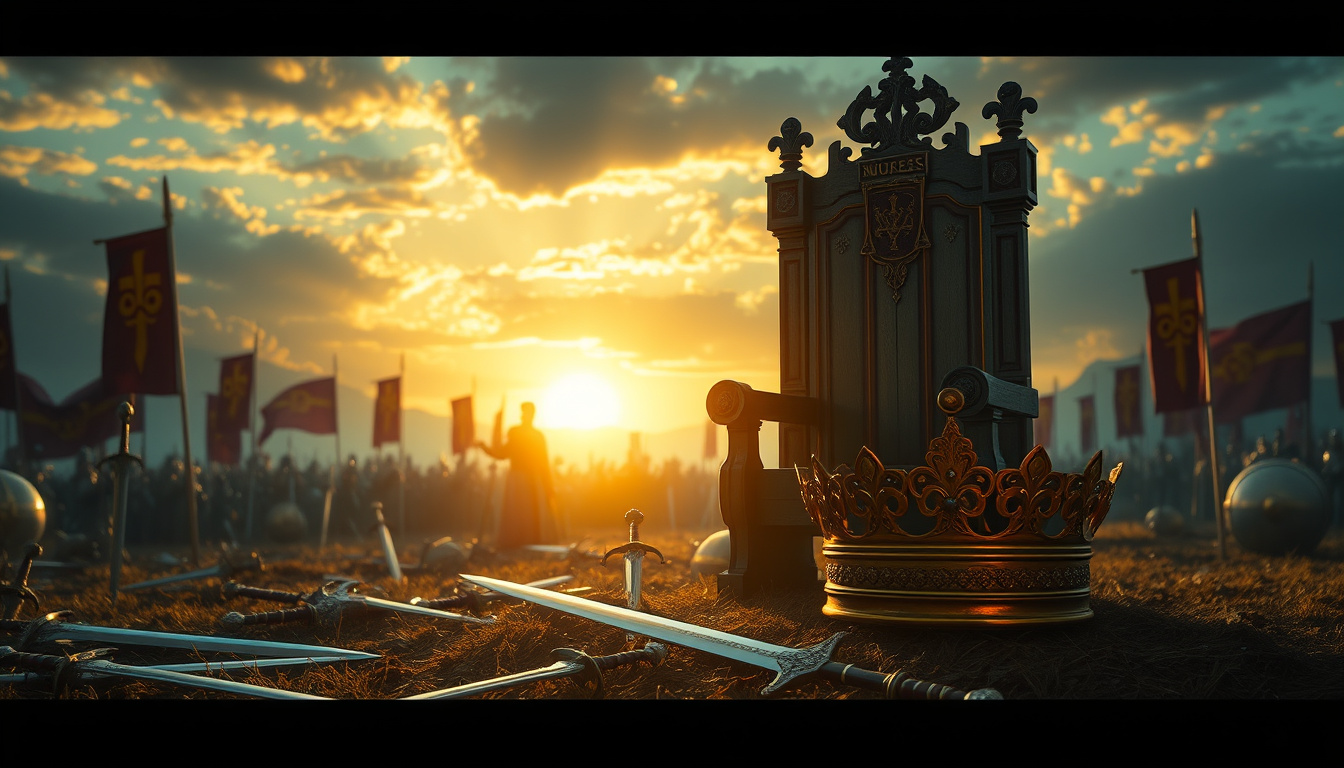

Few kings are easier to picture than Richard the Lionheart: the crusader on horseback, sword raised, heading for a war far from home. That image survives a strange fact — he spent only about six months of his ten-year reign in England, according to World History Encyclopedia (independent encyclopedia of world history).
Reign: 1189–1199 ·
Major Campaign: Third Crusade ·
Nickname Origin: Military bravery ·
Time Spent in England: About 6 months ·
Death: 6 April 1199, Châlus
Quick snapshot
- Richard led the Third Crusade and captured Acre (OurHistory (UK history education site))
- He defeated Saladin at Arsuf on 7 September 1191 (Encyclopedia.com (online encyclopedia))
- The 1192 settlement kept Jerusalem under Muslim control while protecting Christian pilgrims (Holy Cross medieval studies project)
- Whether Richard meant to neglect England or simply followed the wars (World History Encyclopedia) (History Skills (history education resource))
- The exact nature of his relationship with Saladin (Holy Cross medieval studies project) (History Skills (history education resource))
- How much of the Lionheart legend was amplified by later chroniclers (History Skills (history education resource))
- 1189 — Coronation at Westminster Abbey (Westminster Abbey (royal abbey’s official records))
- 1190–1192 — Third Crusade (OurHistory) (Westminster Abbey (royal abbey’s official records))
- 1199 — Death at the siege of Châlus (History Skills) (Westminster Abbey (royal abbey’s official records))
- Historians keep weighing his battlefield record against his domestic record (History Skills) (BBC History (UK public broadcaster’s history archive))
- The Lionheart nickname continues to shape public memory (BBC History (UK public broadcaster’s history archive))
- His crusade still anchors popular images of medieval kingship (Encyclopedia.com) (BBC History (UK public broadcaster’s history archive))
Six facts set the skeleton of Richard’s life; the pattern worth noticing is how little of it happened in England.
| Label | Recorded value |
|---|---|
| Born | 8 September 1157, Oxford (BBC History) |
| Died | 6 April 1199, Châlus (Wikipedia (open-collaboration encyclopedia)) |
| Reign | 1189–1199 (World History Encyclopedia) |
| Nickname | Lionheart (BBC History) |
| Major Event | Third Crusade (Encyclopedia.com) |
| Successor | John, his brother (Wikipedia) |
What is Richard the Lionheart most famous for?
Ask why Richard still has name recognition and the answer is one word: crusade. Almost everything in the modern image of the king happened between 1189 and 1192, in a war fought far from Westminster.
Third Crusade
- The Third Crusade ran from 1189 to 1192 and was launched after Saladin captured Jerusalem in 1187 (Encyclopedia.com).
- Richard led the Christian effort alongside Philip II of France and Frederick I Barbarossa (OurHistory).
- The 1192 settlement left Jerusalem under Muslim control while protecting Christian pilgrims (Holy Cross medieval studies project).
Richard did not fund this war from a distance; he fought it in person, and the campaign’s hardest moments — the siege of Acre, the march south — were the ones that made his reputation (OurHistory). The peace he negotiated in 1192 was a compromise: Jerusalem stayed in Saladin’s hands, but Christian pilgrims and merchants were given safety to travel (Holy Cross). By the standards of the moment, that was close to the best outcome available; by the standards of legend, it was not a conquest.
The nickname Lionheart was the reward for all of it. As BBC History (UK public broadcaster’s history archive) notes, the name reflects a later reputation built on military leadership and courage.
Military victories
- Richard captured Acre during the crusade (OurHistory).
- He defeated Saladin’s army at Arsuf on 7 September 1191 (Encyclopedia.com).
- Jerusalem itself remained beyond his reach (Holy Cross).
Arsuf was the clearest demonstration of Richard’s generalship. It was a notable victory, and it showed that Saladin could be beaten in the field when Richard commanded the army (Encyclopedia.com). Yet the campaign ended with negotiation rather than triumph, and the crusade’s central objective — the recovery of Jerusalem — went unmet (Holy Cross). That gap between battlefield success and strategic result is the most honest summary of Richard’s crusade.
Captivity and ransom
- On his way home from the crusade, Richard was captured by Duke Leopold of Austria (Wikipedia).
- He was held in Germany from 1192 to 1194 (Wikipedia).
- England had to raise a heavy ransom to secure his release (Wikipedia).
Richard’s return journey turned a religious war into a political crisis. By the time he reached Europe again, he was a prisoner: Leopold held him from 1192 to 1194, and the captive king became a bargaining chip in imperial politics (Wikipedia). The captivity matters because it consumed the years when Richard could have been governing England. Instead, those years were spent setting a price for the king’s freedom — a price England’s taxpayers ultimately paid (Wikipedia).
The same energy that won Arsuf emptied England’s treasury and left the kingdom to be governed at a distance. A warrior king, by definition, is rarely a resident one.
The pattern: Richard’s fame was built in a war that ended in negotiation, not triumph. That is the paradox at the center of his legend.
Did Richard Lionheart ever go to England?
The gap between image and reality is easiest to measure with a calendar: Richard was king of England for ten years and spent about six months of those years in England (World History Encyclopedia). He was, in the literal sense, an English king who was almost never in England.
Duration of his stay
- Richard spent only about six months of his reign in England (World History Encyclopedia).
- He visited England only twice: once for his coronation, and once for a brief period (Westminster Abbey).
That detail, buried between the famous dates, is the key to understanding his kingship. Richard’s England was, for most of his reign, a financial base for wars fought elsewhere. The machinery of government in England ran on while the king himself was on crusade, in prison, or fighting in France (Holy Cross medieval studies project).
Coronation and departure
- Richard was crowned at Westminster Abbey in 1189, after his father Henry II died (Westminster Abbey).
- He left for the crusade shortly afterward and did not return to England until after his release from captivity (Westminster Abbey).
England appears in Richard’s biography the way a staging post appears in a soldier’s map: necessary, briefly occupied, quickly left. He was crowned, he raised money, he left. The realm’s daily business ran without him while he fought in the Levant and later in France (World History Encyclopedia).
A monarch who is never home can still be powerful — but only if the wars he fights actually serve the people paying for them. Richard’s wars served a reputation.
The implication: Richard treated England as a staging post. Its real value to him was the money and men it could produce for wars elsewhere.
Was King Richard the Lionheart a good King?
Labels like “good king” are anachronistic the moment they leave a school essay, but the question behind them is fair: what did Richard actually do for the people he ruled? The honest answer is that he did almost everything for his reputation and almost nothing for his institutions (History Skills).
Military vs administrative achievements
- Richard’s reputation as a warrior-king rests heavily on battlefield leadership rather than domestic governance (History Skills).
- Historians debate whether military glory can compensate for administrative absence (History Skills).
Medieval kingship was not modern management; kings were expected to fight and lead, and Richard did both at the highest level. But kingship also had a domestic face — courts, coinage, justice, defense — and in those areas Richard’s record is thin, because he was not there to make one. After the crusade, he spent his final years fighting to recover lands in France seized by Philip II (Holy Cross medieval studies project).
Taxation and governance
- Richard raised heavy taxes across England to fund his campaigns (Wikipedia).
- After years of war spending, the ransom added a new layer of financial burden (Wikipedia).
Chroniclers and modern historians alike treat Richard’s financial demands as one of the defining features of his kingship (Wikipedia). The strongest version of the case for Richard is the one his enemies had to admit: he fought well, and he remained dangerous to the end. The strongest version of the case against him is the treasury: England was taxed hard to pay for wars that delivered no lasting gain at home.
England’s most famous medieval king was also one of its most expensive absences. The military record is real; the domestic price was real; the argument is which one should count more.
The trade-off is straightforward: England got a legend and paid for it. Whether the exchange was worthwhile is a question about values, not facts.
Is Queen Elizabeth a descendant of Richard the Lionheart?
The royal family’s interest in Richard is genealogical, and the answer surprises people: yes, Queen Elizabeth II was a descendant of Richard the Lionheart — but through the brother everyone blames, not through the king everyone remembers (Wikipedia).
Genealogical connection through John
- Elizabeth II was a descendant of Richard’s brother John, not of Richard himself (Wikipedia).
- Richard had no legitimate children, so his own branch of the family ended with him (Wikipedia).
Richard married, but the marriage produced no legitimate heirs (Wikipedia). Every later English monarch therefore descends from the junior branch of the family — the one founded by John. The line runs from John through the Plantagenets and into the later dynasties that carried English kingship forward.
House of Windsor’s Plantagenet ancestry
- The modern royal family’s line runs through John, who succeeded Richard in 1199 (Wikipedia).
- The Plantagenet strand of the Windsor family tree thus bypasses Richard entirely (Wikipedia).
For anyone who grew up thinking Richard was the great royal hero, the genealogical reality is the punchline: the most famous medieval king is also the one modern royalty does not descend from. His legend belongs to the history books; his brother’s line belongs to the royal family.
The irony: Richard secured his place in memory by leaving no heirs of his own, while John — remembered as the failure — is the ancestor of every English monarch who came after.
What happened to the kid who shot Richard the Lionheart?
The end of Richard’s life reads like the punchline to a medieval joke, except the joke was fatal. The king who had survived crusade and captivity was killed by a single crossbow bolt at a small siege in 1199 (History Skills).
Siege of Châlus
- Richard was shot by a crossbow bolt at the siege of Châlus in 1199 (History Skills).
- The siege took place during Richard’s campaigns in France to recover lands seized by Philip II (Holy Cross medieval studies project).
Châlus was not an epic battlefield; it was a stubborn castle in the Limousin, and Richard was pressing a siege when the bolt found him (Holy Cross). The wound proved fatal, and the king died on 6 April 1199 (Wikipedia).
Death of Richard
- Richard died on 6 April 1199 from the crossbow wound (Wikipedia).
- The boy who fired the bolt, named in some accounts as Pierre Basile, was allegedly flayed and hanged after the castle fell (Wikipedia).
- John succeeded Richard, ending a reign that had lasted since 1189 (Wikipedia).
Later accounts gave the boy a name — Pierre Basile — and claimed he was flayed and hanged after the castle fell (Wikipedia). Chroniclers disagree on the details, which is why the “full story” remains one of the great loose ends of Richard’s biography. The contradiction is the point: the sources do not agree, and the boy’s fate lives somewhere between legend and record.
A king who faced Saladin’s army and survived years of captivity was brought down by a single crossbow bolt at a minor castle. Medieval chroniclers never quite made peace with the disproportion.
The pattern: Richard’s life was a big war and his death was a small one.
Who was England’s most feared king?
The question “who was England’s most feared king?” produces a different answer depending on who is asking. Soldiers in the twelfth century would have named Richard; later generations tend to name rulers whose fear reached inside England itself. Richard’s case rests on what he did abroad; his rivals’ cases rest on what they did at home.
Richard’s reputation compared to other monarchs
- Richard is often cited as one of England’s most feared kings because of his military prowess (History Skills).
- Popular shortlists usually add William the Conqueror and Henry VIII to the same debate.
- Richard’s fear factor traveled with his armies; he was rarely in England to be feared by his own subjects.
The comparison is useful mainly for the contrast it creates: Richard was feared by his enemies, while the other two names are feared in their own country’s memory. William the Conqueror and Henry VIII built fear through what they did to England; Richard built it through what he did to everyone else.
Three names keep surfacing in the debate; the sharpest contrasts come from keeping each king’s actual record in view.
| King | Why the label sticks | The contrast with Richard |
|---|---|---|
| Richard the Lionheart | Military victories on the Third Crusade, including Arsuf on 7 September 1191 (Encyclopedia.com) | Feared primarily by enemies he faced in war |
| William the Conqueror | Popular shortlist contender | His fear took root inside England itself |
| Henry VIII | Popular shortlist contender | His fear took root in domestic politics |
The implication: “most feared” tells you more about the speaker than the king. Richard’s England feared paying for his glory; Richard’s enemies feared meeting him.
Richard the Lionheart: A Timeline of Key Events
Five moments carry the whole story; notice how quickly the crusade takes over after the coronation.
| Period | Event |
|---|---|
| 1157 | Born in Oxford (BBC History) |
| 1189 | Crowned King of England (Westminster Abbey) |
| 1190–1192 | Third Crusade (Encyclopedia.com) |
| 1192–1194 | Captivity in Germany (Wikipedia) |
| 1199 | Killed at the siege of Châlus (History Skills) |
The pattern: after 1189, Richard’s life is one long campaign with a captivity in the middle. England gets the coronation and the bill.
What’s Confirmed and What’s Still Unclear
Confirmed facts
- Richard died from a crossbow wound at the siege of Châlus (History Skills).
- He participated in the Third Crusade and captured Acre (OurHistory).
- He was captured by Duke Leopold of Austria on his way home (Wikipedia).
- He had no legitimate children (Wikipedia).
What’s unclear
- Whether Richard intended to neglect England or simply followed the wars (World History Encyclopedia).
- The exact nature of his relationship with Saladin (Holy Cross).
- The full story of the boy who shot the fatal bolt (Wikipedia).
- How much of the Lionheart legend was amplified by later chroniclers (History Skills).
This article relies on a set of respected popular-history and academic sources rather than on primary manuscripts; where chronicles conflict, the text says so.
The takeaway: the confirmed list is short and military; the unclear list is personal and political. That imbalance is exactly what a warrior king’s record looks like.
What the Sources Say
“Richard’s part in the Third Crusade made him the most visible English king of the Middle Ages — not because he ruled well, but because he fought at the front.”
— OurHistory (UK history education site)
“The victory at Arsuf on 7 September 1191 demonstrated that Richard could meet Saladin’s army in open battle and win.”
— Encyclopedia.com (online encyclopedia)
“Westminster Abbey’s royal records place Richard’s coronation in 1189, a ceremony that marked the beginning of a reign spent mostly away from England.”
— Westminster Abbey (royal abbey’s official records)
“Richard’s reputation as a warrior-king rests heavily on battlefield leadership rather than domestic governance.”
— History Skills (history education resource)
What this means: every source points in the same direction. The king the sources agree on is a soldier; the king they cannot agree on is the ruler.
The Verdict
Richard the Lionheart was not a good king in the modern sense — he was a great warrior who happened to wear a crown. His reign taxed England heavily, spent almost all of its time away from it, and ended with a crossbow bolt that left the throne to a brother whose reputation was far worse. For students of English history, the choice is clear: judge Richard as a military commander first and a monarch second, or you will keep misreading the bills he left behind.
en.wikipedia.org, ebsco.com, encyclopedia.com, en.wikipedia.org
Frequently asked questions
What was Richard the Lionheart’s relationship with Saladin?
They led opposing sides in the Third Crusade and negotiated the 1192 settlement that kept Jerusalem under Muslim control while protecting Christian pilgrims (Holy Cross medieval studies project). The exact personal regard between them remains unclear.
Did Richard the Lionheart speak English?
Richard was born in Oxford but raised in his mother’s lands in Aquitaine and spent almost his entire adult life in France and the Holy Land (World History Encyclopedia). There is no surviving record of him using English; his world was the French-speaking Plantagenet court.
How did Richard get the nickname Lionheart?
The nickname reflects a later reputation built on military leadership and courage, not on his brief time in England (BBC History).
What was the ransom for Richard the Lionheart?
Richard was captured by Duke Leopold of Austria while returning from the crusade and held in Germany from 1192 to 1194; England raised a heavy ransom to secure his release (Wikipedia).
Who succeeded Richard the Lionheart?
His brother John succeeded him in 1199, since Richard had no legitimate children (Wikipedia).
How long did Richard the Lionheart rule England?
He ruled from 1189 to 1199, a ten-year reign in which he spent only about six months in England (World History Encyclopedia).
Was Richard the Lionheart married?
Yes. Richard was married, but the marriage produced no legitimate children, which is why his brother John inherited the throne (Wikipedia).
What is the legacy of Richard the Lionheart?
His legacy is the Lionheart image: a warrior-king remembered for crusading courage and military victories rather than for domestic rule (BBC History).
Related reading

Oliver Jack Carter Cooper is a staff writer for EveningLedger.uk, covering UK news, politics, business and culture. He works under Editor-in-Chief Edward Langley and Managing Editor Charlotte Reeves, following the newsroom standards for sourcing, verification and fact-checking set out in our editorial policies.