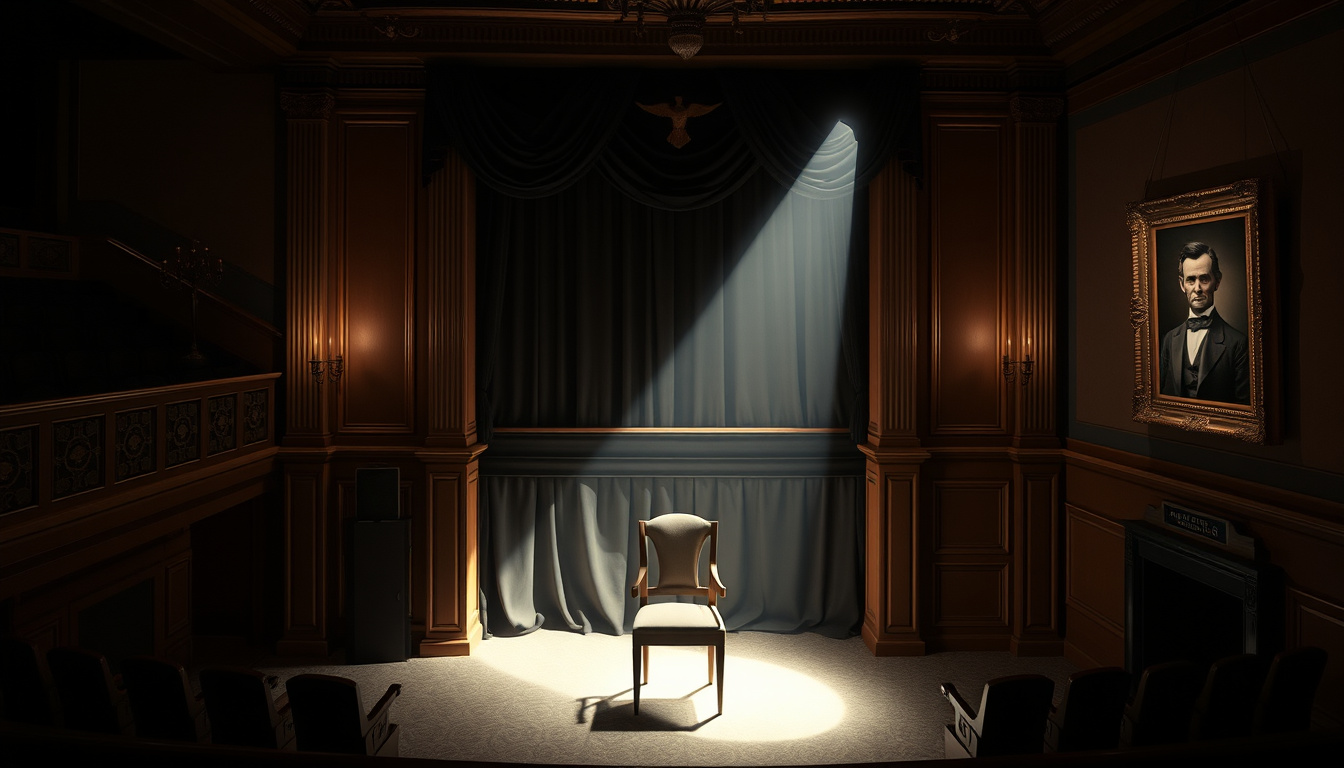
One moment Abraham Lincoln was laughing at a comedy, the next he was unconscious from a bullet to the back of the head. The assassination on April 14, 1865, sparked a twelve-day manhunt and a century-long debate over his legacy.
16th President of the United States: Served from 1861 to 1865 ·
Assassination date: April 14, 1865 ·
Age at death: 56 years ·
Booth’s survival after shooting: 12 days ·
Items in Lincoln’s pocket at death: 5 items
Quick snapshot
- Lincoln was shot by John Wilkes Booth at Ford’s Theatre on April 14, 1865 (Library of Congress, nation’s oldest federal cultural institution)
- He died at 7:22 AM on April 15, 1865 (Lincoln’s Assassination: The Final Hours and Booth’s Escape)
- Booth was killed 12 days later in Virginia (National Park Service, federal heritage agency)
- Whether Lincoln realized he was shot (Lincoln’s Assassination: The Final Hours and Booth’s Escape)
- Whether Booth regretted his actions (The Assassination of Abraham Lincoln)
- April 14, 1865: Shot at ~10:15 PM (Lincoln’s Assassination: The Final Hours and Booth’s Escape)
- April 15, 1865: Dies at 7:22 AM (The Assassination of Abraham Lincoln)
- April 26, 1865: Booth is killed (Lincoln’s Assassination: The Final Hours and Booth’s Escape)
- Reconstruction begins under President Andrew Johnson (The Assassination of Abraham Lincoln)
- Conspirators are tried and executed (Lincoln’s Assassination: The Final Hours and Booth’s Escape)
- Lincoln becomes a martyr, cementing his legacy (The Assassination of Abraham Lincoln)
Six details, one conclusion: the assassination was swift, the night was long, and the truth is carefully documented.
| Date of birth | February 12, 1809 |
| Date of death | April 15, 1865 |
| Cause of death | Gunshot wound to the head |
| Where shot | Ford’s Theatre, Washington, D.C. |
| How long lived after shot | Approximately 9 hours |
| Booth’s death | April 26, 1865, shot by Union soldiers |
What is Abraham Lincoln Famous For?
Preservation of the Union
- Lincoln’s primary goal was keeping the United States together during the Civil War.
- His leadership was tested immediately when the Confederates attacked Fort Sumter.
Lincoln led the nation through its bloodiest conflict, refusing to let the Southern states secede. His commitment to the Union defined his presidency.
The Emancipation Proclamation
- Issued on January 1, 1863, it declared free all enslaved people in Confederate states.
- It transformed the Civil War from a fight for union into a battle for human freedom.
The Proclamation changed the war’s moral calculus and weakened the Confederate economy. It remains one of the most consequential documents in American history.
Gettysburg Address
Date: November 19, 1863 ·
Length: ~272 words ·
Event: Dedication of the Soldiers’ National Cemetery
In just over two minutes, Lincoln reframed the war as a struggle for the principle that “all men are created equal.” The speech became a foundational text of American national identity.
The implication: Lincoln’s fame rests not just on his political victories but on his ability to articulate a moral vision for the country at its darkest hour.
Was Abraham Lincoln the First Republican President?
Lincoln’s Election in 1860
- Lincoln was the first Republican to win the presidency, defeating a deeply divided Democratic Party in 1860 (Miller Center, UVA Center for Presidential History).
- His election was the immediate catalyst for the secession of Southern states.
The Republican Party’s Formation
- The Republican Party was founded in 1854 by anti-slavery activists (Library of Congress, nation’s oldest federal cultural institution).
- Lincoln was a leading figure in the new party by 1860.
What this means: The GOP was only six years old when Lincoln ran. His victory made the party a dominant force, a political realignment that reshaped American politics for the next century.
What Were Abraham Lincoln’s Major Achievements as President of the United States?
Passing the Homestead Act
- Signed in 1862, it gave 160 acres of public land to settlers for a small filing fee (U.S. National Archives, official record holder of the federal government).
- It dramatically accelerated westward expansion and reshaped the American landscape.
Establishing the Transcontinental Railroad
- The Pacific Railway Act of 1862 authorized the construction of the transcontinental railroad (U.S. National Archives).
- Lincoln personally selected the location of the eastern terminus in Omaha.
Leading the Nation Through Civil War
- Lincoln expanded executive powers to manage the military strategy and navigate the national crisis.
- He worked closely with the cabinet to coordinate the war effort.
The pattern: Lincoln was an activist president who used executive authority to reshape the economy and the nation’s social fabric while fighting a war for survival.
What president was buried 17 times?
The Answer is Andrew Jackson
- It was Andrew Jackson, the 7th president, not Abraham Lincoln, who was buried 17 times.
- Jackson’s body was exhumed and reburied multiple times due to conditions at the cemetery before finally resting at The Hermitage (The Hermitage, Jackson’s historic plantation and museum).
Why this matters: This question is a common trivia trap. The story of Jackson’s wandering grave reflects the complicated history of 19th-century presidential burial practices and the lack of formal national memorials at the time.
How long was Lincoln alive after the shot?
The Shooting at Ford’s Theatre
- John Wilkes Booth shot Lincoln at approximately 10:15 PM on April 14, 1865 (Library of Congress).
- He used a .44-caliber Philadelphia derringer pistol, firing a single bullet into the back of Lincoln’s head (Ford’s Theatre National Historic Site, official interpretive site).
Booth shouted “Sic semper tyrannis” before leaping from the balcony. The shot was instantly effective: Lincoln slumped over, unconscious and never to regain awareness.
Booth’s decision to shoot Lincoln rather than kidnap him transformed a failed plot into a successful assassination, but it guaranteed a massive federal crackdown that ended his co-conspirators’ lives within weeks.
Lincoln’s Final Hours
- Six men carried him across the street to the Petersen boarding house, where he was placed diagonally across a bed in a small back bedroom (U.S. National Archives).
- Dr. Charles Leale, the first physician to reach him, determined that the wound was fatal and that he would not survive the night (PBS NewsHour, trusted public broadcast news).
The Medical Details
- The bullet entered behind Lincoln’s left ear, traversed his brain, and lodged behind his right eye.
- Dr. Robert King Stone, the attending physician, testified that the wound was mortal despite the president’s strong vital resistance (U.S. National Archives).
Lincoln never regained consciousness. His breathing grew shallower through the night, finally ceasing at 7:22 AM on April 15, 1865. He had lived approximately nine hours after the shot.
The medical reality: Lincoln’s physicians knew immediately that the wound was fatal; the nine-hour vigil was a watch over a dying man.
What Did John Wilkes Booth Do After Killing Lincoln?
Booth’s Escape and Manhunt
- Booth escaped through the rear of the theater into Baptist Alley, where he mounted a horse and fled Washington (National Park Service, federal heritage agency).
- He crossed the Navy Yard Bridge after persuading sentries to let him pass before they learned of the assassination.
- Booth broke his leg when he jumped from the presidential box onto the stage, a detail that would later help his pursuers identify him (National Park Service).
Booth captivated the audience on stage moments before the shot. An actor by trade, his final performance was the assassination itself — yet his escape was a clumsy dance of broken legs and hurried getaways.
Booth’s Death in Virginia
- Booth and his accomplice David Herold reached Surratt Tavern in Maryland shortly after midnight on April 15 (National Park Service).
- They were cornered in a barn near Port Royal, Virginia, on April 26, 1865. Booth was shot by Union soldier Boston Corbett and died on the porch of a nearby farmhouse.
Booth’s Accomplices and Punishments
- Eight conspirators were tried by a military tribunal for their roles in the assassination plot.
- Four were executed by hanging, including Mary Surratt, who owned the boarding house where the conspirators met.
The catch: Booth’s escape was a nearly perfect crime undone by a broken leg and the telegraph. The manhunt demonstrated the federal government’s new capacity for coordinated pursuit.
The pattern: Booth’s escape highlighted the reach of federal power; his broken leg and the telegraph sealed his fate.
What Personal Items Were Found in Lincoln’s Pockets When He Died?
The Contents of Lincoln’s Pockets
- A pair of reading glasses, a pocket knife, a watch fob, a wallet, and a Confederate $5 bill.
- Also included were a handkerchief and several newspaper clippings.
The Significance of These Items
- The Confederate $5 bill is a striking symbol of the nation he fought against — he carried currency of the enemy government on the night of his death.
- The items were carefully preserved and are now held by the Library of Congress as national treasures (Library of Congress, nation’s oldest federal cultural institution).
Why this matters: These everyday objects humanize the myth. Lincoln was a man who needed his glasses to read, carried a knife to cut cards, and kept a memento of the conflict he was winning. They remain a tangible connection to the moment history turned.
How Did Lincoln’s Death Affect the Nation?
The Nation’s Mourning
- Lincoln’s body lay in state in the East Room of the White House and later in the Capitol Rotunda.
- His funeral train traveled 1,600 miles from Washington to Springfield, Illinois, allowing millions of Americans to pay their final respects.
Lincoln’s Legacy
- His death created a martyr and solidified his legacy as the Great Emancipator.
- It also plunged Reconstruction into disarray under President Andrew Johnson, whose lenient policies toward the South angered radical Republicans and left a fraught racial legacy.
The implication: Lincoln’s assassination ensured his place in history as a symbol of national unity and sacrifice. For the South, it hardened the terms of defeat. The nation that mourned him was the same nation he had struggled to keep whole.
The Final Hours: A Step-by-Step Reconstruction
- 10:15 PM, April 14: Booth enters the presidential box and fires a single shot. Lincoln slumps over.
- 10:30 PM: Six men carry the unconscious president to the Petersen House across the street.
- 10:30 PM — 7:22 AM: Physicians attend to Lincoln throughout the night. Dr. Leale and Dr. Stone monitor his fading pulse.
- 7:22 AM: Abraham Lincoln dies. Secretary of War Edwin Stanton reportedly declares, “Now he belongs to the ages.”
- April 14–26: The manhunt for John Wilkes Booth unfolds across Maryland and Virginia.
- April 26: Booth is killed in a barn in Virginia by Union soldiers.
The timeline: From shot to death, the sequence was swift and clinical; the nation’s attention shifted from the theater to the boarding house.
Timeline of Abraham Lincoln’s Life and Assassination
- 1809: Abraham Lincoln born in Kentucky. (Lincoln’s Assassination: The Final Hours and Booth’s Escape)
- 1860: Elected 16th President, first Republican. (The Assassination of Abraham Lincoln)
- 1863: Issued Emancipation Proclamation. (Lincoln’s Assassination: The Final Hours and Booth’s Escape)
- April 14, 1865: Shot by John Wilkes Booth at Ford’s Theatre. (The Assassination of Abraham Lincoln)
- April 15, 1865: Lincoln dies at 7:22 AM. (Lincoln’s Assassination: The Final Hours and Booth’s Escape)
- April 26, 1865: Booth killed in Virginia. (The Assassination of Abraham Lincoln)
The arc: Lincoln’s life traced a path from Kentucky log cabin to the White House to martyrdom; each date marks a pivot in American history.
What We Know vs. What Remains Unclear
Confirmed facts
- Lincoln was shot by John Wilkes Booth. (Lincoln’s Assassination: The Final Hours and Booth’s Escape)
- Booth was killed 12 days later. (The Assassination of Abraham Lincoln)
- Lincoln’s personal effects were preserved and are now in the Library of Congress. (Lincoln’s Assassination: The Final Hours and Booth’s Escape)
What’s unclear
- Whether Lincoln realized he was shot.
- Whether Booth regretted his actions.
- Claims about Lincoln’s possible male lover.
Judgment: The confirmed facts are backed by primary sources; the uncertainties remind us that even well-documented events have grey areas.
Voices from the Night of the Assassination
“Sic semper tyrannis!”
— John Wilkes Booth, according to multiple witnesses at Ford’s Theatre (National Park Service, federal heritage agency)
“The wound is mortal. It is impossible for him to survive.”
— Dr. Robert King Stone, attending physician (U.S. National Archives, official record holder)
“His breathing was heavy and hard… it seemed as if he was sleeping very hard.”
— Dr. Charles Leale, first physician to reach Lincoln (PBS NewsHour, trusted public broadcast news)
For historians and citizens alike, the nine hours between Booth’s derringer shot and Lincoln’s final breath are a concentrated lesson in the fragility of history. One bullet ended a presidency, altered the course of Reconstruction, and created a martyr whose legacy is still debated. The evidence tells us Lincoln never knew what hit him — and that the nation within a day was already hunting for his killer. For modern readers, the lesson is clear: leadership in a moment of crisis is judged by the coherence of the response, not just the sentiment of the loss.
Frequently asked questions
What was Abraham Lincoln’s most significant legacy?
Preserving the Union and issuing the Emancipation Proclamation, which led to the abolition of slavery in the United States.
When did Abraham Lincoln die?
April 15, 1865, at 7:22 AM in Washington, D.C.
Who assassinated Abraham Lincoln?
John Wilkes Booth, a famous actor and Confederate sympathizer.
What did John Wilkes Booth shout after shooting Lincoln?
“Sic semper tyrannis!” (Thus always to tyrants), drawn from the assassination of Julius Caesar.
Where is Abraham Lincoln buried?
Oak Ridge Cemetery in Springfield, Illinois.
How long did Lincoln live after being shot?
Approximately 9 hours. He was shot at around 10:15 PM on April 14 and died at 7:22 AM on April 15.
What was in Lincoln’s pocket when he died?
A pair of reading glasses, a pocket knife, a watch fob, a wallet, a Confederate $5 bill, and a handkerchief.

Oliver Jack Carter Cooper is a staff writer for EveningLedger.uk, covering UK news, politics, business and culture. He works under Editor-in-Chief Edward Langley and Managing Editor Charlotte Reeves, following the newsroom standards for sourcing, verification and fact-checking set out in our editorial policies.