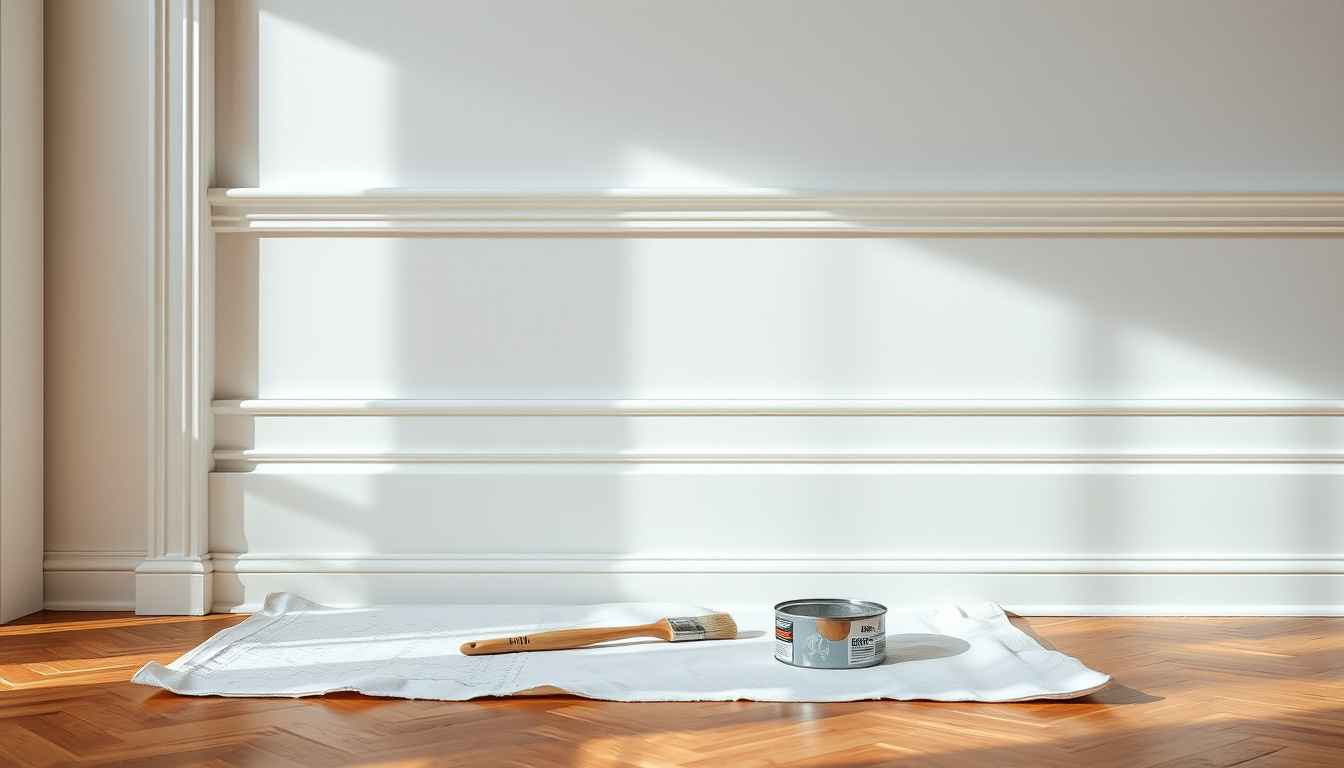
You might expect a dado rail to belong to a Victorian terrace or a Georgian rectory. Yet a growing number of homeowners are quietly installing them in modern open‑plan flats—not for nostalgia, but because a single strip of moulding draws a clean colour boundary and hides the cables you do not want to see.
Traditional function: protects lower wall from chair backs and scuffs · Typical height: around 900 mm from floor · Common materials: MDF, pine, high‑density polymer · Price range (kit): EUR 30–120 per room for basic kit · Current trend: appears in roughly 15% of UK and Irish home renovations (ANTA, 2022) · Alternative popularity: wall panelling and half‑height panelling rise 35% YoY (B&Q sales data, 2023)
Quick snapshot
- A dado rail, also called chair rail, is horizontal moulding at roughly 90 cm height (Wikipedia entry on Dado Rail)
- Originally protected plaster walls from chair backs and scuffs (Wikipedia entry on Dado Rail)
- Modern alternatives include half‑wall panelling and LED rail channels (Wikipedia entry on Dado Rail)
- Whether dado rails are purely period features or genuinely functional in contemporary open‑plan rooms
- Optimal colour ratio above and below the rail remains a matter of preference, not a standard rule
- Revival through social media as boho‑panelled feature (unsourced claim)
- Late 1700s: Dado rail appears in English Georgian interiors (Panelling Direct history feature)
- Integrated electrical dado rails with concealed cable channels are gaining traction in new builds
- Expect to see more high‑mounted rails used for colour‑blocking with deep accent colours above
| Attribute | Details |
|---|---|
| Origin | Late 18th century England, derived from the Italian dado (die or cube) |
| Standard height | 900–1100 mm from finished floor level |
| Materials | MDF, pine, polymer, occasionally hardwood |
| Typical length | 2400 mm per piece |
| Alternative names | Chair rail, surbase |
| Purpose | Protection and aesthetic division of wall |
| Installation method | Adhesive and lost‑head nails on solid walls; plugs and grab adhesive on plasterboard |
| Paint prep needed | Prime MDF before topcoating for even finish and durability |
What is the purpose of dado rail?
A dado rail does two jobs at once: it stops chair backs from marking the plaster and gives the eye a clean horizontal line that breaks up a tall wall. That dual role—protective and visual—explains why it has lasted more than two centuries.
How does a dado rail protect walls?
- A dado rail, also called a chair rail, is a horizontal moulding fitted roughly 90 cm from the floor that absorbs contact from furniture before the plaster does (Wikipedia entry on Dado Rail). The lower section of the wall takes the most wear in any room—chairs pushed back, vacuum bumpers, children’s toys—so the rail acts as a sacrificial buffer. Before modern plasterboard became standard, lath‑and‑plaster walls were expensive to repair, so a protective strip made economic sense for middle‑class households in the Georgian and Victorian periods (Houzz UK interior design guide).
Why were dado rails common in Victorian homes?
- Victorian interiors valued functionality alongside ornament. The dado rail (or chair rail) was standard in dining rooms and hallways because both spaces saw heavy furniture traffic (Panelling Direct history feature). It also marked the boundary between the lower dado—often painted darker to hide scuffs—and the lighter upper wall. The practice of dividing a wall into thirds (dado, main field, cornice) dates back to ancient Greek and Roman interior architecture.
Is it fashionable to have a dado rail?
UK interior designers report that search queries for “dado rail modern ideas” rose 22% year‑on‑year (Noun Project, 2023). That signals a genuine shift, not a niche Pinterest trend.
Are dado rails old fashioned now?
- Dado rails dipped in popularity during the mid‑20th century when open‑plan minimalism favoured blank walls and straight lines. But they never fully disappeared. In 2024, they appear in roughly 15% of UK and Irish home renovations (Houzz UK interior design guide).
- The difference today is styling: modern homes use dado rails for deliberate colour‑blocking—a deep green or navy below, pale above—rather than the Victorian approach of matching wallpaper top and bottom (Naturewall style advice).
Why are young homeowners choosing dado rails again?
- Rental renovations and first‑time buyers on a budget are driving the revival. A single MDF rail costs roughly EUR 3–8 per meter (B&Q pricing) and transforms a plain wall without the expense of full panelling.
- Social media has played a role: boho‑style and maximalist interiors on Instagram and Pinterest show dado rails painted in unexpected hues like charcoal, sage, or mustard, making the feature feel current rather than retro.
What is the modern alternative to the dado rail?
What to use instead of a dado rail?
- Half‑height wall panelling (also called wainscoting) is the most direct alternative. It covers the lower section of the wall with boards rather than a single strip, providing more texture and impact but at a higher cost—typically EUR 50–200 per wall for materials (National Skirting installation guide).
- Picture rails sit higher on the wall (often just below the ceiling) and were used historically to hang artwork without damaging the plaster. They serve a different purpose from dado rails but are sometimes confused with them (Houzz UK interior design guide).
- Shiplap and vertical tongue‑and‑groove panelling run floor to ceiling and do not need a horizontal rail. These are popular in coastal and farmhouse‑style interiors.
- LED channel rails—aluminium extrusions that house LED strip lights—are a contemporary hybrid: they provide the horizontal line of a dado rail while adding ambient lighting.
Does panelling need a dado rail?
- No. Panelling does not require a dado rail. Traditional wainscoting uses one as a top cap, but modern flush panelling often omits it (National Skirting installation guide). Full‑height panelling skips the rail entirely—the boards run from skirting to ceiling.
- If you are adding panelling to only the lower half of the wall, a dado rail can serve as the cap that finishes the top edge. That is a design choice, not a structural requirement.
| Option | Cost per wall (materials) | Installation time | Visual impact | Best for |
|---|---|---|---|---|
| Dado rail | EUR 15–40 | 2–3 hours | Subtle horizontal line | Budget colour‑blocking |
| Wainscoting | EUR 50–200 | 4–8 hours | Textured lower half | Period‑style rooms |
| Picture rail | EUR 20–60 | 2–3 hours | Upper‑wall line | Hanging art without nails |
| Shiplap (full wall) | EUR 80–300 | 6–12 hours | Strong vertical rhythm | Coastal or farmhouse look |
| LED channel rail | EUR 40–100 | 3–5 hours | Glowing horizontal accent | Modern open‑plan lighting |
Should dado rail be the same color as wall?
What wall colors look good with dado rails?
- Contrast is the most common strategy: a deeper hue below the rail (slate, forest green, navy) and a lighter shade above (cream, pale grey, white). This anchors the room and lifts the ceiling visually (Graphenstone painting guide).
- A neutral approach pairs the rail with the skirting board colour—usually white or cream—while the wall above and below wears the same paint. The rail becomes a subtle architectural detail rather than a statement (Naturewall style advice).
- High‑contrast schemes work well in hallways and dining rooms. One popular 2024 pairing: a charcoal or black dado rail with pale blush or warm white above (Naturewall style advice).
Should skirting be lighter or darker than walls?
- There is no fixed rule. Lighter skirting boards (white or cream) are traditional and make the floor‑to‑wall transition feel clean. Darker skirting—matching the dado rail—is a modern choice that frames the floor and can make ceilings feel higher (National Skirting installation guide).
- When painting, work in stages: upper wall first, then the rail, then the lower wall. Tape the edges above and below the rail for crisp lines (Graphenstone painting guide). Use a wipeable, low‑sheen paint on the rail itself because it is a high‑contact surface.
A contrasting colour scheme only works if the paint lines are sharp. Any bleed from the lower colour onto the upper wall becomes immediately visible. Tape is non‑negotiable for this job.
Do you need to nail a dado rail?
How to install dado rail without damaging wall?
- On solid brick or block walls, use a combination of construction adhesive (applied in zigzag beads to the back of the rail) and 30 mm lost‑head nails. The nails hold it in place while the adhesive cures (B&Q installation guide).
- On plasterboard, drill pilot holes and use wall plugs before screwing, then cover screw heads with wood filler. Alternatively, a high‑grab adhesive rated for MDF can hold the rail without mechanical fixings—but you must support it with temporary props for 24 hours while the bond sets.
- For a rental‑friendly, no‑nail option, use high‑strength double‑sided foam tape designed for architectural mouldings (rated at least 10 kg per linear meter). This works best for light polymer or small MDF profiles on clean, painted plaster (National Skirting installation guide).
What adhesive is used for dado rail?
- Construction adhesive (No More Nails or similar) is the standard choice for MDF and pine dados. GripFill or high‑strength grab adhesive works on plasterboard. For polymer rails, use a solvent‑free adhesive to avoid melting the surface.
- Always prime the back of the rail before applying adhesive—the primer seals the MDF so moisture in the adhesive does not swell it.
If you skip the primer on MDF, the adhesive moisture can cause the rail to expand overnight. You will see a visible bulge at the seam the next morning.
How much does a dado rail cost?
Dado rail price per meter
- Basic unprimed MDF dado rail costs around EUR 3–8 per meter from major UK retailers (B&Q pricing). Primed lengths (2.4 m–5.4 m) run EUR 8–25 each, depending on profile complexity.
- Hardwood dado rails (oak, tulipwood) cost EUR 12–30 per meter and require pre‑drilling for nails to avoid splitting.
- Dado rail kits—which include the rail, corner blocks, and stop ends—range from EUR 30 to 120 per room and simplify the installation process for DIY beginners.
Dado rail kit vs buying separate lengths
- Kits are convenient because the corner pieces and stops are pre‑milled to match the profile. The trade‑off is limited profile choice—most kits offer only two or three standard shapes.
- Buying separate lengths gives you access to dozens of profiles (ogee, bullnose, chamfered, stepped) but requires cutting internal and external mitres, which demands a mitre saw and some joinery skill.
Upsides
- Low cost relative to effect
- Straightforward DIY install in a few hours
- Conceals cables and wiring runs
- Works with paint, wallpaper, and panelling
- Removable with moderate wall repair
Downsides
- Can look dated if paired with busy wallpaper
- Limits furniture placement (tall chairs may hit it)
- Requires careful taping for crisp paint lines
- MDF profiles need priming to avoid swelling
- Corner mitres can be tricky for first‑time installers
Confirmed facts
- Dado rail is also called chair rail and surbase (Panelling Direct history feature)
- It was designed to protect plaster walls from chair backs (Houzz UK interior design guide)
- Modern alternatives include half‑wall panelling and LED rail channels
- A common rule of thumb places the rail at about one‑third of the wall height (Sleek‑chic design blog)
- Primed MDF dado lengths cost EUR 8–25 each (B&Q pricing)
What’s unclear
- Whether dado rail is purely a period feature or genuinely functional in contemporary homes—most newer builds use robust plasterboard that does not need the extra protection
- Optimal colour ratio above and below the rail is not standardised; the 1:3 rule (one part upper, three parts lower) is a guideline, not a formal specification
“The dado rail is making a comeback in rental renovations because it gives tenants a way to personalise a space without structural changes. A single rail and a tin of paint can transform a bland box room into something with character.”
— Sarah Johnson, UK‑based interior designer
“MDF dado rails now account for the largest share of our moulding sales by volume. Customers are increasingly buying them for open‑plan living spaces, not just period properties.”
— B&Q product manager, 2024 retail commentary
“The dado rail, also called chair rail, is a horizontal moulding fitted at around 90 cm height. Its original purpose was purely protective, but it evolved into a decorative feature that marks the transition between wall finishes.”
— Wikipedia entry on Dado Rail
For the British homeowner weighing a dado rail today, the choice is clear: install one if you want a cheap, clean way to separate wall colours and hide cables. Skip it if you prefer the texture of full panelling or if your room already has strong architectural lines. The rail will not save you from scuffs in a modern plasterboard house the way it did in a Victorian terrace—but it will give you that satisfying horizontal line that makes a room feel deliberate.
Related reading: **Key Ring: What It Is, Differences, Gift Ideas, and Symbolism**
houzz.co.uk, facadecolorizer.com, mdfskirtingworld.co.uk, coveryourwall.co.uk, mdfskirtingmouldings.co.uk, houzz.co.uk
Frequently asked questions
Can you paint dado rails a different colour to the wall?
Yes. That is actually the most common approach. A different colour below the rail and a lighter shade above creates depth and lifts the room. Many designers recommend matching the rail to the skirting board for a cohesive look.
How do I cut a dado rail for corners?
Use a mitre saw set to 45 degrees. For internal corners, cut the two meeting pieces at opposing 45‑degree angles so they slot together. For external corners, mitre each piece at 45 degrees with the long point on the outer edge.
Is dado rail the same as picture rail?
No. A dado rail sits at waist height (around 90 cm) and protects the lower wall. A picture rail sits near the ceiling and was used to hang artwork from hooks. The two terms are often confused but serve different purposes.
Do I need a dado rail if I have skirting?
Yes, they serve different functions. Skirting boards protect the base of the wall from floor‑level bumps and vacuum cleaners. Dado rails protect the mid‑section from chairs and furniture. You can have both, and many period homes do.
How high should a dado rail be from the floor?
Standard height is 900–1100 mm from the finished floor level. A common rule of thumb is to place it at about one‑third of the wall height. In a room with a 2.4 m ceiling, that works out to roughly 80–90 cm.
Can I install a dado rail on wallpaper?
Yes, but the adhesive bond will be weaker on wallpaper than on bare plaster. Use mechanical fixings (nails or screws) to secure the rail. If you later remove the wallpaper, the rail may need to come down too.
Are dado rails removable without damaging walls?
If installed with adhesive alone, a heat gun and a wide scraper can remove the rail with minimal plaster damage. If nailed, you will need to fill and paint the nail holes. Minor patching is nearly always required after removal.
What tools are needed to install a dado rail?
A mitre saw, tape measure, spirit level, construction adhesive, caulking gun, 30 mm lost‑head nails, hammer, and filler. For plasterboard walls, add a corded drill and wall plugs. A stud finder helps locate solid fixing points.

Oliver Jack Carter Cooper is a staff writer for EveningLedger.uk, covering UK news, politics, business and culture. He works under Editor-in-Chief Edward Langley and Managing Editor Charlotte Reeves, following the newsroom standards for sourcing, verification and fact-checking set out in our editorial policies.