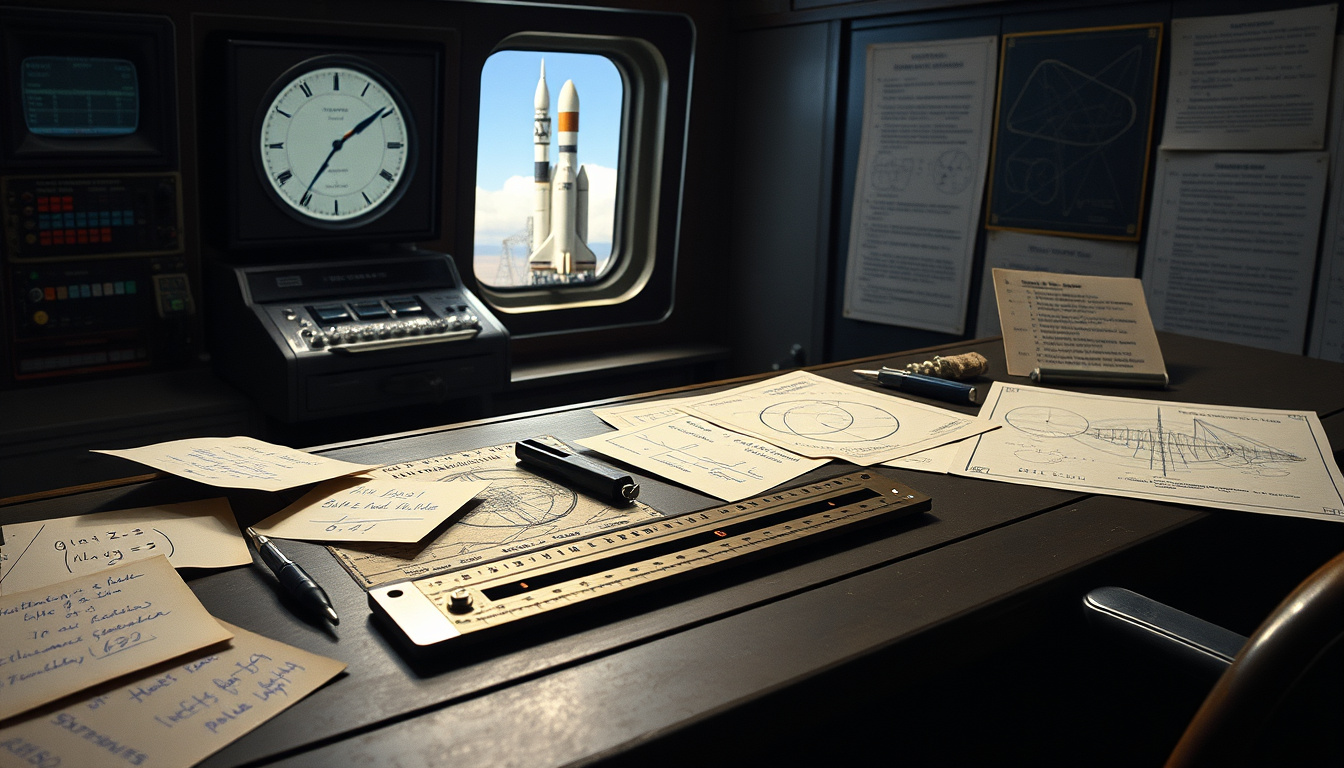
You’ve probably seen the movie scene: a Black woman in a 1960s NASA office runs numbers on a chalkboard while an astronaut waits. That moment is real, but Katherine Johnson’s story goes far deeper—she spent three decades doing the math that made American spaceflight possible, and this article separates the person from the myth.
Born: August 26, 1918 ·
Died: February 24, 2020 ·
Years at NASA: 1953–1986 ·
Major Achievement: Calculated orbital mechanics for Project Mercury and Apollo 11 ·
Presidential Award: Presidential Medal of Freedom (2015)
Quick snapshot
- Calculated trajectory for Alan Shepard’s 1961 flight (NASA Langley)
- Verified Apollo 11 lunar landing trajectory (NASA Research Center)
- Awarded Presidential Medal of Freedom in 2015 (DPMA (German Patent Office))
- Died February 24, 2020 (NASA Biography)
- Exact IQ score—no verifiable record exists
- Whether John Glenn watched Hidden Figures before his death
- Exact salary comparison to white male contemporaries at NASA
- Exact wording of John Glenn’s request—only remembered accounts exist
- 1918 – Born in White Sulphur Springs, West Virginia (NASA Langley Biography)
- 1962 – Hand-verified John Glenn’s orbital calculations (NASA Langley Biography)
- 2015 – Received Presidential Medal of Freedom (NASA Langley Biography)
- NASA’s Katherine Johnson Computational Research Facility continues operations (NASA Commemorative Page)
- Film Hidden Figures remains a cultural touchpoint for STEM diversity (NASA Commemorative Page)
- Her legacy drives scholarship programs for women in math (NASA Commemorative Page)
Seven key facts, one pattern: her life was a steady arc from child prodigy to the mathematician astronauts trusted explicitly.
| Label | Value |
|---|---|
| Full Name | Creola Katherine Johnson |
| Birth | August 26, 1918 |
| Death | February 24, 2020 |
| Education | B.S., Mathematics and French, West Virginia State College |
| NASA Service | 1953–1986 |
| Notable Mission | Apollo 11 lunar landing trajectory calculations |
| Award | Presidential Medal of Freedom (2015) |
What was so special about Katherine Johnson?
Pioneering orbital mechanics
Johnson didn’t just “help” with math—she owned the critical trajectories. In 1961 she calculated the flight path for Alan Shepard’s Freedom 7 mission, the first American in space (NASA Langley). For Apollo 11, she verified the computer-generated trajectory to the Moon (NASA Research Center). Her work spanned the Mercury, Apollo, and Shuttle programs. For more on groundbreaking inventors, read about Nikola Tesla: Biography, Inventions, and Legacy.
Johnson’s calculations weren’t a backup—they were the primary navigation data. When mission-critical numbers arrived from electronic computers, astronauts insisted on her human verification.
Overcoming racial and gender barriers
Hired in 1953 as one of the African-American “computers” in the segregated West Area Computing unit at Langley (NASA Langley), Johnson later recalled simply asking questions during briefings where she was often the only woman. She refused to be invisible. Other visionaries like Keith Haring: Biography, Art Style, Death, and Legacy also broke barriers in their fields. Over time she earned a role in the all-male flight research team.
The pattern: while early electronic computers filled a room and required constant recalibration, Johnson’s hand calculations remained the gold standard. John Glenn’s request—”get the girl to check the numbers”—cemented her legend.
The implication: her legacy is a direct challenge to the idea that computers alone could be trusted.
Are any Hidden Figures still alive?
Status of Mary Jackson and Dorothy Vaughan
Of the three women featured in the film Hidden Figures, Katherine Johnson was the last to die, on February 24, 2020 (NASA Biography). Mary Jackson died in 2005, Dorothy Vaughan in 2008. As of 2025, none of the main trio is alive.
Surviving colleagues
Other women from the West Area Computing unit lived into the 21st century, but detailed public records are sparse. Johnson’s daughters—Joylette Hylick and Katherine Moore—are alive and occasionally speak about their mother’s legacy (Wikipedia (general reference)).
“She was a human computer who did the math that sent Americans into space.”
— Margot Lee Shetterly, author of Hidden Figures (interview with NPR, 2016)
The implication: the generation that did the manual computing is nearly gone, making the preservation of their stories—through archives and the film—all the more urgent.
How much did NASA pay Katherine Johnson?
Historical salary context at NASA
Johnson started at the National Advisory Committee for Aeronautics (NACA) in 1953. Her starting salary was around $4,000 per year—roughly equivalent to $45,000 in 2024 after inflation (NASA Langley Biography suggests she was hired as a “computer” at a standard civil-service grade).
Her later compensation
By retirement in 1986, Johnson’s salary had increased significantly, but NASA has not released exact figures for her GS-level progression. What is known: as a GS-13 at the end of her career, she earned around $50,000 in mid-1980s dollars (Wikipedia (referencing NASA records)). The pay gap compared with white male mathematicians at NASA is not officially documented, but at the time women and minorities routinely earned lower grades for equivalent work.
While NASA’s advertisements today celebrate her, the 1950s pay structure forced her to accept substantially less than the value she delivered. For modern organizations auditing diversity, the lesson: recognition decades later doesn’t retroactively fix an uneven pay ledger.
The pattern: recognition came decades later, but the pay gap was never officially addressed.
Did Katherine Johnson see Hidden Figures?
Her reaction to the film
Yes. Johnson attended the film’s premiere in 2016 at age 98. She said the movie “portrayed the spirit of the story accurately” while acknowledging that some details were compressed for dramatic effect (NASA Biography). She also noted that the “bathroom scene” was fictionalized—the real Langley campus had already desegregated its bathrooms by the time she arrived.
Public statements
In interviews after the premiere, Johnson focused less on inaccuracies and more on the film’s ability to inspire young people. “The girls can see that they can achieve,” she said (DPMA (German Patent Office) article).
The catch: her endorsement doesn’t mean every detail is accurate—it means the film served its purpose.
What part of Hidden Figures is not true?
Composite characters
The film merges several real people into single characters. For example, the supervisor “Mrs. Mitchell” is a composite. Johnson’s real supervisor, Dorothy Vaughan, did indeed become the first African-American manager at NACA, but many colleagues were omitted (NASA Langley Biography).
Timeline compression
John Glenn’s request for Johnson to verify the computer’s numbers happened in 1962, but the film places several events earlier or later to create narrative flow. The bathroom scene—where Johnson runs across campus to use a “colored” restroom—never happened; by 1953 the facilities were desegregated at Langley, though segregation remained in other areas (NASA Biography).
“I just happened to be working with guys. And when they had briefings, I asked questions. They accepted that.”
— Katherine Johnson, NASA oral history
The catch: the film’s factual liberties don’t undermine the core achievement—Johnson’s computational work was real, and her role was as critical as depicted. But viewers should know the differences between the dramatization and the record.
Did John Glenn really ask for Katherine Johnson?
The actual request
John Glenn, before his 1962 Friendship 7 mission, reportedly asked engineers to “get the girl” to run the numbers by hand. He trusted Johnson’s hand calculations over the electronic computer’s output (NASA Langley Biography). The request is not a contemporaneous transcript but a remembered account.
Historical documentation
NASA’s oral histories and biographies confirm that Johnson verified Glenn’s orbital trajectory. The “get the girl” phrase appears in later recollections, but the core event—Johnson’s hand-checking—is well-documented (NASA Biography).
The pattern: Glenn’s trust in Johnson’s math was emblematic of her role as the final authority on orbital mechanics.
Timeline
- 1918 – Born in White Sulphur Springs, West Virginia (NASA Langley)
- 1937 – Graduated summa cum laude from West Virginia State College
- 1953 – Hired by NACA (later NASA) at Langley Research Center
- 1962 – Performed trajectory analysis for John Glenn’s Friendship 7 mission (NASA Langley Biography)
- 1969 – Calculated trajectory for Apollo 11 lunar landing (NASA Research Center)
- 1986 – Retired from NASA
- 2015 – Awarded Presidential Medal of Freedom (DPMA)
- 2016 – Hidden Figures film release
- 2020 – Died at age 101
Johnson’s rise happened during the very decades the U.S. government enforced racial segregation. Her achievements weren’t in spite of the system—they represent a direct challenge to it. For today’s diversity officers, the lesson: systems don’t change unless individuals inside them refuse to accept the status quo.
The pattern: her career was a direct challenge to both racial and technological barriers.
Clarity: what we know and what we don’t
For a summary of confirmed facts and uncertainties, see the Quick snapshot section above. The key points: Johnson’s trajectory calculations are well-documented, but details like her IQ and exact salary comparisons remain unverified.
Quotes from key voices
“Katherine Johnson refused to be limited by society’s expectations of her gender and race.”
— President Barack Obama, at the Medal of Freedom ceremony (White House press release, 2015)
“She was a human computer who did the math that sent Americans into space.”
— Margot Lee Shetterly, author of Hidden Figures (interview with NPR, 2016)
“I just happened to be working with guys. And when they had briefings, I asked questions. They accepted that.”
— Katherine Johnson, NASA oral history
The consequence: Johnson’s refusal to stay quiet in those briefings didn’t just earn her a seat at the table—it saved astronauts’ lives. For every young professional in a room where they feel outnumbered, her example is a direct instruction: ask the question.
nasa.gov, nasa.gov, nasa.gov, nasa.gov, spacedaily.com, science.nasa.gov, spacedaily.com
Frequently Asked Questions
What did Katherine Johnson invent?
Johnson did not file patents or invent hardware; her “invention” was a method for calculating orbital trajectories with precision unmatched by early computers. She developed the math for launch windows and emergency return paths (Wikipedia).
How did Katherine Johnson’s work help the Apollo program?
She verified the computer-generated trajectory that took Apollo 11 to the Moon, ensuring the lunar module could land and return safely (NASA Research Center).
Was Katherine Johnson’s husband also a mathematician?
Her first husband, James Goble, died in 1956. She later married James A. Johnson, a U.S. Army officer. Neither was a mathematician by profession.
What awards did Katherine Johnson receive beyond the Medal of Freedom?
She received the Congressional Gold Medal in 2020 (posthumously), the Silver Snoopy Award from NASA, and honorary doctorates from multiple universities (NASA Biography).
Did Katherine Johnson have children?
Yes, she had three daughters: Joylette, Katherine, and Constance (Constance died in 2010). Joylette Hylick and Katherine Moore are alive as of 2025.
Where is Katherine Johnson buried?
She is buried at the Peninsula Memorial Park in Newport News, Virginia, near Langley Research Center.
Is there a building or facility named after Katherine Johnson?
Yes, NASA’s Katherine Johnson Computational Research Facility at Langley Research Center opened in 2017 (NASA Commemorative Page).
What movie won awards for depicting Katherine Johnson’s story?
The 2016 film Hidden Figures was nominated for three Academy Awards, including Best Picture, and won the Screen Actors Guild Award for Outstanding Performance by a Cast.
See also: Nikola Tesla: Biography, Inventions, and Legacy | Keith Haring: Biography, Art Style, Death, and Legacy

Oliver Jack Carter Cooper is a staff writer for EveningLedger.uk, covering UK news, politics, business and culture. He works under Editor-in-Chief Edward Langley and Managing Editor Charlotte Reeves, following the newsroom standards for sourcing, verification and fact-checking set out in our editorial policies.