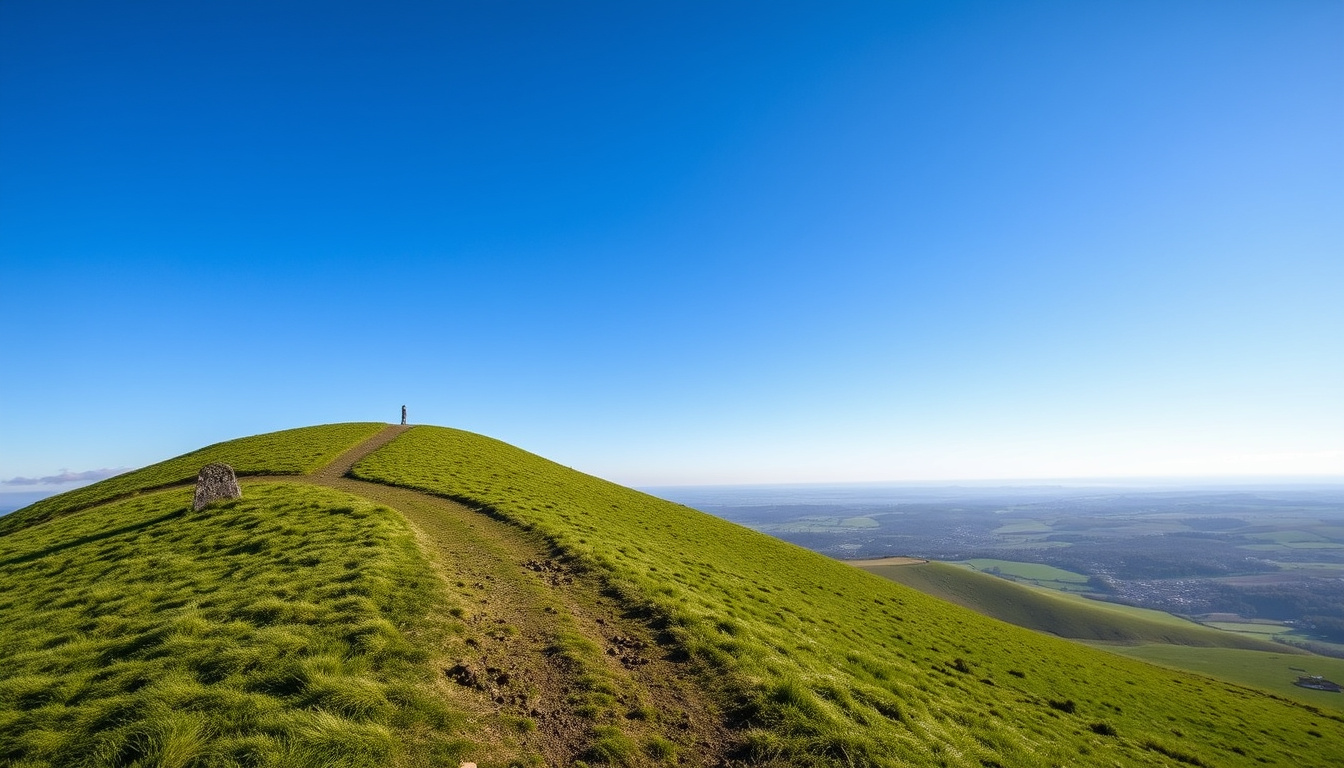
There aren’t many places where a satisfying hill walk and a 400-year-old witch trial share the same signpost. Pendle Hill, rising sharply above the Lancashire countryside, is exactly that kind of spot — a summit for the boots-on-the-ground hiker and a landmark for anyone curious about one of England’s most haunting legal cases.
Elevation: 557 m (1,827 ft) ·
Location: Lancashire, England, near Burnley ·
Prominence: 306 m (1,004 ft) ·
Notoriety: 1612 Pendle witch trials ·
Walking time (typical circular): 3–4 hours ·
Designation: Area of Outstanding Natural Beauty
Quick snapshot
- Elevation 557 m (Ordnance Survey)
- Prominence 306 m (Wikipedia)
- Isolated hill in east Lancashire (Ordnance Survey)
- One of England’s most notorious witch trials (VisitEngland)
- 10 executions at Lancaster (Bronte Adventures)
- Two families accused (Visit North West)
- Barley circular: ~7.6 km, 3-4 hrs (AllTrails)
- Long Circular from Sabden (Visit North West)
- Stiles and uneven ground (AllTrails)
- Car park in Barley (Visit Pendle)
- Nearby villages: Clitheroe, Burnley (Visit North West)
- Pubs and cafés on route (Visit North West)
Six key facts at a glance — one pattern: Pendle Hill is as much a historical archive as it is a walking route.
| Label | Value |
|---|---|
| Height | 557 m (1,827 ft) |
| Summit marker | Trig point |
| Location | Lancashire, England, grid reference SD822414 |
| Notable event | 1612 Pendle witch trials |
| OS Map | Explorer OL21 |
| Typical walk time (circular) | 3–4 hours |
Why is Pendle Hill famous?
The 1612 Pendle witch trials
The straightforward answer: Pendle Hill draws people for two very different reasons. One is the 557-metre summit that dominates the skyline of east Lancashire. The other is the legal ordeal that unfolded at its foot in 1612, when ten people were hanged for witchcraft after a trial at Lancaster Assizes VisitEngland (national tourism authority). The story begins in March 1612 when John Law, a pedlar, encountered Alison Device on the road near Colne. According to one walking guide, Alison cursed Law after he refused to give her some pins Visit North West (regional travel guide).
The hill itself was not the scene of any trial or execution — the legal proceedings happened 25 miles away at Lancaster Castle. Yet the hill’s name became permanently attached to the case, because the accused families lived in the parishes clustered around it.
The accusation set off a chain that pulled in two extended families: the Demdike clan, centred on Elizabeth Southerns (known as Old Demdike), and the Chattox family, led by Anne Whittle. By the time the case reached the Lancaster Assizes in August 1612, twelve people had been charged. Eleven were tried; ten were hanged on 20 August 1612 at Gallows Hill, now the site of Williamson Park Visit North West (regional travel guide). One defendant died in prison Bronte Adventures (walking blog).
Geographic prominence and walking appeal
Pendle Hill’s 306 metres of prominence mean it rises decisively from the surrounding landscape rather than fading into a ridge Wikipedia. That isolation is a large part of its appeal for walkers: the views from the trig point at the summit stretch across the Forest of Bowland to the Yorkshire Dales on a clear day. The area has been designated part of the Forest of Bowland Area of Outstanding Natural Beauty since the 1950s.
How long does it take to walk Pendle Hill?
Typical circular route timing
The standard answer for most visitors is 3 to 4 hours. The most popular route is the Pendle Hill Circular from Barley, which AllTrails lists as 7.6 kilometres (4.7 miles) with a moderate rating AllTrails (user-reviewed walking database).
- Barley circular (standard): 7.6 km, rated moderate
- Pendle Witches Walking Trail (two 4-mile loops): 6.4 km each loop, departs from Barley car park VisitEngland (national tourism authority)
- Long Circular from Sabden: approximately 11 km, more strenuous
- The Pendle Way: a 45-mile long-distance footpath encircling the borough of Pendle Visit North West (regional travel guide)
First-time walkers who underestimate the hill’s steep sections often find the “moderate” rating more honest than expected. The ascent from Barley includes a sustained climb on uneven ground that demands reasonable fitness, not just enthusiasm.
Factors affecting walking time
Weather is the biggest variable. Boggy ground after rain makes the descent slower and more cautious, especially on the steeper sections where the path narrows. Walkers with dogs should factor in stiles — the route has several, and not all are dog-friendly for smaller breeds. The route can be approached by a steep steps route or a longer, gentler slope route Visit North West (regional travel guide). The gentler route adds about 30 to 40 minutes but reduces strain on knees.
The pattern: the 3-to-4-hour estimate is a reliable baseline for a fit walker on a dry day. Add 20% for wet conditions, 30% for a family group with children, and 50% if you plan to stop frequently for photos or history reading.
Where are the Pendle Hill witches located?
Geographical location of the trials
The accused witches lived in villages around Pendle Hill — Newchurch in Pendle, Roughlee, and Barley — not on the hill itself VisitEngland (national tourism authority). The trial was held at Lancaster Castle, about 25 miles west Bronte Adventures (walking blog). Pendle Hill sits in east Lancashire, roughly midway between Burnley and Clitheroe.
The key sites most walkers encounter:
- Barley: Starting point for the main circular walk; car park, pub, and café available
- Newchurch in Pendle: Village with a church that has a reputed “eye of God” stone above the door, often cited in witch-trial lore
- Roughlee: Home to Alice Nutter, one of the executed women; has a plaque and a small museum
- Lancaster Castle: Site of the actual trial and sentencing (separate visit, not part of the hill walk)
Several walking guides and local signs use the phrase “witches’ trail” loosely. A walker expecting to find execution sites on the hill itself will be disappointed — the legal story happened off the hill, and the only physical link is the landscape the accused families walked.
Key sites: Newchurch in Pendle, Roughlee, Lancaster Castle
Dr Angela Buckley, a historian who leads guided walking tours of the area, places the starting point at the Pendle Heritage Centre in Barrowford and describes her tour beginning at Roughlee Dr Angela Buckley (historian and author). Her account emphasises that the “walking with witches” experience is more about understanding the social geography of the early 17th century — one where poverty, family feuds, and superstition turned a minor roadside argument into a capital case.
Is Pendle Hill a difficult walk?
Difficulty rating for different routes
The main Barley circular is rated moderate by AllTrails and most local guides AllTrails (user-reviewed walking database). This means it has sections of sustained incline, uneven ground, and several stiles. Walkers with basic fitness levels should manage it comfortably, but it is not recommended for anyone with mobility issues, because the descent on the standard route includes steep, loose gravel sections.
The moderate rating works as an honest signal for experienced hikers but may underplay the challenge for casual walkers. The climb from Barley gains roughly 350 metres in elevation over 3.8 km — a 9% average gradient that feels steeper because the path is uneven in places.
What to expect on the ascent
Most accounts agree: the first 20 minutes from the Barley car park are the steepest. After that, the gradient eases and the path opens onto the broad summit plateau. One community travel blog describes the local council’s Pendle witch trail as an eight-mile walking tour that loops from Barley, including Upper Ogden Reservoir and Roughlee Inner Lives Blog (personal travel account). Walkers recommend starting early, especially in summer, to avoid the midday sun on the exposed upper sections.
- Footwear: Walking boots recommended for grip on steeper descents; trainers usable on dry days
- Navigation: Paths are well-marked; OS Explorer OL21 covers the area; the trig point is visible from much of the route
- Water: No drinking water available on the hill; carry at least 1 litre per person
- Dogs: Allowed on most routes but stiles may be difficult for larger or older dogs
Who were the 12 Pendle Witches?
Key figures: Demdike, Chattox, Alice Nutter
The phrase “12 Pendle Witches” is a simplification. Twelve people were arrested and charged, but only eleven were tried, and ten were executed Bronte Adventures (walking blog). The two core families were the Demdikes (Elizabeth Southerns, her daughter Elizabeth Device, and her grandchildren James and Alison Device) and the Chattoxes (Anne Whittle, her daughter Anne Redferne). Alice Nutter, a relatively wealthy farmer’s wife from Roughlee, was also caught up in the accusations and executed.
ITV’s Britain’s Favourite Walks programme states that 10 local women were accused and sentenced to death ITV (broadcaster documentary). Visit North West says nine of the ten who made it to trial were found guilty Visit North West (regional travel guide) — a slight discrepancy that reflects how the records from 1612 have gaps and ambiguities.
Legal context of the 1612 trial
The trial was not a random outburst of panic. It was conducted under the Witchcraft Act of 1604, which made causing harm by witchcraft a capital offence. The evidence included testimony from a nine-year-old girl (Jennet Device, Alison’s younger sister) who gave evidence against her own family — a detail that still disturbs modern readers. The judge, Sir James Altham, presided over a proceeding that was legally formal but was shaped by fear, gossip, and the vulnerability of poor, elderly women in a society where accusations could destroy a household.
For visitors, understanding the legal context clarifies why the hill’s history is more nuanced than the ’12 witches’ label suggests.
Walking Pendle Hill: practical steps
- Step 1: Choose your route
- First-time visitors: start with the Barley circular (3–4 hours, 7.6 km)
- History-focused: take the Pendle Witches Walking Trail from Barley car park (two 4-mile loops) VisitEngland (national tourism authority)
- Longer day out: Long Circular from Sabden or combine with the Pendle Way
- Step 2: Plan your start
- Park at Barley car park (pay and display, reasonable rates)
- Arrive by 9am in summer to secure a spot; the car park fills by 10:30 on weekends
- Use the pub in Barley for post-walk refreshments
- Step 3: Check the forecast
- Weather on the exposed summit can differ sharply from the valley — wind speeds are often 15–20 km/h higher at the top
- Visibility can drop to under 50 metres in low cloud; avoid in poor visibility unless you have navigation skills
- Step 4: Pack appropriately
- Walking boots or sturdy trainers with good grip
- Waterproof jacket (mandatory even on dry forecast days — conditions change fast)
- Map and compass or a fully charged phone with the OS Maps app downloaded
- Snacks and at least 1 litre of water per person
With these preparations, walkers can enjoy the hill safely and fully appreciate its layered history.
Timeline signal
The table below tracks the key moments that connect Pendle Hill’s physical landscape to its legal history — one pattern: the hill’s reputation was made in a few months in 1612, but its use as a walking destination built up over the next three centuries.
| Date or period | Event |
|---|---|
| March 1612 | John Law and Alison Device incident near Colne; accusations begin Visit North West (regional travel guide) |
| August 1612 | Lancaster Assizes hears the Pendle witch trials; 10 hanged at Gallows Hill on 20 August Bronte Adventures (walking blog) |
| 19th–20th centuries | Pendle Hill becomes a popular walking destination; the Pendle Way and other footpaths developed |
| 1950s–present | Designated part of the Forest of Bowland Area of Outstanding Natural Beauty |
| 2012 | 400th anniversary of the trials; commemoration events held across Pendle and Lancaster |
The timeline shows how the hill’s reputation evolved from infamy to recreation.
What’s unclear
Some aspects of the Pendle story remain unresolved — and honest guides should flag them.
Confirmed facts
- Pendle Hill elevation is 557 m — Ordnance Survey (UK mapping authority)
- The 1612 trial is historically documented in the Lancashire Archives
- The Pendle Hill circular walk from Barley is a standard route — AllTrails (walking database)
What’s unclear
- Exact number of defendants — accounts vary from 11 to 13; the record is incomplete
- Whether any biological descendants of the accused survive today — no reliable genealogical records exist
- Whether Alison Device’s curse actually matched the account in trial transcripts or was embellished later
These open questions remind visitors that historical gaps are part of the story.
What others say about walking Pendle Hill
“The Pendle Witches trail offers two loops, each around 4 miles long, and departs from Barley car park.”
“Pendle Hill can be approached by a steep steps route or a longer, gentler slope route.”
“The Pendle Hill Circular is 7.6 km and rated moderate.”
“The walking tour begins at Roughlee, near where a casual meeting set off the chain of events leading to the trials.”
Summary
Pendle Hill rewards the visitor who arrives with both walking boots and a historian’s curiosity. The 3-to-4-hour circular route from Barley is achievable for anyone with moderate fitness, but the hill’s real depth is in the stories embedded in its villages — Newchurch, Roughlee, Barley — and the shadow of a 1612 trial that turned local feuds into executions. For the walker planning a day out in Lancashire, the choice is clear: treat it as just a hill and you’ll get a fine view; treat it as a historical landscape and you’ll walk away with an understanding of why people still talk about Pendle Hill 400 years on.
youtube.com, youtube.com, themorbidtourist.com, drangelabuckley.substack.com, innerlivesblog.wordpress.com, soulcitywanderer.com, youtube.com, theoutdoorguide.co.uk, hotelcari.com
For a more detailed look at the history and routes, check out this comprehensive Pendle Hill walk and witch trials guide.
Frequently asked questions
What is the best time of year to walk Pendle Hill?
Spring (April–June) and early autumn (September–October) offer the most reliable conditions — cool temperatures, fewer midges, and generally drier ground. Summer weekends are busiest; winter walks are possible but require ice gear if frost or snow is forecast Visit North West (regional travel guide).
Are dogs allowed on Pendle Hill walks?
Yes, dogs are allowed on all public footpaths. Be aware of stiles — some are narrow and may be difficult for larger or older dogs. Carry water for your dog as there are no streams on the upper section.
Is there a pub near the Pendle Hill start point?
The Pendle Inn in Barley is the most convenient option, located near the car park. Several other pubs operate in the surrounding villages including Roughlee and Clitheroe.
Can I park near Pendle Hill for free?
The main car park at Barley is pay and display (reasonable rates, typically £2–£4 per day). Free parking is limited to small lay-bys on the approach roads, but these fill quickly and may not be safe for long stays.
What is a coven of witches?
A coven traditionally refers to a group of witches, often numbering 13. The number 13 is symbolic in Western occult tradition but has no basis in the Pendle trial records — the accused families were not referred to as a coven in contemporary documents.
Were the Pendle Witches actually guilty?
Legally, they were convicted under the Witchcraft Act of 1604, which made causing harm by supernatural means a crime. Modern historians view the evidence — including testimony from a nine-year-old child — as unreliable and shaped by social tension, poverty, and personal grudges. Most scholars consider the convictions unjust.
What is the Pendle Hill Long Circular route distance?
The Long Circular route from Sabden covers approximately 11 kilometres (6.8 miles) and takes 4–5 hours. It’s rated moderate to challenging due to a longer sustained climb and rougher terrain on the descent Visit North West (regional travel guide).

Oliver Jack Carter Cooper is a staff writer for EveningLedger.uk, covering UK news, politics, business and culture. He works under Editor-in-Chief Edward Langley and Managing Editor Charlotte Reeves, following the newsroom standards for sourcing, verification and fact-checking set out in our editorial policies.