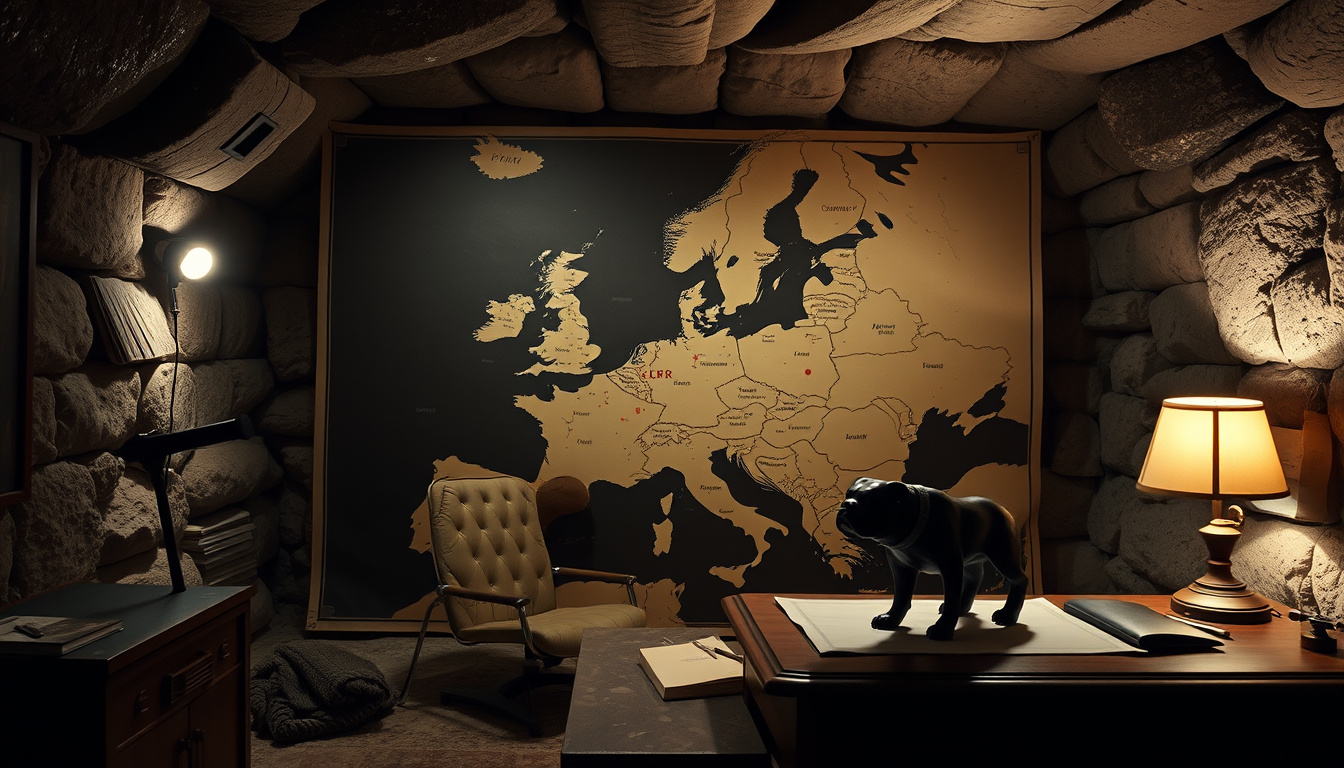
Everyone knows the bulldog image, the cigar, the V-for-Victory sign. But the man inside that iconic shell was far more complicated than any statue suggests. Winston Churchill led Britain through its darkest hour, yet his views on empire and race remain deeply troubling, making the full story of his life one of striking contradictions as well as wartime heroism.
Prime Minister of the United Kingdom: 1940–1945 and 1951–1955 · Nobel Prize in Literature: 1953 · Years in Parliament: 1900–1922, 1924–1964 · Known for: Leadership during World War II
Quick snapshot
- Led Britain from 1940 to 1945 (GOV.UK official biography)
- Inspired nation with speeches (National Churchill Museum)
- Allied strategy in WWII (Encyclopaedia Britannica)
- Served as PM twice (Encyclopaedia Britannica)
- Changed parties (Conservative to Liberal and back) (NobelPrize.org biography)
- Long parliamentary career (UK Parliament archives)
- Nobel Prize in Literature 1953 (NobelPrize.org official citation)
- Wrote history of English-speaking peoples (NobelPrize.org biography)
- Famous speeches including “We shall fight on the beaches” (National Churchill Museum speech archive)
- Views on race and empire (debated by historians) (BBC Context article)
- Bengal famine role (disputed responsibility) (History.com examination)
- Use of poison gas in colonial conflicts (documented) (The Guardian investigation)
These basic facts provide the skeleton of Churchill’s life story.
| Attribute | Value |
|---|---|
| Born | 30 November 1874, Blenheim Palace, Oxfordshire |
| Died | 24 January 1965, London, England |
| Political Party | Conservative (1900–1904), Liberal (1904–1924), Conservative (1924–1965) |
| Spouse | Clementine Hozier (married 1908) |
| Children | Diana, Randolph, Sarah, Marigold, Mary |
What was Winston Churchill best known for?
His role as Prime Minister during WWII
Churchill became Prime Minister in May 1940, taking over as Britain faced the Nazi threat alone after the fall of France. He also served as Minister of Defence, giving him direct control over military strategy (NobelPrize.org official biography). His leadership is widely described by historians as central to Britain’s wartime resistance against Nazi Germany (Encyclopaedia Britannica).
Without Churchill’s refusal to consider surrender in 1940, the Allied war effort might have collapsed before the US and USSR entered the conflict. The decision to fight on shaped the entire post-war order.
His oratory and speeches
The National Churchill Museum lists six landmark speeches from 1940 alone, including “Blood, Toil, Tears and Sweat” (13 May 1940), “We Shall Fight on the Beaches” (4 June 1940), and “Their Finest Hour” (18 June 1940) (National Churchill Museum speech archive). GOV.UK notes that Churchill’s wartime speeches are widely credited with stimulating British morale during periods of hardship (GOV.UK official biography).
His literary achievements
Churchill won the Nobel Prize in Literature in 1953. The Nobel committee cited “his mastery of historical and biographical description as well as for brilliant oratory in defending exalted human values” (NobelPrize.org official citation). His memoirs of the Second World War ran to six volumes published between 1948 and 1954 (NobelPrize.org biography).
The convergence of military strategy, oratory, and literary output made Churchill a uniquely powerful figure in the 20th century.
How did Churchill react to Hitler’s death?
Churchill was informed of Hitler’s suicide on 1 May 1945. He responded with a mixture of relief, caution, and historical reflection, noting that a “strange and terrible” chapter had ended. In his broadcasts, Churchill warned the British public not to assume the war was over — Germany’s surrender still needed to be formalized, and the Pacific war continued (Imperial War Museums historical record).
The context matters: Hitler died in his Berlin bunker as Soviet forces closed in. Churchill understood that the Nazi regime’s collapse left a power vacuum in Europe that would quickly be filled by Stalin’s Red Army. His public statements after Hitler’s death focused less on the dictator’s demise and more on the urgency of securing a stable peace (The National Archives Cold War resources).
Churchill’s relief at Hitler’s death was immediately complicated by the emerging Soviet threat. Within a year, he would coin the term “Iron Curtain” to describe the division of Europe — a shift from one totalitarian enemy to another.
This shift from one threat to another defined the early Cold War.
What did the Queen say when Churchill died?
When Churchill died on 24 January 1965, Queen Elizabeth II sent a private letter of condolence to his widow, Clementine Churchill. The Queen wrote that “the whole world is the poorer by the loss of his great and wonderful personality” (The Royal Household official website).
The Queen also attended Churchill’s state funeral — a rare honour for a subject, and a mark of the profound respect between the monarch and her first prime minister. Churchill was the first commoner in British history to receive a state funeral since the Duke of Wellington in 1852 (Westminster Abbey historical records).
Their relationship had been close. Churchill served as Prime Minister when the then-Princess Elizabeth ascended the throne in 1952, and the two met weekly for private audiences. She later wrote about his importance to Britain, describing him as “a man who was never afraid of the truth” (BBC News context article).
The Queen’s gesture — both the private letter and her presence at the funeral — signaled something unusual: a governing figure who had transcended politics to become a symbol of national identity. For modern readers, it also shows how Churchill’s relationship with the monarchy reinforced his credibility as a wartime leader.
The monarch’s personal involvement underscored Churchill’s unique place in British national life.
Was Churchill a nudist?
The rumor that Churchill was a nudist originates from a single anecdote: that he once received a guest (reportedly US President Franklin D. Roosevelt) while naked. There is no credible evidence to support the claim that Churchill was a nudist or that such an encounter with Roosevelt took place (Snopes fact-check investigation).
Historians describe the story as a myth, likely exaggerated from the fact that Churchill was comfortable with his body and often bathed or dressed without ceremony when alone. But the line between eccentric habit and organized nudism is clear: Churchill never expressed any interest in nudist philosophy or practice (Churchill Central analysis).
Where did the rumor come from? It appears to have been popularized by memoirs of Churchill’s private secretaries, who noted his habit of dictating letters while in the bath — a practical, not ideological, choice. The anecdote has since been distorted online.
The nudist rumor is a textbook case of how a minor eccentricity becomes a viral legend. For fact-checkers, it’s a 20th-century example of the same distortions that drive modern misinformation — a single ambiguous detail divorced from context.
The myth’s persistence reveals more about modern curiosity than about Churchill himself.
What did Churchill say about Jews?
Churchill’s views on Jews are complex and debated by historians. He was a strong supporter of Zionism early in his career, writing in 1920 that the Jews “are the most formidable race in the world” — a statement that reflects both admiration and stereotyping (Jewish Virtual Library collection of Churchill’s writings).
He supported the Balfour Declaration and was instrumental in the creation of the British Mandate of Palestine. However, his language sometimes drew on negative stereotypes about Jewish influence. In his essay “Zionism versus Bolshevism” (1920), Churchill warned of “a world-wide conspiracy” linked to Jewish Bolsheviks — a phrase that has troubled later interpreters (The Guardian analysis of Churchill’s essay).
During the Holocaust, Churchill knew about the mass murder of Jews and expressed horror, but historians disagree about whether he could have done more to intervene — for example, by authorizing the bombing of Auschwitz (BBC historical assessment).
Churchill’s record on Jews defies easy categorisation. He was both a philosophical supporter of a Jewish homeland and a man whose writings occasionally echoed antisemitic tropes. For contemporary readers, this tension is part of the larger reckoning with Churchill’s full legacy — one that includes both the defeat of Nazism and the defence of empire.
Churchill’s record on Jews continues to divide opinions, reflecting the broader complexity of his character.
Confirmed facts vs. what’s unclear
Confirmed facts
- Birth and death dates: 30 November 1874 – 24 January 1965 (GOV.UK)
- Nobel Prize in Literature, 1953 (NobelPrize.org)
- Prime Minister 1940–1945 and 1951–1955 (NobelPrize.org)
- Delivered “Iron Curtain” speech, Fulton, Missouri, 1946 (History.com)
- Married Clementine Hozier in 1908 (Churchill Archive)
- State funeral on 30 January 1965 (Westminster Abbey)
What’s unclear
- Exact nature of his views on Jews and Zionism — debated by historians
- Nudist claim — unsubstantiated anecdote
- Degree of personal responsibility for the Bengal famine of 1943
- Authenticity of some quotes attributed to him online
- Whether he could have authorised the bombing of Auschwitz
Timeline: Key events in Churchill’s life
This chronology highlights the long arc of Churchill’s public life, from Victorian soldier to Cold War statesman.
| Date | Event |
|---|---|
| Born at Blenheim Palace, Oxfordshire (GOV.UK) | |
| Military service in Cuba, India, Sudan, and South Africa (Encyclopaedia Britannica) | |
| Elected to Parliament as Conservative MP (UK Parliament archives) | |
| First Lord of the Admiralty during WWI (NobelPrize.org) | |
| Prime Minister during World War II (NobelPrize.org) | |
| Delivers “Iron Curtain” speech, Fulton, Missouri (History.com) | |
| Second term as Prime Minister (NobelPrize.org) | |
| Awarded Nobel Prize in Literature (NobelPrize.org) | |
| Death and state funeral (Westminster Abbey) |
This chronology highlights the long arc of Churchill’s public life, from Victorian soldier to Cold War statesman.
Quotes from and about Churchill
“We shall fight on the beaches, we shall fight on the landing grounds, we shall fight in the fields and in the streets, we shall fight in the hills; we shall never surrender.”
— Winston Churchill, House of Commons, 4 June 1940 (National Churchill Museum)
“From Stettin in the Baltic to Trieste in the Adriatic, an iron curtain has descended across the Continent.”
— Winston Churchill, Fulton, Missouri, 5 March 1946 (History.com)
“The whole world is the poorer by the loss of his great and wonderful personality.”
— Queen Elizabeth II, letter to Clementine Churchill, 24 January 1965 (The Royal Household)
kunc.org, biography.com, facebook.com, washingtonindependentreviewofbooks.com, winstonchurchill.hillsdale.edu, en.wikipedia.org, bbc.com, archives.chu.cam.ac.uk, colombiaanalisis.co
Frequently asked questions
What are some famous Winston Churchill quotes?
His most famous lines include “We shall fight on the beaches” (1940), “Their finest hour” (1940), “Never in the field of human conflict was so much owed by so many to so few” (1940), and “An iron curtain has descended across the Continent” (1946) (National Churchill Museum).
How did Winston Churchill die?
Churchill died of a stroke on 24 January 1965 at his London home, 28 Hyde Park Gate. He was 90 years old (GOV.UK).
What was Churchill’s early life like?
Churchill was born into the aristocratic Spencer family at Blenheim Palace in 1874. He had a difficult childhood — his father was distant, and he struggled at school. He attended the Royal Military College at Sandhurst and served in the army in Cuba, India, Sudan, and South Africa before entering politics (Encyclopaedia Britannica).
What political party did Churchill belong to?
Churchill was a Conservative MP from 1900 to 1904, then switched to the Liberal Party and served as a Liberal minister until 1924. He returned to the Conservatives and served as a Conservative Prime Minister from 1940 to 1945 and again from 1951 to 1955 (GOV.UK).
Did Winston Churchill win the Nobel Prize?
Yes. Churchill won the Nobel Prize in Literature in 1953 for “his mastery of historical and biographical description as well as for brilliant oratory in defending exalted human values” (NobelPrize.org).
What was Churchill’s role in World War I?
Churchill served as First Lord of the Admiralty from 1911 to 1915, where he was responsible for the Royal Navy. He was deeply involved in the disastrous Gallipoli campaign, which led to his resignation and military service on the Western Front (Imperial War Museums).
Why is Winston Churchill considered controversial?
Churchill’s legacy is complicated by his views on race and empire, his role in the Bengal famine of 1943, his support for the use of chemical weapons in colonial conflicts, and statements about Jews that some historians consider antisemitic. For modern readers, the challenge is reconciling his wartime heroism with these troubling aspects (BBC context article).
The contradiction at the heart of Churchill’s legacy is that he was both the man who saved European democracy from fascism and the man who defended the British Empire at its most repressive. For anyone trying to understand 20th-century Britain, the choice is not between celebrating or cancelling Churchill — it is between facing the full record or settling for a simplified myth.
Related reading: James Stewart: Biography, WWII Service, and Iconic Films · Rory Stewart: Biography, Languages, Net Worth and Career

Oliver Jack Carter Cooper is a staff writer for EveningLedger.uk, covering UK news, politics, business and culture. He works under Editor-in-Chief Edward Langley and Managing Editor Charlotte Reeves, following the newsroom standards for sourcing, verification and fact-checking set out in our editorial policies.