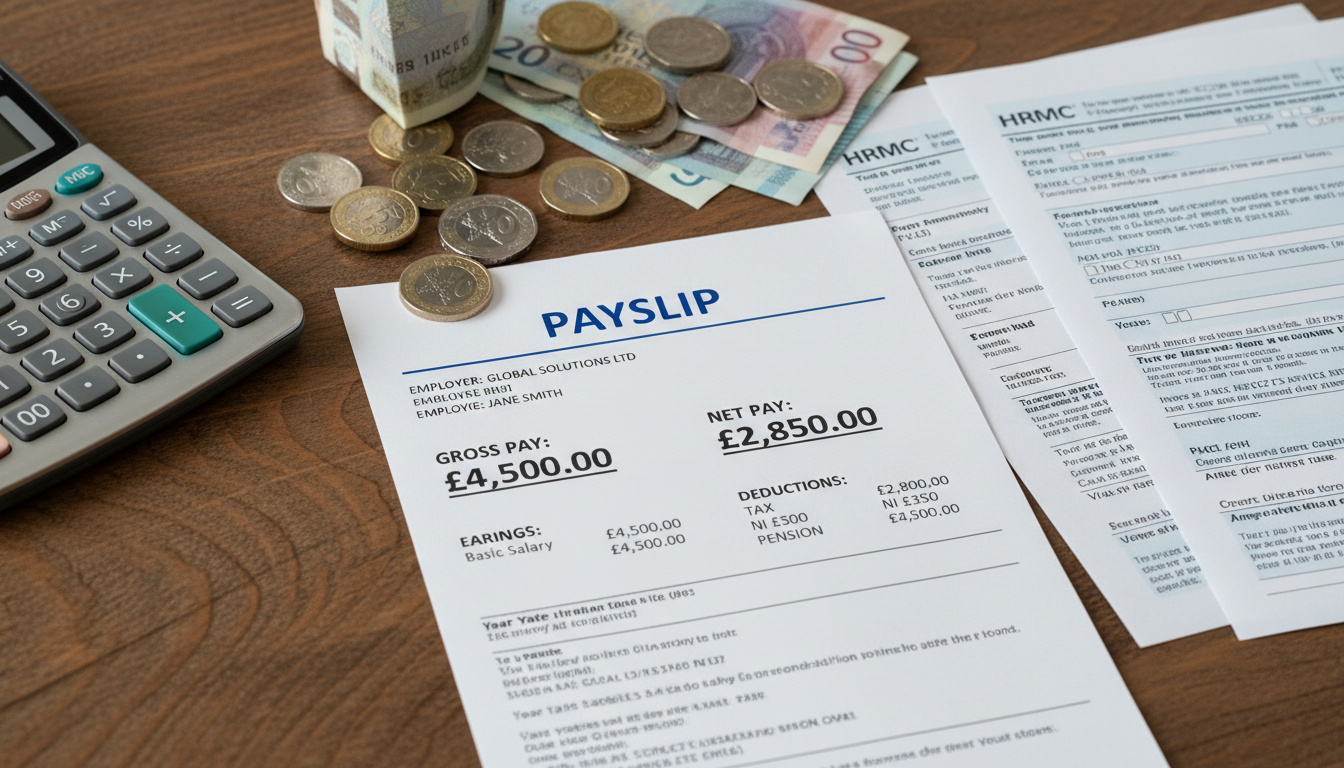
Net pay represents the actual amount of money an employee receives after all deductions have been subtracted from their gross earnings. While gross pay appears in job advertisements and employment contracts as the headline figure, net pay reflects the reality of what lands in your bank account.
In the United Kingdom, understanding this distinction proves essential for accurate personal budgeting and financial planning. The difference between these two figures can amount to thousands of pounds annually, depending on tax brackets, National Insurance contributions, and pension arrangements.
This guide examines the mechanics of net pay calculations, legal payslip requirements, and the specific factors affecting UK employees.
What Is Net Pay vs Gross Pay?
Gross pay encompasses the total compensation earned before any deductions, including base salary, overtime, bonuses, and allowances. Net pay, alternatively termed take-home pay, results from subtracting mandatory and voluntary deductions from this gross amount. In the UK, this calculation follows specific statutory requirements governing tax collection and social security contributions.
Gross Pay
Total earnings comprising base salary, overtime, bonuses, and allowances before any deductions apply.
Net Pay
The residual amount after subtracting income tax, National Insurance, pensions, and other withholdings.
Key Deductions
PAYE income tax, Class 1 National Insurance contributions, auto-enrolment pensions, and student loan repayments.
Take-Home Amount
The final figure transferred to your bank account, representing actual disposable income.
Key Insights
- Net pay varies significantly by tax bracket and individual circumstances
- National Insurance thresholds directly reduce take-home amounts above specific earning levels
- Online calculators provide necessary precision due to multiple variables
- Payslips must itemise every deduction separately
- Auto-enrolment pensions typically deduct 5-8% of qualifying earnings
- Scottish taxpayers may face different rates than those in England, Wales, or Northern Ireland
| Term | Definition | Example (Annual) |
|---|---|---|
| Gross Pay | Total earnings before deductions | £30,000 |
| Personal Allowance | Tax-free earnings threshold (£12,570) | £12,570 |
| Income Tax (PAYE) | Tax deducted at source | ~£3,484 |
| National Insurance | Class 1 employee contributions | ~£1,394 |
| Pension Contribution | Auto-enrolment deduction | ~£90 monthly |
| Net Pay | Final take-home amount | ~£25,122 |
How to Calculate Net Pay
Calculating net pay requires systematic subtraction of all deductions from the gross amount. For salaried employees, the process begins with dividing the annual salary by pay periods, typically twelve for monthly payments. Hourly workers multiply hours worked by their rate, adding any overtime premium.
The Standard Deduction Formula
The fundamental formula follows: Net pay equals gross pay minus the sum of income tax, employee National Insurance, pension contributions, and any additional deductions such as student loans or salary sacrifice schemes. Each deduction carries specific thresholds and rates established by HMRC.
Precise net pay calculation requires current tax year rates, as thresholds and percentages change annually. The 2024/25 tax year mandates a 20% basic rate on earnings between £12,571 and £50,270, with higher rates applying above these thresholds.
Salaried versus Hourly Calculations
Salaried employees calculate gross pay by dividing annual remuneration by the number of pay periods. An annual salary of £36,000 yields £3,000 monthly gross. Hourly employees multiply time worked by their rate; 160 hours at £12 per hour generates £1,920 monthly gross before overtime adjustments.
Progressing from gross to net involves applying tax codes to determine personal allowance allocation, then computing PAYE liability using the appropriate tax bands. National Insurance follows separate thresholds, with Class 1 contributions calculated on earnings above the primary threshold.
What Is Net Pay on a Payslip?
UK employment law mandates that payslips clearly distinguish between gross earnings, individual deduction categories, and the final net amount. This itemisation ensures transparency regarding where employment costs distribute between employee take-home pay and statutory obligations.
Mandatory Itemisation Requirements
Payslips must display gross pay as a subtotal before listing each deduction separately. Income tax appears under PAYE, National Insurance contributions show as distinct line items, and pension deductions require separate identification. The net pay figure typically appears in bold or emphasised formatting as the final amount.
Employers must provide payslips on or before the payment date. Electronic payslips satisfy legal requirements provided employees can access and print them. Each payslip serves as legal proof of earnings and deductions for tax year reconciliation.
Reading Deduction Details
Understanding payslip codes proves essential. Tax codes such as 1257L indicate the standard personal allowance allocation. Emergency tax codes (W1/M1) signal temporary calculations that may require later adjustment. National Insurance categories determine contribution rates, with most employees falling under Category A.
Discrepancies between expected and actual net pay often stem from emergency tax codes, unpaid student loan thresholds being crossed, or multiple income sources affecting tax bracket placement. Cross-reference payslip deductions against HMRC tax code notices.
Is Net Pay Monthly or Yearly?
Net pay can be expressed in either temporal format depending on context. Employment contracts typically quote annual gross salaries, while payslips display the net amount for the specific pay period—weekly, fortnightly, or monthly. Budgeting requires understanding both figures.
Monthly Net Income Context
Monthly net pay represents the most common reference point for household budgeting. This figure accounts for twelve equal distributions of annual earnings, though bonus months or tax adjustments may create occasional variations. Financial commitments such as rent and mortgages typically align with monthly net income cycles.
Annual Projections
Annual net pay provides the accurate picture for tax liability assessment and long-term financial planning. Multiplication of monthly net by twelve often produces slight discrepancies from actual annual totals due to rounding, tax code adjustments throughout the year, or one-off payments.
Self-employed individuals and those considering additional income streams must understand how side earnings aggregate with primary employment net pay. Changes to tax thresholds affect overall net position, making resources like HMRC Side Hustle Tax Limit Change relevant for comprehensive net income calculations.
How Net Pay Moves From Contract to Bank
The transition from quoted salary to deposited funds follows a regulated sequence of calculations and compliance checks. Understanding how your net pay is calculated is crucial, and you can find more information on this topic at $площа трикутника.
- Gross pay determination based on contracted hours and rates
- Application of tax codes and personal allowances
- Calculation of PAYE income tax liability
- Computation of Class 1 National Insurance contributions
- Application of auto-enrolment pension and voluntary deductions
- Final net pay transfer to designated bank accounts
What Is Certain and Uncertain About Net Pay?
| Established Information | Uncertain or Variable Elements |
|---|---|
| Gross pay always exceeds net pay when deductions apply | Exact net pay without specific tax code knowledge |
| PAYE and NI rates are fixed by statute for each tax year | Future tax year thresholds and percentages |
| Payslips must itemise all deductions by law | Individual circumstances like emergency tax adjustments |
| Personal allowance is £12,570 for 2024/25 | Impact of mid-year tax code changes |
Net Pay in the UK Context
The United Kingdom operates a progressive tax system where net pay decreases proportionally less than gross pay increases until higher rate thresholds. National Insurance contributions fund state benefits and the NHS, while auto-enrolment pensions represent a recent legislative change affecting net pay since 2012.
Geographic location within the UK creates net pay variations. Scottish tax payers fall under different band rates for income tax, though National Insurance remains consistent across the UK. Those operating business structures face different net pay calculations entirely; individuals considering this route should examine how to Set Up a Limited Company for optimal remuneration structures.
The average UK full-time gross salary stands at approximately £34,963, with corresponding net pay slightly lower after statutory deductions. This average masks significant regional and sectoral variations affecting actual take-home amounts.
Official Definitions and Source Guidance
Gross pay is an employee’s total earnings before any deductions, while net pay (or take-home pay) is the amount received after subtracting taxes, National Insurance (NI), pensions, and other withholdings.
For precise figures, use online take-home pay calculators, as they factor in exact tax years, allowances, and variables like location or benefits.
Summary
Net pay represents the culmination of gross earnings minus mandatory deductions including PAYE income tax, National Insurance, and pension contributions. Understanding this figure proves essential for accurate budgeting, with payslips providing the legally required transparency into how employers calculate the final amount. For complex income situations or changing tax circumstances, consultation with HMRC resources or current tax limit changes ensures compliance and accuracy.
Common Questions
What is net monthly income?
Net monthly income is your take-home pay divided by twelve, representing the actual amount available for spending each month after all tax and benefit deductions.
What will my take home pay be?
Your specific take-home pay depends on your tax code, gross salary, pension contributions, and any student loan repayments. Use HMRC-approved calculators for precise figures.
What is net pay calculator?
A net pay calculator is a digital tool that computes your take-home amount by subtracting current tax rates, National Insurance, and pension deductions from your gross salary.
Is net pay always after tax?
Yes, by definition net pay is calculated after income tax, National Insurance, and other statutory deductions have been subtracted from gross earnings.
Why does my net pay vary each month?
Variations occur due to tax code adjustments, bonus payments pushing you temporarily into higher brackets, or changes in pension contributions and working hours.
How does salary sacrifice affect net pay?
Salary sacrifice schemes reduce gross pay before tax calculation, potentially increasing net pay by lowering your taxable income, though they reduce cash salary.
Can net pay ever exceed gross pay?
No, net pay cannot exceed gross pay when statutory deductions apply. However, expense reimbursements or tax rebates may appear as separate payments alongside net salary.

Oliver Jack Carter Cooper is a staff writer for EveningLedger.uk, covering UK news, politics, business and culture. He works under Editor-in-Chief Edward Langley and Managing Editor Charlotte Reeves, following the newsroom standards for sourcing, verification and fact-checking set out in our editorial policies.