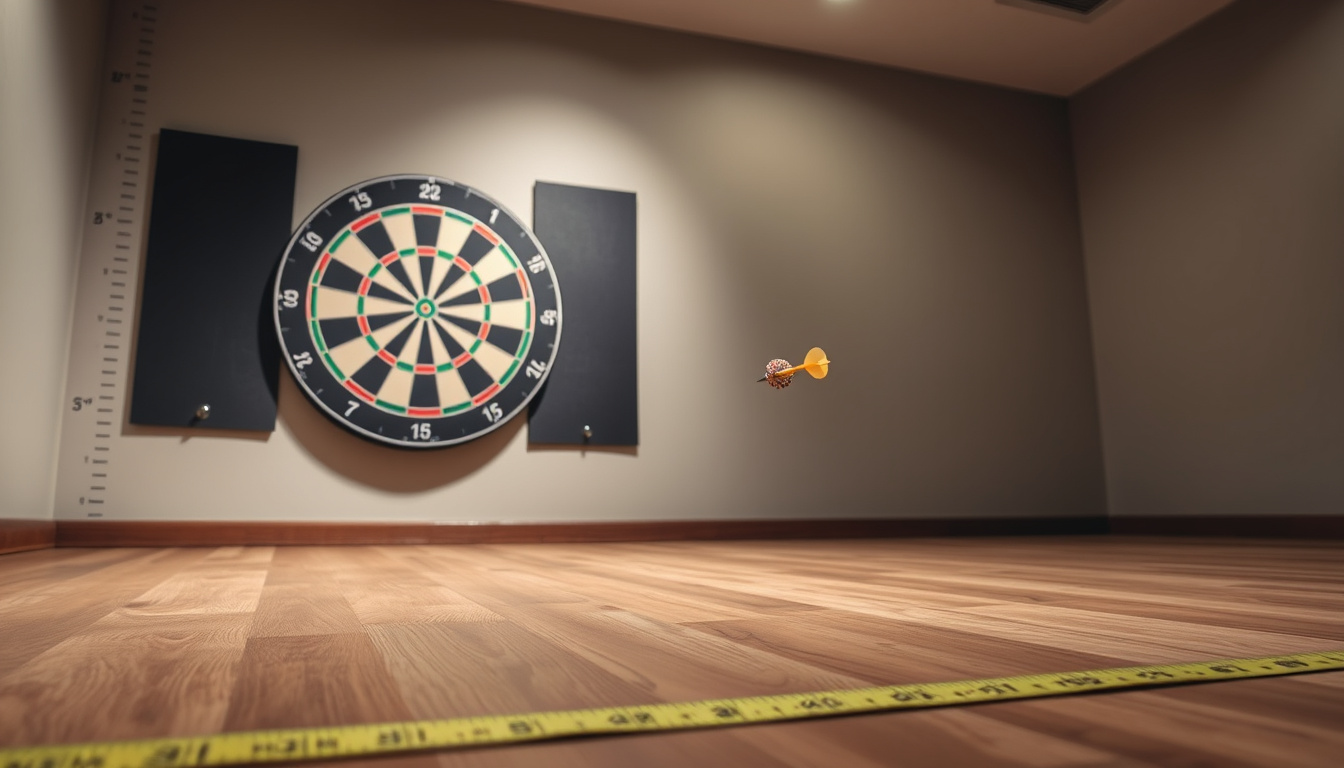
Setting up a dartboard seems straightforward — hang it on the wall, step back, and throw. But the distance between you and the board is surprisingly precise, and getting it wrong can throw off your game more than you’d think. Whether you’re outfitting a home pub or preparing for league play, the official measurements are worth knowing down to the millimeter.
Official throwing distance (steel tip): 2.37 m (7 ft 9 1/4 in) ·
Bullseye height: 1.73 m (5 ft 8 in) ·
Diagonal bullseye to oche: 2.93 m (9 ft 7.5 in) ·
Oche minimum width: 61 cm (2 ft)
Quick snapshot
- The throwing distance for steel-tip darts is 2.37 m (7 ft 9¼ in) from the board face to the oche (World Darts Federation (governing body for international darts)).
- The bullseye must be 1.73 m (5 ft 8 in) above the floor (World Darts Federation (governing body for international darts)).
- Soft-tip distances vary by league — 2.44 m (8 ft) is common but not universal (GLD Products (soft-tip dartboard manufacturer)).
- Home setups often use improvised oche markings that may not match regulation width or height. (GLD Products (soft-tip dartboard manufacturer))
- The metric distance of 2.37 m was adopted by the World Darts Federation in 1977 (Lakeside World Darts (tournament organizer)).
- Use the diagonal check (bullseye to oche) to verify your setup — a quick, reliable method (Net World Sports (darts equipment retailer)).
Five key measurements, one pattern: the setup is defined by a right triangle — the horizontal throw line, the vertical bullseye height, and the diagonal that connects them. That diagonal is the forgotten check that ensures your board is truly square.
| Measurement | Value |
|---|---|
| Throwing distance (steel tip) | 2.37 m (7 ft 9 1/4 in) |
| Bullseye height | 1.73 m (5 ft 8 in) |
| Diagonal distance | 2.93 m (9 ft 7.5 in) |
| Oche minimum width | 61 cm (2 ft) |
| Distance from wall to board face | Typically 0.5–1 cm (board thickness varies) |
How far do you stand from a dart board?
Official throwing distance for steel tip darts
The standard steel-tip throwing distance is exactly 2.37 m (7 ft 9¼ in) from the face of the dartboard to the back of the oche — the throwing line. This is the rule enforced by the World Darts Federation (World Darts Federation (governing body for international darts)). The precise imperial conversion of 2.37 m is 7 ft 9¼ in (2.3688 m), which is why the metric figure rounds to 2.37 m (Lakeside World Darts (tournament organizer)).
The measurement is taken from the back of the oche to a plumb line dropped from the board’s front face — not from the wall behind it. Many home setups measure from the wall, which adds the board’s thickness and throws off the distance (Darts Corner (darts equipment retailer)).
Distance for soft tip darts
Soft-tip or electronic dartboards use a different standard. The common throwing distance is 2.44 m (8 ft) from the board face to the throw line (GLD Products (soft-tip dartboard manufacturer)). Some leagues adopt 2.37 m, so always check the rules of your specific competition (Shot Darts (darts manufacturer)).
How to measure the oche
- Place the dartboard flat against the wall, with the bullseye at 1.73 m from the floor.
- From the board’s face, measure horizontally 2.37 m (or 2.44 m for soft tip) to the floor.
- Mark that point. This is the back edge of the oche.
- The oche itself should be at least 61 cm (2 ft) wide and 38 mm high for WDF regulation (World Darts Federation (governing body for international darts)).
- Diagonal check: Measure from the bullseye to the oche mark. The distance should be 2.93 m (9 ft 7½ in). If it’s off, your board or oche is not square (Net World Sports (darts equipment retailer)).
The diagonal is the forgotten litmus test. A 2.93 m hypotenuse confirms both the height and the horizontal distance are correct, especially on uneven floors.
A misaligned diagonal means your brain is compensating for an angle that shouldn’t exist. Over time, that slight adjustment becomes a permanent flaw in your throw.
The diagonal check is the quickest way to verify your entire setup without additional tools.
Why is darts 2.37 m?
History of the oche distance
The 2.37 m (7 ft 9¼ in) distance wasn’t plucked from a hat. The World Darts Federation adopted the metric measurement in 1977, standardizing the earlier imperial distance that had been used informally in British pubs (Lakeside World Darts (tournament organizer)). The number sticks because it produces a consistent diagonal relationship with the bullseye height — a practical geometry that ensures the dartboard is square to the player.
The precise conversion of 7 ft 9¼ in to metric is 2.3688 m, which is why 2.37 m is the official figure (Dartshopper (darts equipment retailer)).
Why 2.37 m is not arbitrary
The distance relates directly to the board’s diameter (45.72 cm) and the height of the bullseye. The resulting diagonal of 2.93 m (9 ft 7½ in) creates a right triangle that is easy to check with a single tape measure — a built-in verification tool that many players overlook (GLD Products (soft-tip dartboard manufacturer)).
The pattern: the measurement is not just a rule — it’s a self-checking system. Use the diagonal, and you’ll catch errors in both height and distance at once.
What is the correct height to hang a dartboard?
Bullseye height
The center of the bullseye must be 1.73 m (5 ft 8 in) from the floor. This is the same across all major governing bodies, including the WDF, BDO, and PDC (World Darts Federation (governing body for international darts)). The measurement is taken from the floor to the center of the bullseye, not the top of the board.
For wheelchair users, the bullseye height is commonly adjusted to 1.37 m (4 ft 6 in), while the throwing distance remains 2.37 m (Shot Darts (darts manufacturer)).
Mounting the board
Secure the board so the face is vertical and the 20 segment is at the top. A standard bracket or cabinet mount works as long as the board doesn’t wobble. The board face should be flush with the wall — any gap changes the distance measured from the face (Darts Corner (darts equipment retailer)).
If you measure from the wall instead of the board face, you add roughly 4–5 cm — that’s enough to shift your throw by a full segment on the board.
Getting the height right is as critical as the distance; both must be square to each other to ensure consistent practice.
What is the correct distance to throw a dart?
Stance and oche positioning
The distance to throw is the same as the oche distance: 2.37 m for steel-tip, 2.44 m for soft-tip. Players must stand behind the oche, with at least one foot on the floor and behind the line (World Darts Federation (governing body for international darts)).
The oche itself is a raised strip 38 mm high and 610 mm long, but in home setups, a piece of tape or a wooden strip works. The key is consistency: the same distance every time.
Throwing technique
No rule governs your throwing style — only the position of your feet matters. The distance is fixed, so your arm’s arc and release point must adapt to the constant. The diagonal check ensures you’re not leaning or reaching to compensate for a misaligned board (Net World Sports (darts equipment retailer)).
What is an illegal throw in darts?
Foot faults
A throw is illegal if the player steps over the oche — any part of the foot crossing the line before the dart leaves the hand. The rule requires at least one foot on the floor and behind the oche (World Darts Federation (governing body for international darts)).
Dart release rules
The dart must be released behind the oche. If you release it after your foot has crossed the line, it’s a foul. There is no rule about how you grip or throw — only where you stand at the moment of release (Shot Darts (darts manufacturer)).
The implication: a correct setup — with a clearly marked oche and verified diagonal — makes it easy to stay legal. Without it, you’re guessing.
How to Measure Dart Board Distance Step by Step
- Mount the dartboard at the correct height: center of bullseye 1.73 m (5 ft 8 in) from the floor. Ensure the board is vertical and the 20 is at top.
- Measure from the board face — not the wall. Use a tape measure horizontally from the front of the board to the floor, marking the point at 2.37 m (7 ft 9¼ in) for steel-tip, or 2.44 m (8 ft) for soft-tip.
- Create the oche at that mark. It should be at least 61 cm (2 ft) wide and 38 mm high for regulation (World Darts Federation (governing body)).
- Perform the diagonal check: Measure from the bullseye to the back edge of the oche. The distance should be 2.93 m (9 ft 7½ in). If it’s off, recheck your height and horizontal distance (Net World Sports (darts equipment retailer)).
- Test with a practice throw. Stand behind the oche, throw a few darts, and confirm your stance feels natural. Adjust only if the diagonal check indicates a problem.
Skipping the diagonal check saves 30 seconds but costs you accuracy. That 30 seconds is the difference between a setup that builds muscle memory and one that builds bad habits.
Thirty seconds spent on the diagonal check can save weeks of flawed practice.
What We Know and What’s Not Clear
Confirmed facts
- The official steel-tip throwing distance is 2.37 m (7 ft 9¼ in) — WDF (governing body).
- Bullseye height is 1.73 m (5 ft 8 in) — GLD Products (manufacturer).
- Diagonal from bullseye to oche is 2.93 m (9 ft 7½ in) — Net World Sports (retailer).
What’s unclear
- Soft-tip distance varies by league (2.44 m common, but not universal) — Shot Darts (manufacturer).
- Exact oche marking may differ in home setups (tape vs. raised strip).
- Some organizations allow different oche lengths for electronic boards.
- The exact angle of the diagonal may differ if the floor is uneven.
Understanding the confirmed facts and the open questions helps you set up with confidence and adapt to league rules.
What the Experts Say
” The official distance for steel-tipped darts is 7 ft 9¼ in.”
— Net World Sports (darts equipment retailer) Buyer’s guide
” The center of the bullseye should be 1.73 meters above the floor.”
— Dartshopper (darts equipment retailer) Dartshopper blog
The two quotes show a consistent range: official sources state 7 ft 9¼ in and 1.73 m, confirming the standard.
thedartguide.com, darts501.com, dartsdaily.net, dartrankings.co.uk, thedartscout.com
Frequently Asked Questions
What is the oche in darts?
The oche is the throwing line — the mark behind which players must stand when throwing. It can be a raised strip, a piece of tape, or a painted line. The minimum width is 61 cm (2 ft) and the height for regulation is 38 mm (WDF (governing body)).
Can I use a standard tape measure to set up my dart board?
Yes. A standard tape measure is accurate enough for home use. The key is to measure from the board face, not the wall, and to perform the diagonal check (2.93 m) to verify both height and distance at once.
Do I need a throw line or can I mark the floor?
You can mark the floor with tape, a piece of wood, or a painted line. The oche must be at least 61 cm (2 ft) wide. For practice, tape is fine. For competition, a raised oche is required (WDF (governing body)).
What is the distance for electronic dartboards?
Electronic dartboards (soft-tip) are commonly set at 2.44 m (8 ft) from the board face to the throw line, but always check your league’s rules — some use 2.37 m (GLD Products (manufacturer)).
How do I check the diagonal distance from bullseye to oche?
Measure from the center of the bullseye to the back edge of the oche. The distance should be 2.93 m (9 ft 7½ in). If it’s off, either the height or the horizontal distance is wrong (Net World Sports (retailer)).
Is the distance different for left-handed players?
No. The throwing distance and height are the same for all players regardless of handedness. The oche is centered on the board, so both left- and right-handed players use the same measurement.
What happens if my oche is not exactly 2.37 m?
A small deviation of a few millimeters is unlikely to affect casual play, but for serious practice, even 1 cm off can alter your throwing angle. Use the diagonal check to confirm accuracy. If you’re off by more than 2 cm, readjust.
For the home player, the choice is clear: measure twice, throw once. A properly set up dartboard — with the correct height, distance, and diagonal verified — builds muscle memory that translates to better accuracy. Skip the diagonal check, and you’re practicing a flawed geometry that will cost you points in the long run.

Oliver Jack Carter Cooper is a staff writer for EveningLedger.uk, covering UK news, politics, business and culture. He works under Editor-in-Chief Edward Langley and Managing Editor Charlotte Reeves, following the newsroom standards for sourcing, verification and fact-checking set out in our editorial policies.