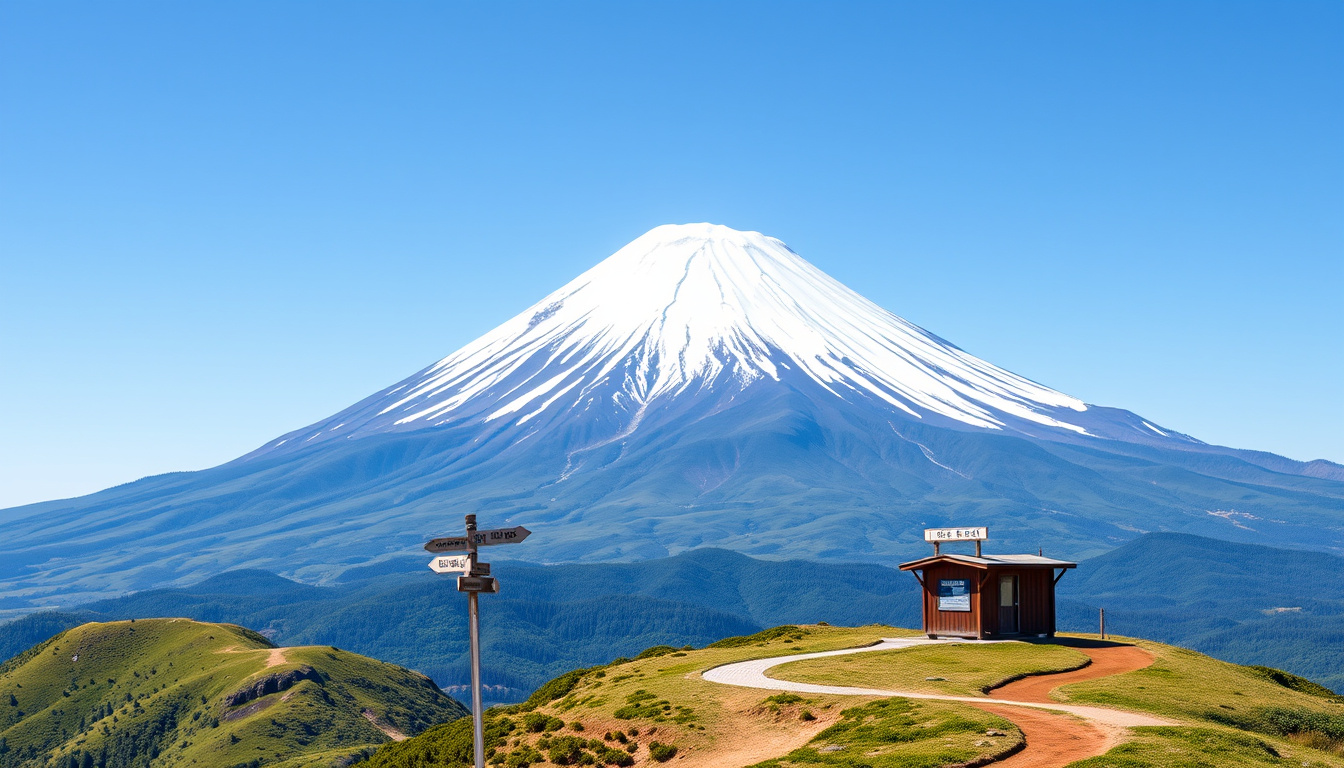
Anyone who’s planned a trip to Japan has likely stared at a photo of Mount Fuji and wondered if it’s actually possible to just show up and climb it. The short answer is yes, but the specifics – from new fees and route rules to train times and trail fees – require some planning. This guide breaks down everything you need to know to plan a Mount Fuji day trip or climb in 2025, from Tokyo or otherwise.
Height: 3,776 m (12,389 ft) ·
Climbing season: July – September ·
2025 fee: ¥4,000 per person ·
Climbing routes: 4 main routes
Quick Snapshot
- 4,000 yen fee applies to all climbers in 2025 (Japan Guide)
- Climbing season: July 1 – September 10 (Japan Guide)
- Exact future eruption probability is unknown but monitored.
- Seasonal weather can change access conditions unexpectedly.
- Last eruption: 1707–1708 (Japan Guide)
- 2025 fee doubles from ¥2,000 (TheTravel)
- 2025 fee increase takes effect May 9 (South China Morning Post)
- New requirements apply to all 4 routes (The Japan Times)
| Fact | Detail | Source |
|---|---|---|
| Height | 3,776 m (12,389 ft) | Japan Guide |
| Location | Honshu, Japan, 100 km SW of Tokyo | Japan Guide |
| Last eruption | 1707–1708 | Japan Guide |
| 2025 climbing fee | ¥4,000 (previously ¥2,000) | TheTravel |
| Trail gates | Closed 2 p.m. – 3 a.m. | Japan Guide |
| Daily limit (Yoshida) | 4,000 climbers | Stars and Stripes |
Where is Mount Fuji located?
Mount Fuji sits on Honshu Island, about 100 km southwest of Tokyo. The mountain straddles Yamanashi and Shizuoka prefectures, with the closest cities being Fujinomiya and Fujiyoshida. Tokyo is roughly 100 km away, while Kyoto is about 300 km to the southwest.
- Location: Honshu Island, Japan
- Nearest cities: Fujinomiya (south), Fujiyoshida (north)
- Distance from Tokyo: ~100 km
- Distance from Kyoto: ~300 km
Fuji’s position between two prefectures means you have to choose your base carefully based on which route you plan to take. Pick the side that matches your trail, or you’ll add unnecessary transit time.
Which city is closest to Mount Fuji?
Fujinomiya on the southwest side and Fujiyoshida on the northeast are the two gateway cities. Both offer accommodation and transport connections, but Fujiyoshida sits closest to the Yoshida Trail (the most popular route), while Fujinomiya anchors the Fujinomiya Trail.
Fujiyoshida gets you closer to the climbing action, but Fujinomiya offers faster access to the highest trailhead (Fujinomiya 5th Station). Your choice depends on whether you prioritize proximity to trails or a head start on altitude.
Is Mount Fuji closer to Kyoto or Tokyo?
Tokyo is significantly closer. At roughly 100 km, the capital is about 2–2.5 hours by train or bus. Kyoto, at 300 km, requires 4–5 hours of travel each way. For a day trip, Tokyo is the logical launch point.
One pattern holds for most hikers: the closer you are, the more flexible your timing. If you’re scrambling to fit Fuji into a Kansai itinerary, expect to lose almost a full day to transit.
| City | Distance | Travel time |
|---|---|---|
| Tokyo | ~100 km | 2–2.5 hrs |
| Kyoto | ~300 km | 4–5 hrs |
| Osaka | ~350 km | 5+ hrs |
Is Mount Fuji still an active volcano?
Yes, but it has been dormant since the last eruption in 1707–1708. The Japan Guide explains that Mount Fuji is an active stratovolcano, not an extinct one. The Japan Meteorological Agency monitors it continuously. While no major eruption has occurred in over 300 years, the mountain is not considered extinct — only dormant.
- Volcanic status: Active (dormant)
- Last eruption: 1707–1708 (Hoei eruption)
- Monitoring: Japan Meteorological Agency
- Eruption risk: Low but continuously assessed
The volcano’s dormant status creates a false sense of security. Officials can restrict access with little notice due to increased seismic activity.
When was the last eruption of Mount Fuji?
The last confirmed eruption was the Hoei eruption of 1707–1708. This was the most recent of 17 confirmed eruptions since 781 AD.
What is the current volcanic activity level?
The Japan Meteorological Agency maintains real-time monitoring. As of early 2025, no immediate eruption warnings have been issued, and climbing season is proceeding as planned. However, the mountain is assessed as having a low but non-zero probability of renewed activity.
How long does it take to climb Mount Fuji?
Climbing duration varies by route and experience. Japan Guide reports the ascent takes 5–10 hours, with descent at 3–6 hours. Most climbers opt for an overnight stay at a mountain hut to summit for sunrise, which extends the total time to 18–24 hours from hut to hut.
- Ascent: 5–10 hours (varies by route and pace)
- Descent: 3–6 hours
- One-day climb: Feasible only for the fastest, most experienced hikers
- Overnight: Recommended for sunrise summit views
Is 1 day enough to climb Mount Fuji?
For experienced, fit hikers, yes — but it’s not advisable. A one-day ascent requires starting before dawn, maintaining a fast pace, and finishing descent before dusk. Japan Guide cautions that altitude sickness and exhaustion are real risks. Most climbers use the mountain-hut system to break the climb into two days.
Is it easy to walk up Mount Fuji?
No. The trail from the 5th station to the summit covers about 1,500 meters of elevation gain. The trail is steep in sections, rocky, and there’s thin air above 3,500 m. Climbers without prior altitude experience should expect difficulty. The official Japan Guide describes it as “a serious undertaking” — not a walk in the park.
| Route | Difficulty | Ascent time | Descent time |
|---|---|---|---|
| Yoshida (north) | Moderate | 6–8 hrs | 3–5 hrs |
| Subashiri (east) | Moderate | 7–9 hrs | 3–5 hrs |
| Fujinomiya (south) | Moderate-Hard | 5–7 hrs | 3–5 hrs |
| Gotemba (south) | Hard (longest) | 8–10 hrs | 4–6 hrs |
Four routes, one reliable pattern: the Yoshida Trail sees the most traffic and has the most mountain huts; the Gotemba Trail is the quietest but longest. Choose based on your tolerance for crowds versus solitude.
If you’re only doing one climb, the Yoshida Trail’s support infrastructure — huts, toilets, and rescue services — offsets its crowds. For beginners, this trade-off is worth it.
How much does it cost to visit Mount Fuji?
Costs have changed significantly for 2025. TheTravel reports that the 2025 fee has doubled from ¥2,000 to ¥4,000 per person. This applies to all four main trails. The ¥1,000 voluntary contribution has been abolished. Climbers on the Yoshida Trail must also pay entrance fees at the 5th-station gates, which are separate from the trail fee.
| Item | Cost (JPY) | Notes |
|---|---|---|
| Climbing fee (2025) | ¥4,000 | Mandatory, all routes |
| Trailhead gate (Yoshida) | ¥4,000 | Collected at 5th Station |
| Mountain hut stay | ¥7,000–¥10,000 | Per night, incl. 1-2 meals |
| Gear rental | ¥5,000–¥10,000 | Boots, coat, headlamp |
| Day trip from Tokyo | ¥10,000–¥15,000 | Bus, food, optional extras |
| Full climb package | ¥20,000–¥30,000 | Incl. transport, fee, hut |
The ¥4,000 fee is charged per person on all four routes — including the previously free trails on the Shizuoka side. A family of four pays ¥16,000 just for the permit, before any transport or hut costs.
How much is a day trip to Mount Fuji from Tokyo?
A budget-conscious traveler can do it for about ¥10,000–¥15,000 all-inclusive. This includes the bus ticket, entry fee (¥4,000 is unavoidable), and meals. Add ¥3,000–¥5,000 if you want to rent a hiking stick or buy a can of oxygen at the 5th Station.
How much money does it cost to climb Mount Fuji?
In 2025, expect to pay at least ¥4,000 for the mandatory climbing fee. Add transport from Tokyo (¥10,000–¥15,000 round trip), hut stay (¥7,000–¥10,000), and gear rental (¥5,000–¥10,000) if needed. A full overnight trip costs about ¥25,000–¥40,000 per person. Japan Guide notes that an overnight hut stay adds ¥8,000–¥12,000 to the total.
How to get to Mount Fuji from Tokyo
Getting to Fuji involves a three-step journey: Tokyo → gateway city → 5th Station. Most climbers take a bus from Shinjuku Expressway Bus Terminal directly to the 5th Station, which takes 2–2.5 hours depending on traffic. Alternatively, the Japan Guide confirms that train travelers head to Fujiyoshida Station, then catch a connector bus to the 5th Station. The complete journey takes 3–4 hours one-way.
- Take the JR Chuo Line from Shinjuku to Otsuki Station (about 75 minutes, ¥2,000).
- Transfer to the Fujikyu Railway for a 50-minute ride to Fujiyoshida Station.
- Board the Mount Fuji 5th Station bus (50 minutes, ¥1,500).
| Sector | Transport | Time | Cost (JPY) |
|---|---|---|---|
| Tokyo → 5th Station | Highway bus | 2–2.5 hrs | ¥3,000–¥5,000 |
| Tokyo → Fujiyoshida | JR Chuo Line | 2.5 hrs | ¥2,000–¥3,000 |
| Fujiyoshida → 5th Station | Local bus | 50 min | ¥1,500 |
| Tokyo → Shin-Fuji (Shinkansen) | Bullet train | 2.5 hrs | ¥8,000–¥10,000 (one-way) |
For a day trip, stick to the Yoshida Trail’s lower sections (5th to 7th Station) and save the summit for an overnight trip. You’ll enjoy the view, avoid altitude sickness, and still return to Tokyo in time for dinner.
How long is a bullet train from Tokyo to Mount Fuji?
The Shinkansen from Tokyo to Shin-Fuji Station takes about 2.5 hours. However, the total door-to-door journey to the 5th Station is closer to 4 hours, as it includes the bus transfer. For comparison, the direct highway bus from Shinjuku takes 2–2.5 hours without transfers.
Can Fuji be a day trip from Tokyo?
Yes — with serious constraints. Japan Guide confirms that a day trip is possible, but it requires leaving Tokyo before 5 a.m. and returning after 9 p.m. The CNN report notes that even the 4,000-visitor daily cap assumes most visitors will only hike partway, not summit. If you’re set on summiting, an overnight stay is strongly recommended.
Day-trippers save money and need no hut booking, but they miss the sunrise summit. Overnighters pay more but get the classic Fuji experience. The Japan Times covers the trade-off: overnighters contribute more to the local economy but add to trail traffic.
When to avoid trains in Japan?
Golden Week (late April–early May) and Obon (mid-August) are the busiest travel periods in Japan. Trains to Fuji, especially the JR Chuo Line, experience severe overcrowding. Japan Guide recommends booking seats at least a week in advance for these periods. On weekends in July and August, the mountain-bus from Shinjuku sells out days ahead — book online before your trip.
Avoiding trains doesn’t mean you’ll escape crowds. The bus from Shinjuku can also hit traffic jams on summer weekends — allow an extra hour of buffer time each way.
Mount Fuji climbing season: when to go and what it costs
The 2025 climbing season runs from July 1 to September 10 for the Yoshida Trail. The Stars and Stripes reports that the season opens slightly later for the other three trails — July 10 — and all routes close on September 10. The 2025 season also marks the first year of the mandatory ¥4,000 fee, which South China Morning Post confirmed took effect May 9, 2025.
When does the 2025 Mount Fuji climbing season start and end?
July 1 – September 10, 2025 (all routes). The Yoshida Trail has a distinct window from July 1 to September 10, while the Subashiri, Gotemba, and Fujinomiya trails run from July 10 to September 10. The gates on all four trails close between 2 p.m. and 3 a.m. each day, unless you have a mountain-hut reservation.
Is Mount Fuji in season in October?
No. October is outside the official season. Expect unmaintained trails, closed huts, and potentially icy conditions at the summit. Some tour operators run “pre-season” climbs in late June, but this is not officially sanctioned.
Is Mount Fuji in season in April?
No. April is out of season. Snow covers the upper slopes until June, and ice persists in the gullies. Attempting a climb is dangerous and irresponsible without proper mountaineering equipment, which ordinary climbers won’t have.
Mount Fuji day trip from Tokyo: travel routes and logistics
A day trip is a whirlwind of planning, but it’s doable. Here’s a typical itinerary based on the Japan Guide and Tokyo Cheapo guidance:
- 05:00 – Depart Shinjuku by bus
- 07:30 – Arrive at 5th Station, register or pay fee
- 08:30 – Start climbing if attempting summit
- 13:00 – Turn around at 8th Station if short on time
- 15:00 – Begin descent from 5th Station
- 16:00 – Catch return bus to Tokyo
- 19:30 – Arrive back in Shinjuku
The pattern for day-trippers: you lose the summit sunrise but gain a manageable schedule. Tokyo Cheapo confirms that tickets for the Mount Fuji 5th Station bus must be reserved online in English — even for non-climbers.
How much is a day trip to Mount Fuji from Tokyo?
A budget-conscious traveler can do it for about ¥10,000–¥15,000 all-inclusive. This includes the bus ticket, entry fee (¥4,000 is unavoidable), and meals. Add ¥3,000–¥5,000 if you want to rent a hiking stick or buy a can of oxygen at the 5th Station.
Should I book Mount Fuji tickets in advance?
Yes. Tokyo Cheapo confirms that tickets for the Mount Fuji 5th Station bus must be reserved online (in English). This applies even for day-trippers not climbing. The same goes for mountain huts — they book out months in advance for July–September.
Which is better: day trip or overnight stay?
Day trips are cheaper (¥10,000–¥15,000 vs. ¥20,000–¥30,000 for an overnight climb) and require no hut booking. But overnight stays let you summit for sunrise, which is the singular highlight of the experience. The Japan Times covers the trade-off: overnighters contribute more to the local economy (hut fees, meals) but add to the traffic. Day-trippers need to stick to lower sections, which misses the full reward.
Mount Fuji safety: volcanic risk, weather, and hiking tips
Volcanic risk is low but real. The last eruption in 1707–1708 buried Edo (Tokyo) in ash. CNN reports that the Japan Meteorological Agency maintains a 24/7 monitoring system. In the event of an eruption, authorities would restrict access and potentially issue evacuation orders. Climbers should monitor Japan Guide’s live updates before heading out.
- Check Japan Guide for trail closures and weather warnings.
- Carry a headlamp, rain gear, and warm layers even in summer.
- Book a mountain hut if climbing overnight — you can’t rely on walk-ins.
- Know the signs of altitude sickness: headache, nausea, shortness of breath.
Is Mount Fuji currently active in 2025?
No recent eruption has occurred, but it remains an active volcano. The Japan Meteorological Agency has not issued eruption warnings as of February 2025. The planned climbing season proceeds as normal, with the new fee and reservation system in place.
The 4,000-yen fee doesn’t include insurance or rescue coverage. If you call for help on the trail, you may face separate charges for medical transport.
Mount Fuji vs. alternatives: is it worth the trip?
If you’re short on time or money, consider whether Fuji is the right choice. Japan Guide also covers other mountains in Japan, like Mount Tate or Mount Haku, which are less crowded and cheaper. But if seeing the iconic cone is your priority, Fuji is the only one that delivers that exact silhouette.
| Criteria | Mount Fuji | Alternative (e.g., Mt. Tate) |
|---|---|---|
| Cost (2025) | ¥4,000 fee + transport + hut | Free entry, lower hut costs |
| Difficulty | Moderate (steep, altitude) | Moderate |
| Access from Tokyo | 2–2.5 hrs | 3–4 hrs |
| Crowds | Extreme (300,000+ climbers/year) | Light |
| Season | July–September | July–October |
One clear pattern emerges: Fuji charges a premium for its name and symbolism. If you’re not attached to climbing the exact mountain, alternatives save you money and offer more solitude.
Paying ¥4,000 for the privilege of climbing Fuji is a fraction of the total trip cost. For day-trippers who just want the view, the 5th Station is still free (if you pay the trail fee at the gate). For serious hikers, the experience justifies the extra cost.
Summary
Climbing Mount Fuji in 2025 means understanding a 300-year-old volcano with modern rules. The mandatory ¥4,000 fee, the 4,000 daily limit, and the 2 p.m.–3 a.m. gate closures have professionalized the experience — which is a good thing for safety but a price increase compared to previous years. For a day-tripper from Tokyo, the cost adds up to ¥10,000–¥15,000; for an overnight climber, expect to pay ¥25,000–¥40,000 with permits, hut fees, and gear. The free trails are gone in 2025 — every route has a fee. That’s the trade-off of visiting a UNESCO World Heritage Site that’s also a busy volcano. For the casual visitor, the Fuji 5th Station experience remains a stunning, low-commitment day trip; for the serious climber, overnight at a Fujiyoshida hut is the classic experience. The key decision: pay the ¥4,000 and climb properly, or save money and skip the summit. Day-trippers get the view without the altitude risk; overnighters get the sunrise but pay triple the cost.
isfujivisible.com, uk.news.yahoo.com, tokyocheapo.com, japantimes.co.jp, japan-experience.com, en.japanopia-fuji.com
Mount Fuji FAQs
Where is Mount Fuji located and how do I get there?
Mount Fuji is on Honshu Island, about 100 km southwest of Tokyo. It straddles Yamanashi and Shizuoka prefectures. The closest cities are Fujinomiya (south) and Fujiyoshida (north). You can get there by bus (2–2.5 hrs from Shinjuku) or train (2.5–3.5 hrs via Otsuki).
Is Mount Fuji an active volcano?
Yes. It is an active stratovolcano that last erupted in 1707–1708. The Japan Meteorological Agency monitors it constantly. It’s currently dormant, but not extinct.
How much does it cost to climb Mount Fuji?
In 2025, expect to pay at least ¥4,000 for the mandatory climbing fee. Add transport from Tokyo (¥10,000–¥15,000 round trip), hut stay (¥7,000–¥10,000), and gear rental (¥5,000–¥10,000) if needed. A full overnight trip costs about ¥25,000–¥40,000 per person.
How long does it take to climb Mount Fuji?
The ascent takes 5–10 hours depending on route and fitness. The descent takes 3–6 hours. Most climbers do it over two days, staying at a hut overnight to summit for sunrise. A one-day climb is possible but risky.
Can beginners climb Mount Fuji?
Yes, with preparation. The Yoshida Trail has moderate difficulty. Beginners should climb the Yoshida or Fujinomiya routes, avoid the Gotemba (longest) and Subashiri (most remote) trails, and consider hiring a guide. Altitude sickness is the main risk.
Do I need a guide to climb Mount Fuji?
No, not in the official season (July–September) on the main routes. However, guides are recommended for beginners or for climbs outside the peak season. Outside the season, a guide is essential for safety.
Is there snow on Mount Fuji in the summer?
No. The snow melts during the climbing season (July–September). Some snow remains in shaded gullies, especially on the north side, but the main trails are snow-free. The iconic snow cap reappears in October.
What is the best time to climb Mount Fuji?
The official climbing season runs from July 1 to September 10. The best conditions are typically in late July and August, when the weather is most stable. Early July and late August can be cooler and less crowded.
Are there toilets on Mount Fuji?
Yes, mountain huts along the trails have toilets, but they are not free. Expect to pay ¥200–¥300 per use. Toilets are also available at the 5th Station.

Oliver Jack Carter Cooper is a staff writer for EveningLedger.uk, covering UK news, politics, business and culture. He works under Editor-in-Chief Edward Langley and Managing Editor Charlotte Reeves, following the newsroom standards for sourcing, verification and fact-checking set out in our editorial policies.