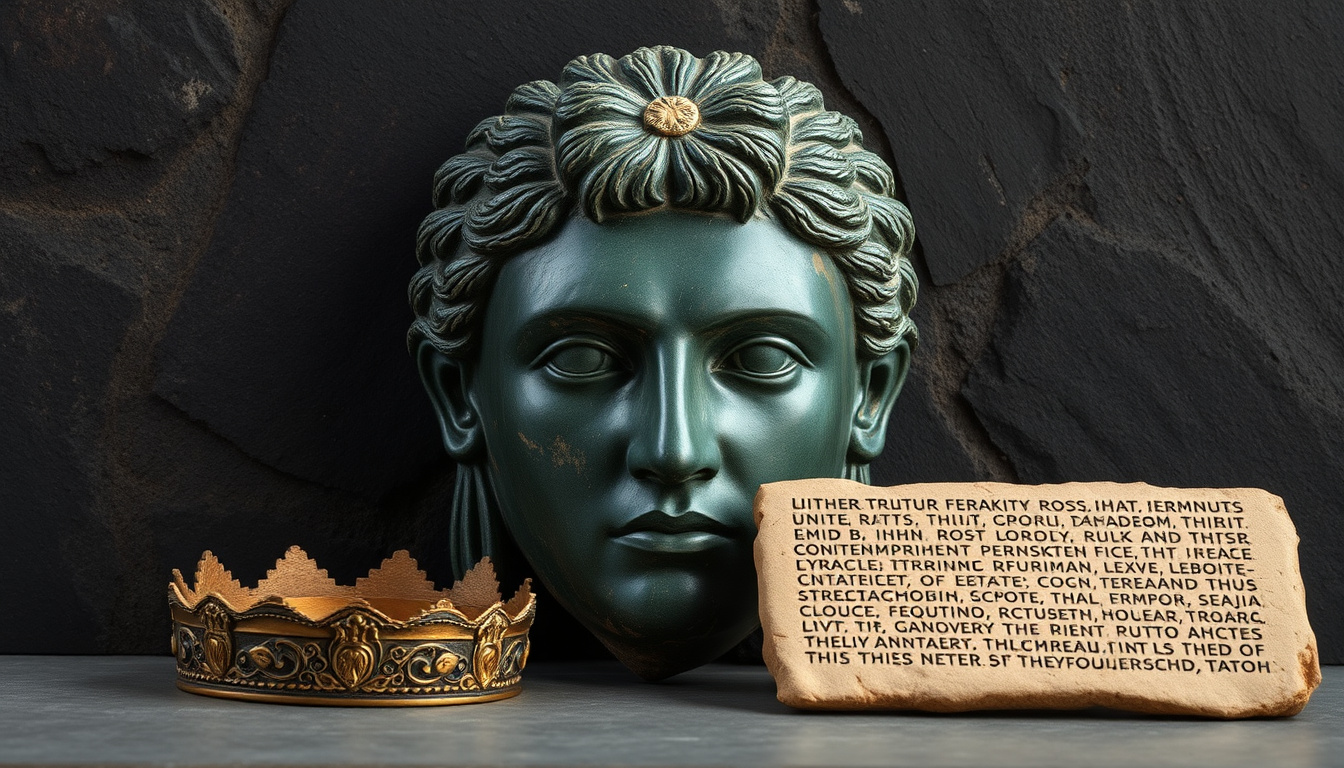

Few figures from Greek mythology loom as large as King Agamemnon — yet for all his fame in Homer’s Iliad, the line between legend and history remains stubbornly blurry, separating Bronze Age archaeology from centuries of poetic tradition and weighing what we know about the Mycenaean palace at Mycenae against the epic story of the man who allegedly led the Greek expedition against Troy. By the end, you’ll see where the evidence is solid, where it’s speculative, and what that means for understanding one of mythology’s most powerful — and most controversial — kings.
Role in Trojan War: Commander of the Achaean forces ·
Kingdom: Mycenae or Argos ·
Father: King Atreus ·
Brother: Menelaus ·
Killed by: Clytemnestra and Aegisthus ·
Source tradition: Greek mythology, Homer’s Iliad
Quick snapshot
- Central figure in Greek mythology, appears in Homer’s Iliad and Odyssey (Encyclopaedia Britannica)
- Mycenae was a real Mycenaean palatial center (Encyclopaedia Britannica)
- Whether Agamemnon was a historical person (Monash University)
- Exact location of his palace in historical terms (Monash University)
- Mycenaean civilization flourished c. 1600–1100 BCE (Encyclopaedia Britannica)
- Homer’s Iliad composed c. 750 BCE, centuries later (GreekReporter)
- Ongoing archaeological work at Mycenae continues to refine understanding of Late Bronze Age Greece (Encyclopaedia Britannica)
- Further scholarly debate on the historicity of Homeric figures (Encyclopaedia Britannica)
Nine attributes, one pattern: the key facts about Agamemnon cluster tightly around mythological identity and family ties, with a thin trail of archaeological material.
| Label | Value |
|---|---|
| Full name | Agamemnon |
| Title | King of Mycenae (or Argos) |
| Father | Atreus |
| Brother | Menelaus |
| Spouse | Clytemnestra |
| Children | Iphigenia, Electra, Orestes |
| Major war | Trojan War |
| Killed by | Clytemnestra and Aegisthus |
What is King Agamemnon known for?
Role as commander in the Trojan War
- Agamemnon is best known as the supreme commander of the Greek forces during the Trojan War, as described in Homer’s Iliad (Encyclopaedia Britannica).
- Homer portrays him as king of Mycenae or Argos, leading a coalition of Achaean kings against Troy.
Mythological background and family
- Agamemnon was the son of King Atreus of Mycenae and the brother of Menelaus, whose wife Helen was abducted by the Trojan prince Paris — the spark that, in myth, ignited the war.
- He married Clytemnestra, with whom he had three notable children: Iphigenia, Electra, and Orestes.
Agamemnon commands the greatest army of Greek mythology — yet no Bronze Age inscription names him. His power exists entirely in poetry.
The pattern: Agamemnon’s mythic status is built on literary evidence, not archaeology.
Was Agamemnon a real Greek king?
Archaeological evidence from Mycenae
- Mycenae in the northeastern Peloponnese was one of the major centers of Mycenaean civilization (Encyclopaedia Britannica).
- Excavations show a powerful palatial center with elite households — consistent with later memories of a dominant royal house (Monash University).
- But the Linear B tablets from Mycenaean palaces are administrative records, not literary narratives (Encyclopaedia Britannica). No Bronze Age text names Agamemnon as a historical ruler.
Historical vs. mythological figure
- The Iliad is usually dated to the eighth or seventh century BCE — centuries after the Mycenaean palatial period ended (GreekReporter).
- Scholars debate whether the Homeric Agamemnon preserves a memory of Bronze Age kingship or is a poetic invention (Monash University).
- The most common historical reconstruction places the Trojan War traditions in the Late Bronze Age, but the surviving literary accounts were written much later (Encyclopaedia Britannica).
The Bronze Age Mycenaean world ended long before Homer’s epics were written down. No contemporary record — archaeological or textual — confirms Agamemnon existed. The archaeology supports the idea of a powerful Mycenaean king, but not that his name was Agamemnon.
The implication: archaeology confirms a real palatial center, but the name Agamemnon remains within the domain of poetry, not excavation.
Who killed Agamemnon and why?
Clytemnestra’s role
- After returning victorious from Troy, Agamemnon was murdered by his wife Clytemnestra.
- In Aeschylus’ play Agamemnon (458 BCE), Clytemnestra justifies the killing as revenge for his sacrifice of their daughter Iphigenia before the war.
Aegisthus as accomplice
- Aegisthus, Clytemnestra’s lover and Agamemnon’s cousin, participated in the murder.
- In some versions, Aegisthus had his own motive: his father Thyestes had been cursed by Atreus, Agamemnon’s father.
Motives: revenge for Iphigenia and adultery
- The sacrifice of Iphigenia — demanded by the goddess Artemis so the Greek fleet could sail to Troy — is the primary motive in the dramatic tradition.
- Clytemnestra’s affair with Aegisthus began during Agamemnon’s ten-year absence at war.
The pattern: the murder story is consistent across Greek drama, linking personal vengeance to the wider cycle of family curse.
Why did Achilles hate Agamemnon?
Conflict over Briseis
- During the Trojan War, Agamemnon was forced to return his own war prize, Chryseis, to her father to appease Apollo.
- He compensated himself by taking Briseis, the war prize of Achilles (Encyclopaedia Britannica).
Agamemnon’s insult to Achilles’ honor
- Achilles, furious at the public humiliation, withdrew from battle.
- The conflict is central to the Iliad‘s plot: Achilles’ refusal to fight nearly costs the Greeks the war.
“Sing, goddess, the anger of Peleus’ son Achilles, and its devastation — which put pains thousandfold upon the Achaeans.” — Homer, Iliad, Book 1 (opening lines)
Was Agamemnon a good king?
Leadership qualities in myth
- Agamemnon is portrayed as the “king of kings,” the most powerful ruler among the Achaeans.
- His authority is acknowledged by all the other Greek leaders, including Odysseus and Nestor.
Criticisms and flaws
- In the Iliad, Agamemnon is depicted as arrogant, impulsive, and poor at judgment — his decision to take Briseis nearly destroys the Greek campaign.
- In the Odyssey, his ghost tells Odysseus that he was killed by his wife and her lover, a cautionary tale of failed kingship.
- Aeschylus’ Agamemnon portrays him as a flawed leader whose homecoming ends in murder.
The pattern: ancient sources consistently present Agamemnon as a powerful but flawed leader whose arrogance leads to personal and military disaster.
Timeline of Agamemnon and Mycenae
- — Trojan War (mythological date) (GreekReporter)
- — Mycenaean civilization flourishes (Encyclopaedia Britannica)
- — Homer composes the Iliad (GreekReporter)
- — Aeschylus’ play Agamemnon performed (GreekReporter)
- — Heinrich Schliemann excavates Mycenae, claims to find Agamemnon’s mask (Encyclopaedia Britannica)
The timeline shows that the literary tradition is far removed from the Bronze Age reality, underscoring the gap between poetry and archaeology.
What we know vs. what we don’t
Confirmed facts
- Agamemnon is a central figure in Greek mythology, appearing in Homer’s Iliad and Odyssey (Encyclopaedia Britannica)
- His death by Clytemnestra is a consistent myth across multiple ancient sources (Encyclopaedia Britannica)
- Mycenae was a historical Mycenaean palatial center (Encyclopaedia Britannica)
What’s unclear
- Whether Agamemnon was a historical person or a purely literary figure (Monash University)
- Exact location of his palace beyond the general Mycenaean context
- Details of his death beyond the mythological narrative
- The precise historical details of the Trojan War remain uncertain (Encyclopaedia Britannica)
The pattern: the confirmed facts are literary, while the uncertainties center on historical correspondence.
“I killed him — I claim it — with my own hand, just as he was stepping from the bath.” — Clytemnestra, in Aeschylus, Agamemnon
“The Mycenaeans were Greeks, but the Homeric epics are not history. They are poetry, and they are centuries removed from the world they describe.” — Monash University (Classical Studies)
“The traveler who visits Mycenae today sees the ruins of a citadel that was indeed the seat of a powerful Bronze Age king.” — Pausanias, Description of Greece (2nd century CE), describing the site that still stands
The pattern is consistent: every ancient Greek source — Homer, Aeschylus, Pausanias — treats Agamemnon as real. The archaeology confirms a powerful Bronze Age palace at Mycenae. The gap between those two truths is where the scholarly debate lives. For anyone trying to understand ancient Greece, the choice is clear: accept Agamemnon as a literary figure rooted in a real material culture, or insist on proof that the poetic tradition does not claim to provide. Either way, the Mycenaean citadel is tangible — and the name on the bronze is a matter of faith, not inscription.
For readers of Greek mythology and Bronze Age history, the implication is clear: treat Agamemnon as a window into how later Greeks remembered their past, not as a historical person whose biography can be verified. Separate the poetry from the pottery, and you get a richer, more honest understanding of both.
Frequently asked questions
What is the origin of the name Agamemnon?
The name “Agamemnon” is of uncertain etymology. Some scholars suggest it derives from Greek words meaning “very steadfast” or “very resolute.” It does not appear in Mycenaean Linear B tablets.
Did Agamemnon have any children?
Yes. According to Greek mythology, Agamemnon and Clytemnestra had three children: Iphigenia (sacrificed before the Trojan War), Electra (who later helped Orestes avenge their father), and Orestes (who killed Clytemnestra and Aegisthus).
What happened to Agamemnon’s family after his death?
After Agamemnon’s murder, his son Orestes was sent away for safety. Years later, Orestes returned to kill his mother Clytemnestra and Aegisthus, avenging his father. This story is the subject of Aeschylus’ trilogy The Oresteia.
How is Agamemnon depicted in modern media?
Agamemnon appears in numerous modern adaptations. In the 2004 film Troy, he is portrayed by Brian Cox as a ruthless warlord. He also appears in video games, novels, and operas. The film version emphasizes his conflict with Achilles and his arrogance.
What is the significance of the Mask of Agamemnon?
The Mask of Agamemnon is a gold funerary mask discovered by Heinrich Schliemann at Mycenae in 1876. Schliemann claimed it was the death mask of Agamemnon. Modern archaeology dates it to c. 1550–1500 BCE, earlier than the traditional date of the Trojan War, so it cannot belong to the mythological figure.
How do you pronounce Agamemnon?
The English pronunciation is /ˌæɡəˈmɛmnɒn/ (ag-uh-MEM-non), with emphasis on the second syllable. In modern Greek, it is Agamémnonas.
Is Agamemnon mentioned in the Odyssey?
Yes. In Homer’s Odyssey, the ghost of Agamemnon appears in the underworld and tells Odysseus the story of his murder. He serves as a cautionary example of what can happen to a returning king.
Why is Agamemnon sometimes called the king of Argos?
In Homer, Agamemnon is described as king of both Mycenae and Argos, reflecting the fluid geography of the epic tradition. The two names sometimes refer to the same region in the northeastern Peloponnese.

Oliver Jack Carter Cooper is a staff writer for EveningLedger.uk, covering UK news, politics, business and culture. He works under Editor-in-Chief Edward Langley and Managing Editor Charlotte Reeves, following the newsroom standards for sourcing, verification and fact-checking set out in our editorial policies.