Anyone who’s tried to plan a Las Vegas trip on a budget knows the tension: the Strip’s neon promises and the reality of your wallet. But with a few insider tricks, you can enjoy the city without breaking the bank. This guide walks through the $20 rule, tipping norms, and free attractions that actually deliver—backed by official sources and real-world traveler experience.
State: Nevada · Country: United States · Time zone: Pacific Standard Time (UTC-8) · Primary industry: Tourism · Nickname: Entertainment Capital of the World
Quick snapshot
- Las Vegas is in Clark County, Nevada (Wikipedia)
- The $20 rule is a widely known hotel upgrade tactic (Metro Report)
- Tipping is standard practice for most services (VegasNearMe)
- Exact success rate of the $20 sandwich trick (Metro Report)
- Precise daily budget needed for luxury travelers (Metro Report)
- Exact success rate of the $20 rule (Metro Report)
- Best budget travel months: spring (March–May) and fall (September–November) when hotel rates are lowest (Visit Las Vegas)
- Plan your itinerary around free attractions and budget-friendly shows (Visit Las Vegas – free things to do)
Six facts about the city, one pattern: Las Vegas is a tourism-driven destination with a massive annual visitor count.
| Label | Value |
|---|---|
| Official name | Las Vegas |
| Location | Nevada, United States |
| Time zone | Pacific Standard Time (UTC-8) |
| Main industry | Tourism |
| Population (city proper) | ~660,000 (2023 est.) |
| Annual visitors | Over 40 million |
How Much Cash Should You Bring to Las Vegas?
Typical daily budget for a budget traveler
A budget-minded solo traveler can get by on roughly $100 per day, according to travel guides. That covers a budget hotel, three meals, and a few activities. For a full week, $1,000 is enough if you avoid splurge shows and high-end dining. A 3-day trip needs about $300–$500, and a 4-day trip about $400–$700 (GetawayK – budget travel blog).
Cost of hotels, food, and attractions
- Hotels: Midweek budget rooms on the Strip can be found for $50–$100 per night, especially if you book in advance.
- Food: Cheap eats at diners and food courts run $10–$15 per meal. Buffets average $25–$40.
- Attractions: Many free options exist (see below), but paid shows start at $50.
The implication: a $1,000 weekly budget is tight but doable if you prioritise free activities and eat smart.
What Is the $20 Rule in Vegas and the $20 Sandwich Trick?
How to use the $20 rule to get room upgrades
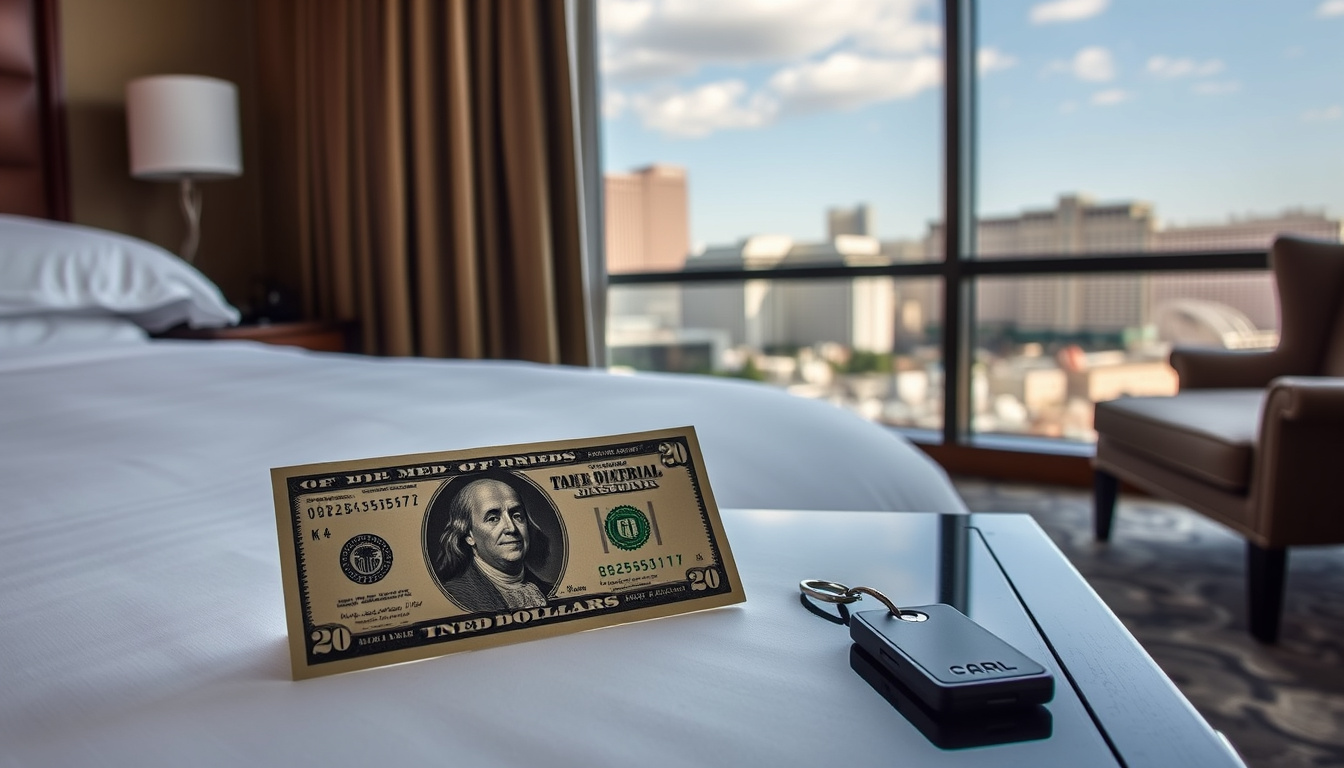
The $20 rule involves slipping a crisp $20 bill between your ID and credit card when checking in, then politely asking about complimentary upgrades. Some travel guides suggest that high-end properties may require a $50 bill instead (Metro Report – travel guide). If the upgrade is granted, no additional tip is expected, though a $5–$10 follow-up is considered classy.
The $20 sandwich trick for free drinks and perks
The $20 sandwich trick means placing a $20 bill between two $1 bills when ordering at a casino bar. Handing it to the bartender signals that you’re tipping generously up front, often resulting in faster service and stronger drinks. The exact success rate is unclear, but the tactic is widely recommended by budget travelers.
The trade-off: the $20 rule works best at off-peak times and at properties that aren’t fully booked. The sandwich trick works better at busy bars where bartenders are incentivised by immediate cash.
What Happens If You Don’t Tip in Las Vegas?
Tipping norms in Vegas
Tipping is expected for most services. Bartenders, waitstaff, housekeepers, valets, and dealers rely on tips. A typical tip is 15–20% at restaurants, $1–$2 per drink at bars, and $3–$5 per night for housekeeping. For dealers, a small bet or cash tip is appreciated (VegasNearMe – tipping guide).
Consequences of not tipping
- Poor service: Bartenders may ignore you, and housekeeping may skip your room.
- Social friction: In a city built on hospitality, not tipping is seen as rude.
- Legal issue: Not tipping itself isn’t illegal, but service charges (gratuities included on bills) are mandatory.
The pattern: tipping is part of the unwritten contract in Las Vegas. Skimping on it undermines the experience you came for.
Things to Do in Las Vegas for Less Than $100 a Day
Free attractions on the Strip
- Fountains of Bellagio – free water show every 15–30 minutes from afternoon to midnight (Visit Las Vegas – official tourism site).
- Bellagio Conservatory & Botanical Gardens – 14,000-square-foot garden that changes five times a year, free entry.
- Fremont Street Experience – free light shows and live music, with a $32 million LED upgrade (Unleash Vegas – travel guide).
- Welcome to Fabulous Las Vegas sign – the iconic photo spot, free to visit.
- AREA15 – free entry to an immersive art and entertainment district (Visit Las Vegas).
- Pinball Hall of Fame – free admission; only need quarters for gameplay.
Budget-friendly shows and restaurants
Discount show tickets can be found at Tix4Tonight booths for up to 50% off. For food, explore off-Strip diners and food courts where a full meal can cost under $10. The Downtown Container Park offers free entry and distinctive eateries (Visit Las Vegas).
What this means: you can easily fill a day without spending a dime on admission. The real cost is transport and food.
Where Is Las Vegas and Why Is It So Famous?
Location: Nevada, USA
Las Vegas is in Clark County, Nevada, in the southwestern United States. It sits in the Mojave Desert, surrounded by mountains. The Las Vegas Strip is the main tourist corridor, running just outside city limits in Paradise, Nevada.
History and reputation as Entertainment Capital
Las Vegas earned its nickname “Entertainment Capital of the World” through its concentration of casinos, luxury resorts, live shows, and nightlife. The city attracts over 40 million visitors annually (Wikipedia – Las Vegas). Its reputation is built on a unique combination of gambling, entertainment, and 24-hour accessibility.
The catch: fame comes with higher prices, but budget travelers can still enjoy the city’s core attractions by sticking to free activities and off-peak timing.
Upsides
- Many free attractions on the Strip and downtown
- The $20 rule can yield significant room upgrades without extra cost
- Budget-friendly dining options exist outside tourist zones
- Off-peak travel (spring/fall) offers low hotel rates
Downsides
- Tipping adds $30–$45 per day to your budget (VegasNearMe)
- Popular attractions like shows and buffets can be expensive
- The $20 rule doesn’t always work (success depends on occupancy)
- Cash is still needed for tipping, street performers, and small vendors
“There are plenty of free things to do in Las Vegas, including the Fountains of Bellagio, Bellagio Conservatory & Botanical Gardens, Lake of Dreams at Wynn, the Atlantis Show at Caesars, Fremont Street Experience, and Downtown Container Park.”
— Visit Las Vegas (official tourism site)
“Las Vegas has a surprising variety of completely free activities amid the Strip’s lights, fountains, shows, and music.”
— National Geographic (travel writer)
“Cash is still important in Las Vegas for tipping, gambling, street performers, club entry tips, buses, shuttles, and food trucks.”
— GetawayK (budget travel blog)
For the budget traveller, the choice is clear: plan your cash flow around free attractions, tip generously, and use the $20 rule as a low-risk gamble. Or risk paying full price for an experience that could have been much cheaper.
youtube.com, nationalgeographic.com, vegasunzipped.com, nocovervegas.com, machupicchu.org, billigasteelisverige.se
Frequently asked questions
What is the best time of year to visit Las Vegas on a budget?
Spring (March–May) and fall (September–November) offer the lowest hotel rates and pleasant weather, avoiding peak summer heat and holiday crowds.
Are there any free shows on the Strip?
Yes. The Bellagio fountains, the Mirage volcano (currently undergoing renovations), and the Fremont Street Experience light shows are all free.
Do I need to tip the hotel housekeeper?
Yes, it’s customary to leave $3–$5 per night. Housekeeping staff rely on these tips.
Can I use credit cards everywhere in Las Vegas?
Most hotels, restaurants, and shops accept cards, but cash is still needed for tipping, small vendors, and gambling.
Is it safe to carry large amounts of cash on the Strip?
It’s generally safe, but use common sense. Keep cash in your hotel safe and carry only what you need for the day.
What is the minimum drinking age in Las Vegas?
The legal drinking age is 21. Bars and casinos strictly enforce this.
How do I get from the airport to the Strip cheaply?
The RTC bus route 108/109 costs $2 and runs from McCarran Airport to the Strip. Rideshare services are also available for about $15–$20.

Oliver Jack Carter Cooper is a staff writer for EveningLedger.uk, covering UK news, politics, business and culture. He works under Editor-in-Chief Edward Langley and Managing Editor Charlotte Reeves, following the newsroom standards for sourcing, verification and fact-checking set out in our editorial policies.