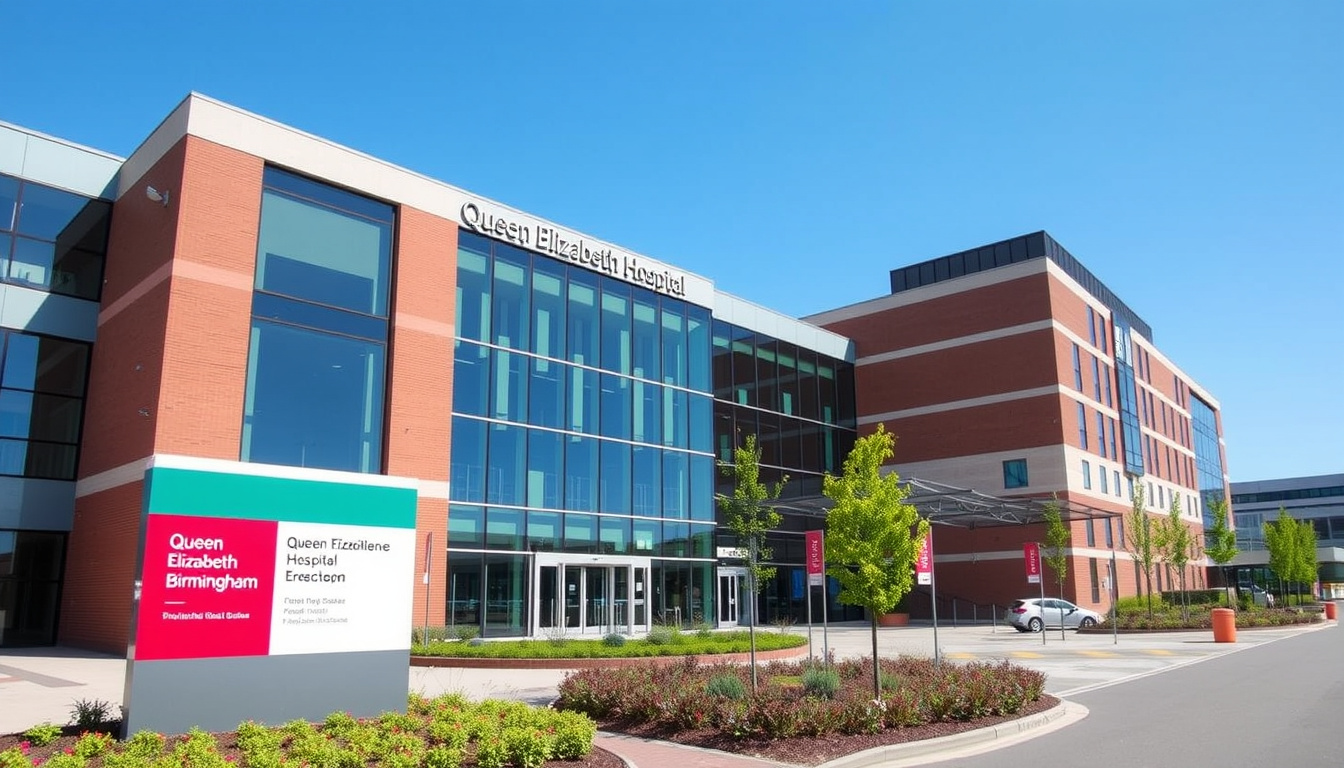
QEHB is one of the largest acute hospitals in England, with 1,215 beds, a world-record critical care unit, and a nationally recognised role in trauma, transplantation, and military medicine.
Opened: June 2010 · Operator: University Hospitals Birmingham NHS Foundation Trust · Critical Care Unit: World’s largest single-floor, 100 beds · Notable Home: Royal Centre for Defence Medicine · New Acute Hospital: Birmingham’s first in 70 years
Quick snapshot
- 1,215-bed hospital opened 16 June 2010 (Wikipedia hospital entry)
- Largest solid organ transplant programme in Europe and largest renal programme in UK (Wikipedia hospital entry)
- 100-bed critical care unit — largest single-floor unit worldwide (Wikipedia hospital entry)
- Precise national ranking position beyond oncology at world #173 (Watchdoq oncology rankings)
- Current department-by-department CQC ratings post-2024 report (Watchdoq oncology rankings)
- Patient outcome data or mortality rates for critical care (Watchdoq oncology rankings)
- 16 June 2010: Hospital opened, replacing previous Queen Elizabeth Hospital and Selly Oak Hospital (Wikipedia hospital entry)
- 8 March 2024: CQC report published following inspections in August and October 2023 (UHB NHS press release)
- UHB reports significant improvements in critical care recruitment and retention since the March 2024 CQC inspection (UHB NHS press release)
- Next CQC inspection will determine whether ratings improve from “requires improvement” (UHB NHS press release)
The table below consolidates key infrastructure and operational details sourced from hospital records and CQC documentation.
| Attribute | Detail |
|---|---|
| Full Name | Queen Elizabeth Hospital Birmingham |
| Opened | 16 June 2010 |
| Trust | University Hospitals Birmingham NHS Foundation Trust |
| Location | Mindelsohn Way, Edgbaston, Birmingham |
| Total Beds | 1,215 |
| Critical Care Beds | 100 (largest single-floor worldwide) |
| Trauma Centre | Level 1 (regional/national) |
| Special Feature | Royal Centre for Defence Medicine |
| Construction Cost | £545 million |
| MRI Scanners | 6 |
What does the Queen Elizabeth Hospital in Birmingham specialise in?
QEHB’s role goes well beyond serving Birmingham’s local population. As a designated level 1 trauma centre, it handles the most complex emergency cases across the West Midlands and beyond. The hospital also hosts the Royal Centre for Defence Medicine — the military’s lead hospital for treating personnel injured in conflict zones — which brings specialist trauma expertise back into civilian care.
Major departments and services
The hospital operates an unusually broad range of specialist departments. According to the Care Quality Commission (CQC), QEHB provides orthopaedics, general surgery, colorectal, breast, upper gastroenterology, ear, nose and throat, and maxillofacial surgery, among others. It is also England’s national specialist centre for liver, heart, and lung transplantation.
QEHB’s transplant programmes set it apart nationally: it runs the largest solid organ transplantation programme in Europe and the largest renal transplant programme in the UK, according to Wikipedia.
Trauma and critical care focus
The hospital’s 100-bed critical care unit is the largest single-floor critical care unit in the world — a point repeated in official documentation and backed by Wikipedia. Six MRI scanners and five CT scanners support its diagnostic capacity for the most complex cases.
Is Queen Elizabeth Hospital Birmingham the biggest hospital?
“Biggest” depends on how you measure it. QEHB is one of the largest single-site hospitals in the UK and is part of one of the largest teaching trusts in England, according to Wikipedia. It opened in June 2010 as Birmingham’s first new acute hospital in 70 years, replacing two older facilities.
Size and capacity compared to others
With 1,215 beds, QEHB sits near the top of UK hospital capacity charts. The construction cost of £545 million made it one of the most expensive hospital builds in the NHS at the time. However, some UK hospitals operate larger bed counts across multiple sites within the same trust.
Scale as a major regional facility
Size alone doesn’t capture QEHB’s regional significance. Its level 1 trauma centre status means it receives the most complex cases from across a wide catchment area, not just Edgbaston. The combination of scale and specialist capability — transplantation, military medicine, and critical care — places it in a distinct category among UK hospitals.
For West Midlands patients, QEHB’s scale means access to specialist services that smaller district hospitals cannot offer, including national transplant programmes and the Defence Medicine centre.
What is the ranking of the Queen Elizabeth Hospital Birmingham?
The most current official ranking comes from the Care Quality Commission, which regulates all NHS hospitals. As of its March 2024 report following inspections in August and October 2023, the overall rating for University Hospitals Birmingham NHS Foundation Trust — which includes QEHB — is “requires improvement,” according to UHB NHS.
National and international rankings
International rankings are harder to pin down. One third-party source places QEHB at world #173 for oncology, though this comes from a tier-3 source and should be treated with caution. National hospital league tables vary by specialty and methodology, and QEHB does not consistently appear in top-five positions for overall care.
The CQC’s “requires improvement” rating applies across the trust, with critical care — previously rated outstanding — now requiring improvement overall and for well-led. The safe rating for critical care also declined from good to requires improvement, the CQC report shows.
League table achievements
Previous CQC assessments noted that critical care at QEHB provided outstanding effective outcomes, focused care, and leadership. Medical Care and End of Life Care services were rated outstanding in responsiveness, per the CQC’s records. The decline in critical care ratings appears linked partly to post-COVID recovery challenges affecting the trust’s ability to meet national standards, according to the CQC report.
What is Queen Elizabeth Hospital Birmingham known for?
QEHB is best known for three things that set it apart from most UK hospitals: its role in military medicine, its transplant programmes, and its critical care capacity.
Key achievements and specialties
The Royal Centre for Defence Medicine is perhaps QEHB’s most distinctive feature — no other UK hospital houses the same military medical capability. For transplantation, the numbers are striking: QEHB handles the largest solid organ transplant programme in Europe and the largest renal programme in the UK, per Wikipedia.
“We are disappointed in the rating change for our critical care services at QEHB. Since the CQC’s inspection, there have been significant improvements with recruitment and retention.”
— University Hospitals Birmingham NHS Foundation Trust, responding to the March 2024 CQC report
Military medicine role
The Royal Centre for Defence Medicine serves military personnel injured in conflict zones, providing specialist treatment that also benefits the civilian population through knowledge transfer. This dual civilian-military role is unique among UK NHS hospitals and requires dedicated infrastructure and staffing arrangements.
Where is Queen Elizabeth Hospital Birmingham and what are its details?
QEHB is located in Edgbaston, a residential area of south Birmingham close to the University of Birmingham campus. Its postcode is B15 2GW, and the main entrance faces Mindelsohn Way. The hospital is well served by public transport from Birmingham city centre.
Address and postcode
The hospital’s official address is Mindelsohn Way, Edgbaston, Birmingham B15 2GW. For sat-nav users, the coordinates roughly correspond to the B15 postcode area in south Birmingham. Parking is available on site, though spaces can be limited during peak visiting hours.
Contact and directions
For appointments and general enquiries, the University Hospitals Birmingham NHS Foundation Trust operates a main switchboard. Patients are encouraged to use the NHS website or the trust’s own site for the most current contact details, as arrangements may change. Visitors travelling from outside Birmingham should allow extra time for city-centre traffic, which can be heavy during peak hours.
The CQC assessed 31 quality statements across safe, effective, caring, responsive, and well-led. For patients considering QEHB, the critical care rating decline warrants attention — but so does the trust’s stated commitment to recruitment and retention improvements since the inspection.
Related reading: Private Hospital Near Me
Those delving into its specialties and rankings will find the hospital’s address and departments guide invaluable for department contacts and precise location details.
Frequently asked questions
What services does Queen Elizabeth Hospital Birmingham provide?
QEHB provides the full range of acute hospital services including emergency care (level 1 trauma), critical care, general and specialist surgery, transplantation (solid organ, renal, liver, heart, lung), military medicine through the Royal Centre for Defence Medicine, cancer treatment, and diagnostic imaging including six MRI and five CT scanners.
How do I contact Queen Elizabeth Hospital Birmingham?
The main contact is through University Hospitals Birmingham NHS Foundation Trust’s switchboard. For appointment queries, use the NHS app or the trust’s official website for direct patient portal access. The hospital is located at Mindelsohn Way, Edgbaston, Birmingham B15 2GW.
What makes Queen Elizabeth Hospital Birmingham unique?
QEHB houses the Royal Centre for Defence Medicine — unique among UK hospitals — and operates Europe’s largest solid organ transplantation programme and the UK’s largest renal programme. Its 100-bed critical care unit is the largest single-floor unit worldwide.
Is Queen Elizabeth Hospital Birmingham a teaching hospital?
Yes. QEHB is part of University Hospitals Birmingham NHS Foundation Trust, one of the largest teaching trusts in England. It works closely with the University of Birmingham and provides clinical placements for medical students and postgraduate training for healthcare professionals.
What are the visiting hours at Queen Elizabeth Hospital Birmingham?
Visiting arrangements vary by ward. Patients and visitors should check the University Hospitals Birmingham NHS website or contact the ward directly for current visiting hours, as policies may differ between departments and have changed following the March 2024 CQC report.
Does Queen Elizabeth Hospital Birmingham treat military patients?
Yes. QEHB hosts the Royal Centre for Defence Medicine, which is the lead NHS hospital for treating UK military personnel injured in conflict zones. This includes specialist trauma care and rehabilitation services provided alongside civilian hospital services.
What parking options are available at Queen Elizabeth Hospital Birmingham?
On-site parking is available, though spaces can be limited during busy periods. The hospital is accessible by public transport from Birmingham city centre, with bus routes serving the Edgbaston area directly. Patients and visitors are encouraged to plan ahead for peak visiting times.
For West Midlands patients, the choice is becoming clearer: QEHB offers specialist capabilities — transplantation, trauma, military medicine — that most other regional hospitals cannot match. But the “requires improvement” rating means patients should weigh that capability against current quality concerns, particularly in critical care. The trust’s ongoing recruitment drive, documented in its response to the March 2024 CQC report, will be the key signal to watch in the next inspection.

Oliver Jack Carter Cooper is a staff writer for EveningLedger.uk, covering UK news, politics, business and culture. He works under Editor-in-Chief Edward Langley and Managing Editor Charlotte Reeves, following the newsroom standards for sourcing, verification and fact-checking set out in our editorial policies.