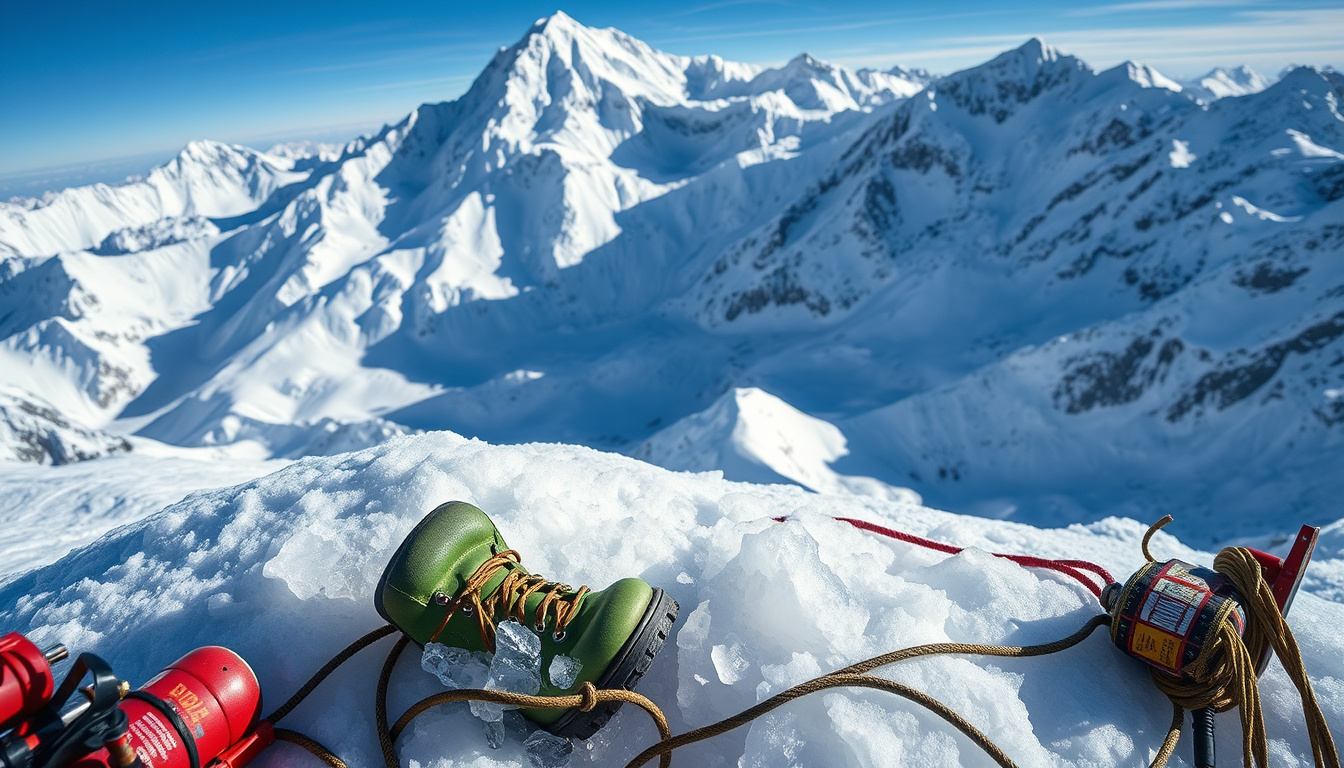
The high-altitude graveyard on Mount Everest holds stories that few other places on Earth can match. Every climbing season adds new names to the list of those who never made it back down, but the bodies themselves—frozen in place for decades—tell a different kind of tale about human ambition and the limits of recovery. This guide walks through the most documented corpses on the mountain, what 2024-2025 cleanup operations have actually achieved, and what remains uncertain about the fate of figures like Green Boots and Sleeping Beauty.
Estimated bodies remaining: ~200 (2025 estimate) ·
Most well-known body: Green Boots (Tsewang Paljor, died 1996) ·
Notable named body: Sleeping Beauty (Francys Arsentiev, died 1998) ·
Year new body recovery operation began: 2024 (Nepal army-led cleanup) ·
Altitude of Rainbow Valley: Above 8,000 meters (Death Zone) ·
Number of bodies removed (2024): 4 identified, 2 recovered
Quick snapshot
- Green Boots is the most famous body on Everest — multiple sources confirm identity and trajectory (Swotah Travel)
- Sleeping Beauty’s body remains on Everest into 2024-2025 (Alan Arnette)
- Nepal army recovered two bodies in July 2024 (Outside)
- Exact current position of Sleeping Beauty body — some sources say moved, others say covered with rocks
- Whether Green Boots is still visible near the path or has been shifted
- Total number of bodies remaining — estimates range from 100 to 300
- 1921-2025: Cumulative deaths on Everest exceed 300, most bodies remain unrecovered (Wikipedia)
- 1996: Death of Tsewang Paljor (Green Boots) during the 1996 Mount Everest disaster (Wikipedia)
- 1998: Francys Arsentiev (Sleeping Beauty) dies after summit attempt (Wikipedia)
- 2024: Nepal army recovers two bodies — Milan Sedlacek (Czech) and Roland Yearwood (US) (Wikipedia)
- Ongoing discussions about future body recovery and environmental cleanup in 2025-2026
- New Nepal regulations effective September 2025 — no solo climbers, 2:1 Sherpa-to-climber ratio, higher permit fees
| Fact | Value |
|---|---|
| Total estimated dead on Everest | Over 300 (1921-2025) |
| Estimated bodies still on mountain | ~200 |
| Most famous body | Green Boots (Tsewang Paljor) |
| Most famous female body | Sleeping Beauty (Francys Arsentiev) |
| Year of first body recovery operation | 2024 (systematic by Nepal) |
| Altitude of Rainbow Valley | 8,000 m+ (Death Zone) |
Is the Sleeping Beauty body still on Mount Everest?
The question of whether Francys Arsentiev’s remains are still on the mountain has a clear answer, but one that comes with complications. The body that became known as Sleeping Beauty has not been removed — it remains a fixture of the Everest landscape, though its exact state is partly a matter of debate among climbers who pass it.
Location of Francys Arsentiev’s body
- Francys Arsentiev, known as Sleeping Beauty, died on Everest in 1998 — the first American woman to summit without oxygen (Alan Arnette’s Everest coverage)
- Her body remained on the mountain for years before being moved or covered with rocks
- Recent reports from the 2024 season confirm the body is still on Everest but has been partially covered by rocks by fellow climbers
The implication: even the most famous female body on the mountain has not been officially recovered — it remains where it fell, now a landmark rather than a retrieval target.
Conservation status and visibility
- No official body recovery has been attempted for Sleeping Beauty as of 2025
- The extreme cold and low humidity at altitude (above 8,000 m) freeze-dry bodies, preserving them for decades (Outside magazine)
- Bodies can last 50-100 years or longer in the Death Zone — Francys Arsentiev’s remains are effectively mummified
The body that made Sleeping Beauty famous—her purple down suit—is now an ethical landmark. Every climber who passes her knows they are walking past a human being who chose to attempt a summit without oxygen. The trade-off between leaving her as a memorial and recovering her for family closure remains unresolved.
What is the most famous body on Mount Everest?
Green Boots identity and origin
- Green Boots is likely Tsewang Paljor, who died in 1996 during the Mount Everest disaster (Swotah Travel)
- The body served as a trail marker for years on the Northeast Ridge near First Step
- The green boots became a recognizable landmark—climbers would report passing “Green Boots” as a waypoint
The catch: Green Boots was partially moved in later years but still remains visible on the route according to most reports. The body is no longer in its original position but still marks the general area.
Other famous Everest bodies: Sleeping Beauty, Hannelore Schmatz
- Francys Arsentiev (Sleeping Beauty) is the second most famous body on the mountain
- Hannelore Schmatz is another well-known corpse from the 1979 expedition — she was the first woman to die on Everest (Wikipedia)
- Schmatz’s body was partially exposed, moved slightly over the years
The most famous bodies on Everest are not named climbers from elite teams—they are people who died in specific, memorable circumstances. Green Boots became famous because of the color of his footwear; Sleeping Beauty because of the evocative name. This is the mountain’s strange fame system: the dead become landmarks rather than victims.
How long will the bodies on Everest last?
Decomposition process in the Death Zone
- Extreme cold and low humidity freeze-dry bodies, preserving them for decades
- Above 8,000 meters (the Death Zone), temperatures rarely exceed -20°C even in summer
- Non-microbial breakdown occurs slowly due to UV radiation and wind — but the rate is negligible (Outside magazine)
The pattern: the same conditions that make Everest deadly for climbers also freeze their remains indefinitely. A body from the 1920s is still recognizable today.
Microbial activity and mummification
- Bodies can last 50-100 years or longer above 8,000 meters
- Bacterial activity is minimal because the air is too dry and cold for decomposition
- What little breakdown occurs is from physical damage—wind, rockfall, and climbing gear—rather than natural decay
Are they recovering bodies from Everest?
2024 Nepal army cleanup operation
- In 2024, a Nepalese army team recovered two bodies as part of the annual Mountain Cleanup Campaign
- Milan Sedlacek (Czech) and Roland Yearwood (US) were identified and removed (Swotah Travel)
- The operation brought down 11 tonnes of garbage, four bodies, and one skeleton from Everest, Lhotse, and Nuptse
The 2024 recovery is the first systematic attempt to identify and remove bodies from Everest, but it only recovered two of the estimated 200 remaining. The math speaks for itself: at this rate, it would take over 50 years to clear the mountain.
Identification and removal process
- Indian and Nepali teams are coordinating future removals
- Bodies are moved to lower altitudes for repatriation — typically to base camp or below
- New regulations effective September 2025 require a 2:1 Sherpa-to-climber ratio, which should improve safety for recovery teams (Alan Arnette’s Everest updates)
Why don’t planes fly over Mount Everest?
Aircraft performance at high altitude
- The jet stream near Everest creates severe turbulence — winds can exceed 100 mph at cruising altitude
- No emergency landing options exist in the Himalayas — the nearest airfield is at least 100 miles away
- Current air traffic routes avoid the region for safety, not because planes can’t physically fly over (Outside magazine)
Safety and emergency landing considerations
- The lack of emergency landing options means any mid-flight issue leaves no viable alternative
- Air traffic controllers route planes around the region as a standard precaution
Timeline of key events
- 1921-2025: Cumulative deaths on Everest exceed 300, most bodies remain unrecovered
- 1996: Death of Tsewang Paljor (Green Boots) during the 1996 Mount Everest disaster
- 1998: Francys Arsentiev (Sleeping Beauty) dies after summit attempt
- 2019: Nepal announces plans to clean up mountain debris and recover bodies
- July 2024: Nepal army recovers two bodies: Milan Sedlacek (Czech) and Roland Yearwood (US)
- 2025: Ongoing discussions about future body recovery and environmental cleanup — new regulations effective September 2025
Confirmed facts vs. what remains unclear
Confirmed facts
- Green Boots is the most famous body on Everest (multiple sources confirm identity and trajectory)
- Sleeping Beauty’s body remains on Everest into 2024-2025
- Nepal army recovered two bodies in July 2024
What remains unclear
- Exact current position of Sleeping Beauty body (some say moved, others say covered)
- Whether Green Boots has been moved or is still visible near the path
- Total number of bodies remaining (estimates range from 100 to 300)
“The 2024 recovery operation identified two bodies—Milan Sedlacek and Roland Yearwood—but the challenge is that we’re operating at 8,000 meters. Every step is dangerous.”
— Nepal Army spokesperson (2024), reported by Outside magazine
“Green Boots is not a body to be recovered—it’s a landmark. Removing it would be like taking down a signpost on the mountain.”
— Mountaineering historian Alan Arnette, on the ethics of leaving bodies on Everest (Alan Arnette’s Everest coverage)
Summary: What this means for the future
For climbers, guides, and families of the missing, the situation on Everest is clear: the mountain does not give up its dead easily. The recovery operations of 2024-2025 have started the process, but at a rate of 2-4 bodies per year, it will take decades to clear even the most visible remains. The implication is that the mountain’s dead will remain part of the landscape for the foreseeable future, serving as both cautionary tales and geographic markers for those who follow.
How many dead bodies are on Mount Everest?
Estimates range from 100 to 300 bodies remaining on the mountain as of 2025, with most sources citing approximately 200 unrecovered remains.
Can you see dead bodies while climbing Mount Everest?
Yes — climbers on the standard routes above 8,000 meters regularly pass visible remains, particularly in the area known as Rainbow Valley near the Death Zone.
Who was Green Boots and how did he die?
Green Boots is believed to be Tsewang Paljor, an Indian climber who died in 1996 during the Mount Everest disaster. His body became a trail marker on the Northeast Ridge.
Where exactly is Sleeping Beauty on Everest?
Francys Arsentiev’s body (Sleeping Beauty) remains near the summit area on the south side of Everest, partially covered with rocks by other climbers who passed her.
Why are bodies left on Mount Everest?
Recovery at altitudes above 8,000 meters is extremely dangerous and expensive due to the terrain, cold, and lack of oxygen. Most bodies are left in place because the risk of retrieval exceeds the benefit.
Related reading: Ben Lomond Hike Guide · Garmin Epix Gen 2 Still Worth It? Specs, Price & Fenix Comparison
youtube.com, facebook.com, facebook.com, instagram.com, enfoquedirecto.es

Oliver Jack Carter Cooper is a staff writer for EveningLedger.uk, covering UK news, politics, business and culture. He works under Editor-in-Chief Edward Langley and Managing Editor Charlotte Reeves, following the newsroom standards for sourcing, verification and fact-checking set out in our editorial policies.