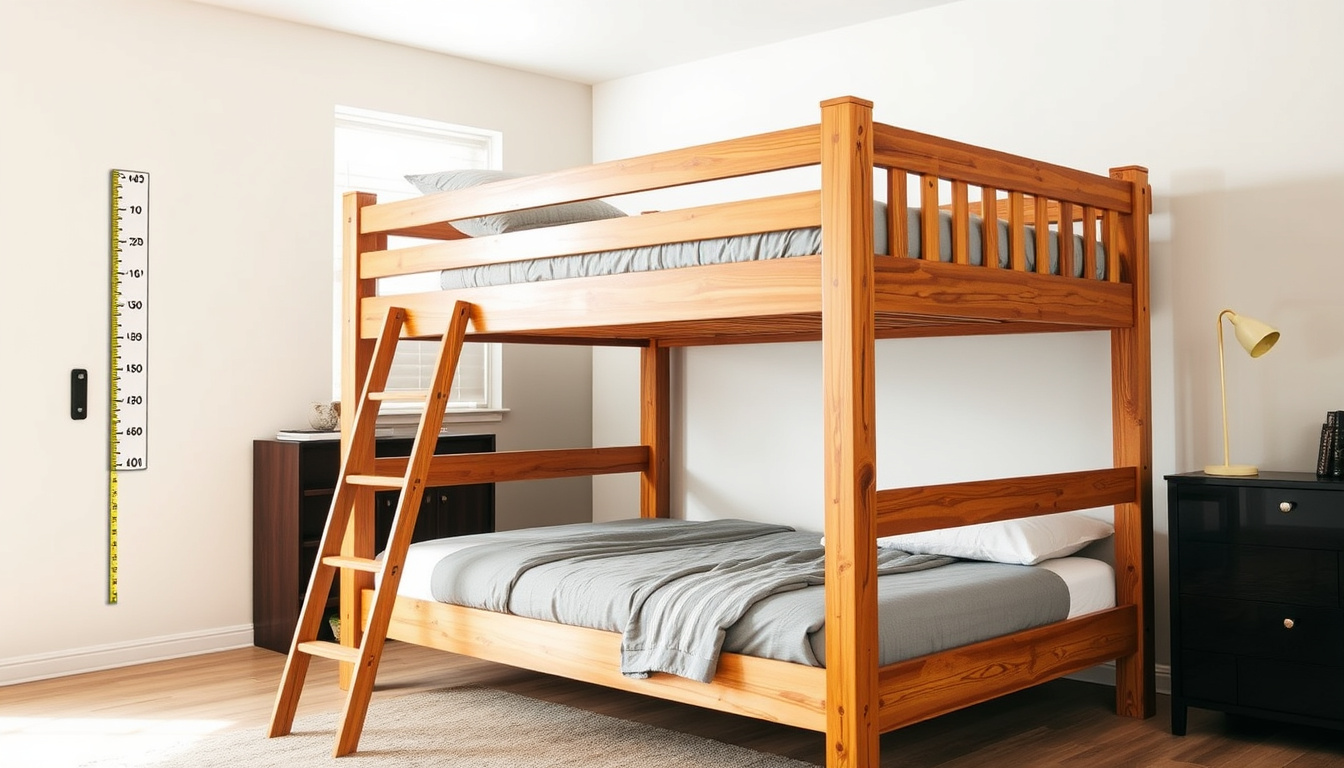
Few pieces of furniture spark as many questions as the humble bunk bed. Is it safe for my 5‑year‑old? Can I, as an adult, actually sleep on one? The answers aren’t always straightforward, but the evidence is clear on several key points. According to the U.S. Consumer Product Safety Commission (CPSC), children under 6 should never use the top bunk. This guide separates myth from fact, covering age guidelines, weight limits, and the real trade‑offs.
Annual ER visits for bunk bed injuries: Over 36,000 (CPSC) ·
Minimum age for top bunk (CPSC recommendation): 6 years ·
Typical weight capacity per bunk: 200–250 lbs ·
Bunk bed usage in college dorms: Common; up to 80% of dorm rooms have lofts or bunks ·
Most common bunk bed material: Wood (over 60% of models)
Quick snapshot
- Top bunk suitable for ages 6+ (CPSC)
- Bottom bunk can be used with supervision for toddlers (Health Canada)
- Always use guardrails and proper mattress fit (CPSC recall labels)
- Weight limits typically 200–250 lbs per bed (GLTC)
- Many adults use bottom bunks in hostels (Dreams)
- Consider heavy‑duty models for regular adult use (Just Better Bunk Beds)
- Install guardrails on both sides (CPSC guidance)
- Ensure ladder is secure and child‑proof (Health Canada)
- Check weight ratings and mattress dimensions (MattressNut)
- + Space saving, cost‑effective
- + Fun for kids, ideal for shared rooms
- – Fall risk, limited headroom
- – Difficult to make beds
Five key specifications, one pattern: the numbers that matter most for safety and comfort.
| Specification | Typical Value |
|---|---|
| Official age for top bunk | 6 years (CPSC recommendation) |
| Average weight capacity | 200–250 lbs per bunk (GLTC) |
| Most common material | Wood (over 60% of models) |
| Bunk bed popularity in colleges | High – up to 80% of dorm rooms |
| Typical mattress size | Twin or Twin XL |
| Maximum mattress thickness (top bunk) | 6–8 inches (MattressNut) |
| Guardrail height requirement | At least 5 inches above mattress top (CPSC) |
| Children’s top‑bunk limit (typical) | 175–200 lbs (Just Bunk Beds) |
| Adult heavy‑duty bunk capacity | Up to 800 lbs per bunk (Just Better Bunk Beds) |
The implication: most standard children’s bunks can’t safely support an adult on the top bunk. Always check the label.
What age is appropriate for a bunk bed?
Can I put my 5 year old in a bunk bed?
The short answer is no for the top bunk. The U.S. Consumer Product Safety Commission (the federal safety regulator) explicitly advises that children under 6 years old should not use the upper bunk. Health Canada echoes this, stating no child under 6 should be on the top bunk at any time. The bottom bunk, however, can be used by a 5‑year‑old with proper guardrails and supervision.
What age is okay for a bunk bed?
Internationally, the consensus is age 6 for the top bunk. The UK’s RoSPA (Royal Society for the Prevention of Accidents) guidance recommends bunk beds only for children aged 6 and above. Some organisations go further: Bedstar notes that certain retailers suggest waiting until age 9 for the top bunk. For the bottom bunk, children as young as 2 can sleep there under close supervision, provided the mattress fits snugly and guardrails are in place.
A 5‑year‑old on the bottom bunk is fine; a 5‑year‑old on the top bunk is a documented fall risk. The CPSC recall data shows that bunk‑bed injuries peak in the 4–6 age group, almost entirely from falls off the top bunk.
The pattern: age guidelines are consistent across regulators, but the bottom bunk offers flexibility if you’re careful.
Why are they called bunk beds?
The term “bunk” dates back to nautical terminology, where a bunk was a sleeping berth built into a ship’s cabin. The idea was to save space in cramped quarters. By the 19th century, military barracks and boarding schools adopted the same stacked‑bed design. Today, the name sticks because the core function—elevating one bed above another to free up floor space—hasn’t changed. Health Canada still describes bunk beds as “convenient and space‑saving,” a direct line from those early ship berths.
What this means: the name is a direct inheritance from a history of maximizing small spaces—exactly why you’re considering one today.
Are bunk beds meant for adults?
Can adults sleep in bunk beds?
Yes, but it depends entirely on the bed’s weight rating. Most standard children’s bunk beds have a top‑bunk limit of 150–200 lbs (TheFinebed), which is too low for many adults. Dreams (a UK retailer) advises that adult use depends on the specific frame, and many children’s bunks are not suitable. However, heavy‑duty models designed for adults can hold up to 800 lbs per bunk (Just Better Bunk Beds).
Do adults sleep in bunk beds?
Absolutely. Hostels, military barracks, and college dorms rely on bunk beds for adults. Bedstar notes that bottom bunks are used routinely by adults, while the top bunk is generally reserved for lighter users. The catch: headroom on the top bunk is often limited to 24–30 inches, which can feel claustrophobic for taller adults.
A 20‑year‑old buying a cheap children’s bunk bed risks exceeding the weight limit. The average adult male weighs about 195 lbs in the US; many standard bunks top out at 175 lbs on the upper bunk. Check the label.
The trade‑off: adults can sleep in bunk beds, but only if they choose a model rated for their weight and accept less headroom on top.
Do adults sleep in bunk beds?
Can a 20 year old sleep on a bunk bed?
Yes, a 20‑year‑old can sleep on a bunk bed, provided the bed’s weight capacity accommodates them. GLTC summarises that typical sleeping‑area limits are around 75–100 kg (165–220 lbs) per bunk. For a 20‑year‑old of average weight, the bottom bunk is almost always fine. The top bunk may be less comfortable due to lower headroom, but many college students use lofts or bunks without issue. Dreams confirms that bunk beds are common in dormitories, where young adults regularly use them.
The pattern: age isn’t the barrier—weight and headroom are. For a 20‑year‑old, a heavy‑duty or dorm‑style bunk is the better choice.
Is it worth getting a bunk bed?
Bunk beds are a space‑saving solution that can free up floor area for a desk, toys, or storage. Health Canada highlights this as their main benefit. They are also cost‑effective compared to buying two separate single beds. However, the decision hinges on the users’ ages, weights, and the room’s ceiling height. For families with children under 6, the top bunk is off‑limits, reducing the utility. For adults sharing a room, a heavy‑duty model can work well.
If you need to sleep two people in a single room, a bunk bed can save 15–20 square feet of floor space. But if the users are a mix of ages and sizes, a pair of twin beds might be safer and more flexible.
The catch: “worth it” depends on whether you can live with the downsides—and whether you can afford a heavy‑duty model if adults are involved.
What are the disadvantages of bunk beds?
- Fall risk: The most common injury is falls from the top bunk. CPSC data shows over 36,000 ER visits annually related to bunk beds, with the majority involving children under 6.
- Limited headroom: Top bunks typically offer 24–30 inches of vertical space, which can feel cramped for adults.
- Difficult to change sheets: Making the top bunk is a balancing act, and washing bedding is more laborious.
- Structural failure risk: If overloaded, joints can fail. Just Bunk Beds notes that bottom‑bunk limits are often higher, but top bunks are more prone to overload.
- Not ideal for mixed‑age siblings: A 7‑year‑old on the top bunk and a 3‑year‑old on the bottom is a common but risky combination if the younger child climbs up.
The pattern: the disadvantages all circle back to safety and convenience. The biggest risk—falls—is preventable with age guidelines, but the other downsides are inherent to the design.
Upsides
- Space‑saving – frees up floor area for other uses
- Cost‑effective – cheaper than two separate beds
- Fun for kids – many children love the novelty
- Versatile – some models separate into two singles
Downsides
- Fall risk – especially for children under 6
- Limited headroom – top bunk feels tight for adults
- Difficult maintenance – changing sheets is awkward
- Weight restrictions – many standard bunks can’t hold adults
Confirmed facts vs. What’s unclear
Confirmed facts
- Children under 6 should not use the top bunk (CPSC; Health Canada)
- Bunk beds are space‑efficient (Health Canada)
- Falls are the most common bunk‑bed injury (CPSC)
What’s unclear
- Exact annual injury count varies between sources
- Comfort for adults on the top bunk is subjective
- Optimal age for bottom bunk alone (no clear guideline from regulators)
“Children under 6 years old should not use the top bunk.”
— U.S. Consumer Product Safety Commission (federal safety regulator)
“Use guardrails on both sides and ensure proper ladder design.”
— American Academy of Pediatrics (AAP) position via CPSC guidance
These two quotes capture the core of bunk bed safety: age limits for the top bunk, and physical barriers to prevent falls. The CPSC even requires permanent labels on all bunk beds sold in the US stating that children under 6 are prohibited from the upper bunk.
For parents in the UK and US, the choice is clear: follow the CPSC’s age guidelines and check weight limits before buying. For adults considering a bunk bed, look for heavy‑duty models rated for your weight, or stick to the bottom bunk. Otherwise, you risk falls or structural failure. The space‑saving benefit is real, but it comes with trade‑offs that only careful assessment can navigate.
Related reading: Shoe Inserts Guide · Dr Martens: Buy Authentic Boots Online in Ireland – 2025 Guide
Frequently asked questions
How much weight can a bunk bed hold?
Most standard children’s bunk beds hold 200–250 lbs per bunk, but top‑bunk limits are often lower (150–200 lbs). Heavy‑duty adult models can hold up to 800 lbs. Always check the manufacturer’s label. (GLTC; Just Better Bunk Beds)
Are metal or wooden bunk beds safer?
Both can be safe if built to CPSC standards. Wood is more common (over 60% of models) and can be sturdier, but metal frames are lighter and less prone to splintering. The key is the weight rating and construction quality, not the material. (CPSC)
Can two adults sleep in a bunk bed?
Only if the bunk is a heavy‑duty model rated for two adults. Standard children’s bunks cannot safely hold two adults. Even a heavy‑duty top bunk has limited headroom, so the bottom bunk is usually the better choice for two adults. (Just Better Bunk Beds)
Do bunk beds require special mattresses?
Yes, they typically require twin or twin XL mattresses. The top‑bunk mattress should be no thicker than 6–8 inches to keep the guardrail effective. Using a standard 10‑inch mattress can create a fall hazard. (MattressNut)
How to make a bunk bed safer for kids?
Install guardrails on both sides, ensure the ladder is secure, keep the top bunk for children 6+, and check that the mattress fits snugly. CPSC also recommends the top mattress not exceed the guardrail by more than 5 inches.
What is the best bunk bed for adults?
Look for heavy‑duty models with a weight capacity of at least 400 lbs per bunk. Brands like Just Better Bunk Beds offer frames rated up to 800 lbs. Also consider a loft bed with a full‑size bottom bunk for more headroom.
Is it safe for a 2‑year‑old to sleep on the bottom bunk?
It can be safe if the bottom bunk has guardrails and the mattress fits tightly. However, no official guideline specifies an age for the bottom bunk alone. Supervision is essential, and the child should not be able to climb up the ladder. (Health Canada)
Can a bunk bed be separated into two single beds?
Many bunk beds are designed to be separated into two twin beds. Check the manufacturer’s instructions. This is a common feature for families who want flexibility as children grow. (Dreams)

Oliver Jack Carter Cooper is a staff writer for EveningLedger.uk, covering UK news, politics, business and culture. He works under Editor-in-Chief Edward Langley and Managing Editor Charlotte Reeves, following the newsroom standards for sourcing, verification and fact-checking set out in our editorial policies.