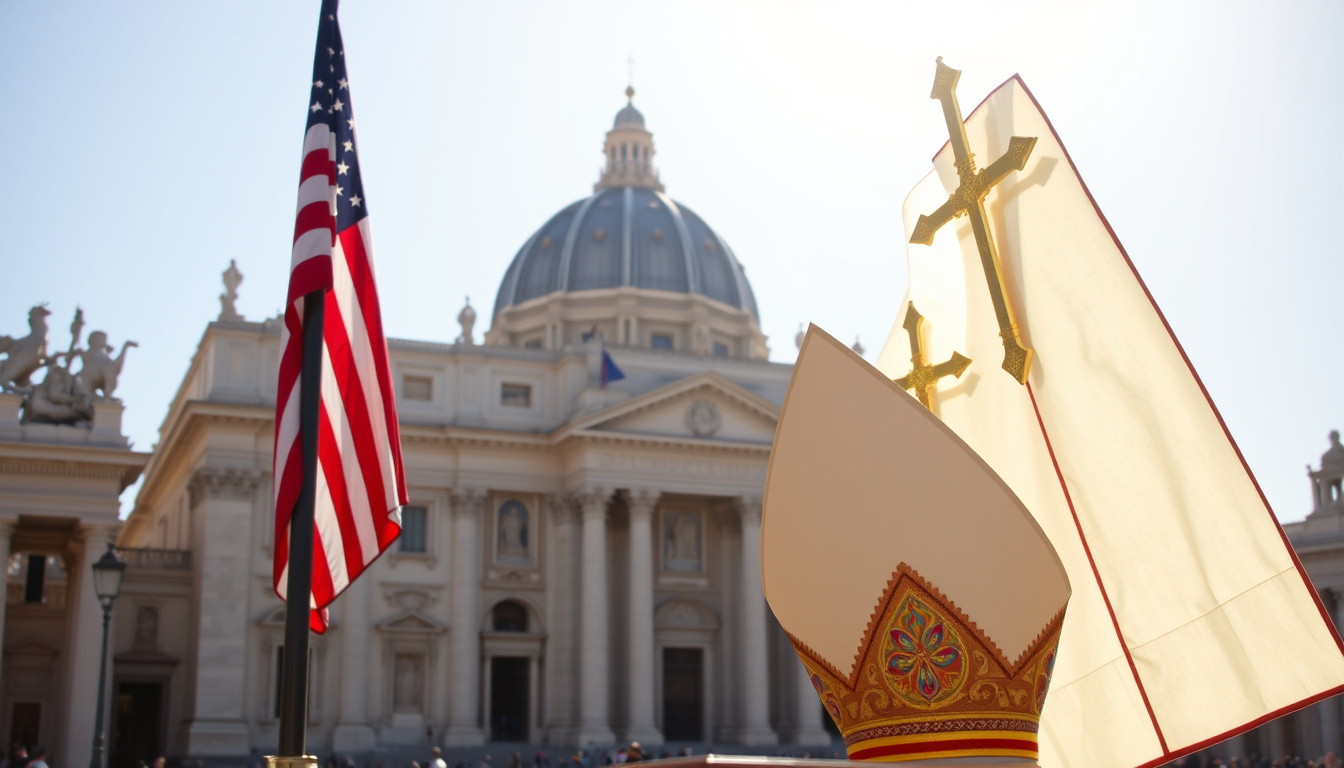
Watching the white smoke curl into a Roman sky on May 8, 2025, the College of Cardinals elected an American—Robert Francis Prevost, a Chicago-born Augustinian who took the name Leo XIV. This piece lays out the verified biographical details, the swift election timeline, and the historical significance of his papacy, drawing from Vatican sources and major news organizations.
Papal name: Leo XIV | Secular name: Robert Francis Prevost | Born: September 14, 1955, Chicago, Illinois, USA | Elected pope: May 8, 2025 | Nationality: American | Religious order: Augustinians (first Augustinian pope)
Key Facts at a Glance
- Religious order: Augustinians (first Augustinian pope) Vatican News
- Nationality: American Vatican
- Parents: Louis Marius Prevost (father) and Rose Marie Prevost (mother) Vatican
| Fact | Detail | Source |
|---|---|---|
| Birth name | Robert Francis Prevost | Vatican |
| Date of birth | September 14, 1955 | Vatican |
| Place of birth | Chicago, Illinois, USA | Vatican |
| Nationality | American | Vatican |
| Religious order | Augustinians (first Augustinian pope) | Vatican News |
| Papal name | Leo XIV | Vatican |
| Election date | May 8, 2025 | Reuters |
| Predecessor | Pope Francis | AP News |
| Parents | Louis Marius Prevost and Rose Marie Prevost | Vatican |
The Man: From Chicago to Chiclayo
What is Pope Leo XIV’s real name?
Before he was the Bishop of Rome, Robert Francis Prevost was just a kid from the Midwest. Born on September 14, 1955, in Chicago, Illinois, to Louis Marius Prevost and Rose Marie Prevost, he grew up in a devout Catholic family with deep roots in the city’s parish life (Vatican). His path to the priesthood wasn’t the typical “altar boy to bishop” pipeline you might imagine for a future pope.
What is Pope Leo XIV’s nationality and background?
He is the first pope born in the United States, making his nationality a historic first. He spent much of his career in Peru, giving him a unique background as both an American and a missionary from the global South. His parents were of French heritage (Vatican).
A Foundation in Mathematics
When he entered the Order of St. Augustine, he brought a sharp analytical mind that would later define his pastoral approach. He attended Villanova University, where he earned a degree in mathematics in 1977, a rare academic background for a prelate (Catholic Apostolate Center).
Decades in the Trenches
The real formation, though, happened far from the ivory tower. He was sent as a missionary to Peru in the 1980s, serving in the challenging diocese of Chiclayo. For years, he worked directly with the poor, learning the realities of Latin American Catholicism. His role evolved from simple priest to bishop, and eventually, he was made the Archbishop of Chiclayo, a position that placed him at the center of a fast-growing but pastorally demanding region (Vatican News).
The implication: His firsthand experience in Peru gives him credibility with the global South cardinals and a unique perspective on the church’s challenges.
“He is the first pope from the United States, and his election signals a shift toward the global periphery.” – Vatican News (source)
The Unlikely Road to the Throne
What is Pope Leo XIV known for?
The 2025 conclave was supposed to be a tight race with no clear frontrunner, but history was made when the cardinals turned to Prevost. He was elected on the second day of the conclave, May 8, 2025, and chose the name Leo XIV to signal a pontificate focused on doctrine and clear teaching, a nod to the great Doctor of the Church, St. Leo the Great (Vatican).
A Lightning-Fast Rise
His ascent is breathtaking precisely because it was so fast. Here is the timeline of the last three years:
He was consecrated a bishop in 2015 for Chiclayo. But the pivotal moment came in 2023 when Pope Francis appointed him to head the Congregation for Bishops. Then, on November 30, 2024, he was made a cardinal. That’s the full extent of his “cardinalate” resume before walking into the Sistine Chapel as a papal elector. The cardinals saw in him a man who understood the modern episcopacy, not from a desk in Rome, but from the trenches.
The same man who was a bishop in a poor Peruvian diocese for a decade was running the Vatican’s most powerful curial office just two years later.
This is a classic case of the papacy bypassing the “usual” diplomatic checkpoints. Most popes in the 20th and 21st centuries were either long-time curial insiders or archbishops of major global cities. Leo XIV was neither. He was a bishop who had a front-row seat to the problems of the Church in the developing world, and that pastoral scar tissue is precisely what the conclave sought.
The break with tradition is stark. Compare his profile to Pope Benedict XVI, a theologian; Pope John Paul II, a philosopher and playwright; or Pope Francis, a Jesuit general. Leo XIV is a pastor-administrator with a head for numbers and a heart for the poor, a potent combination in a leadership vacuum. The cardinals didn’t just pick a pope; they picked a manager who knows what it’s like to be the last one in the room to get a memo.
The pattern: This choice reflects the conclave’s desire for a reformer with hands-on experience in the global South.
“The election was a surprise choice, but it makes sense given the need for a pope who understands the challenges of the developing world.” – Reuters (source)
Firsts and the Weight of History
Being “first” comes with a burden, and Pope Leo XIV carries several weighty distinctions. Most obviously, he is the first U.S.-born pontiff (Vatican). This is a seismic shift for a church whose center of gravity has been European for nearly two millennia.
More Than Just an American
Before the world labeled him “the American pope,” he was defined by his religious order. He is the first Augustinian to become pope. This is significant because the Order of St. Augustine was born from the very heart of the Church’s intellectual tradition and a desire for deeper community. His previous role as the prior provincial of the Midwest Augustinian province before becoming a bishop gave him a unique perspective on religious life (Vatican News). He carries that Augustinian emphasis on community and internal transformation into a church that desperately needs structural reform.
The global and historical implications are massive. For the first time in history, the Bishop of Rome is a citizen of the world’s sole superpower, yet he is the product of the Church of the Global South, having spent his ministry in Peru. This creates a fascinating tension: he represents the nation that is often seen as the engine of global capitalism, yet he comes from a religious tradition that prioritizes the preferential option for the poor.
Vatican News explicitly noted the historic nature of his election, calling him the second Roman Pontiff from the Americas after Pope Francis (Vatican News). But he is not just a second Latin American pope; he is the first from the United States, a country with a powerful and often divergent Catholic culture.
What this means: The historic firsts create both opportunities and tensions for his papacy.
“Leo XIV is the second Roman Pontiff from the Americas, but the first from the United States, a milestone for the Western Hemisphere.” – Vatican News (source)
The Man Behind the Mitre
What is Pope Leo XIV’s education?
Given the lightning speed of his election, the public is naturally curious about the personal details—the things that make him human. Here’s what we know from the initial biographical dossiers.
Family and Name
His parents, Louis and Rose Prevost, raised a family of devout Catholics. The question of siblings is one that has floated around social media, but the official biographies from the Vatican do not list any siblings, leading to the assumption that he is likely an only child, a fact that shapes his inward-looking spirituality. The choice of his papal name, Leo XIV, is also a strong tell. He explicitly stated he chose it to honor the early Church’s defence of orthodoxy, a signal that his papacy will be firmly anchored in doctrinal continuity.
Education’s Role
His mathematics degree from Villanova is more than just a footnote. In a church where most clerics study philosophy and theology, Leo XIV’s background in mathematics sets him apart. It suggests a mind that values logic, precision, and problem-solving. It’s a hint of the management style he will bring to the Vatican bureaucracy—a challenge he has already tackled as head of the Bishops’ Congregation.
Here is a small table to frame the key differences we are seeing:
This comparison highlights the shift in papal profile from theological to administrative.
| Dimension | Pope Francis (2013) | Pope Leo XIV (2025) |
|---|---|---|
| Nationality | Argentine | American |
| Formation | Jesuit, theologian | Augustinian, mathematician |
| Path to Papacy | Archbishop of Buenos Aires | Bishop of Chiclayo, Curia head |
| Primary Profile | Pastor of the periphery | Missionary-bishop turned prefect |
The takeaway is clear: this is a different kind of pope for a different era. He is not a deep theologian like Benedict, nor a political operator like John Paul, nor a radical pastor like Francis. He appears to be a systematic administrator.
The catch: This data-driven approach could either streamline Vatican operations or alienate traditionalists accustomed to theological nuance.
The Vatican has not formally confirmed whether Pope Leo XIV has any siblings. The assumption of being an only child is based on the absence of siblings in official biographies.
What This Papacy Signals
Leo XIV steps into the Shoes of the Fisherman at a moment of deep uncertainty. The Church is bleeding attendance in the West, facing a credibility crisis, and navigating the geopolitical tensions of a multipolar world. His election is a response to those specific challenges.
A Pope for Administration
The cardinals didn’t choose a superstar; they chose a fixer. His primary job will be to clean up the financial scandals and clerical sexual abuse cases that have plagued Rome. His role as head of the Congregation for Bishops gives him the unenviable job of disciplining wayward prelates. This is a man who has been the “bad cop” for the Vatican, and now he’s in the top job.
But the deeper signal is about globalization. The Church is no longer a European institution with global outposts; it is a global institution with European roots. Leo XIV is the perfect symbol of this: a white, English-speaking American in a church of the Global South. He is the bridge between the central authority and the missionary frontier.
The coming months will be telling. Will he focus on internal reform or external evangelization? His first encyclicals and the appointments to his inner circle will speak volumes. He has promised a “clear proclamation of the Gospel” and is expected to use his administrative muscle to bring order to the Vatican’s opaque financial systems.
The implication: If successful, his managerial approach could set a new standard for future papacies.
“Leo XIV is the first Augustinian pope, bringing a tradition of community and internal reform to a church in need of structural change.” – Augustinians (source)
en.wikipedia.org, vatican.va, catholicregister.org, en.wikipedia.org, vaticannews.va
Frequently Asked Questions
Who is Pope Leo XIV?
He is Robert Francis Prevost, an American Augustinian bishop who was elected as the 267th pope of the Catholic Church on May 8, 2025. He is the first U.S.-born pope in history.
Why is he called Leo XIV?
He chose the name Leo XIV to honour the tradition of Pope Leo the Great, signalling a pontificate dedicated to the defence of Christian doctrine. It also precedes the famous Leo XIII, who was a great social reformer.
Did Pope Leo XIV have any siblings?
Official Vatican biographies do not list any siblings, so it is generally understood that he is likely an only child, though this is not formally confirmed in all sources.
Is Pope Leo XIV an American citizen?
Yes, he was born in Chicago, Illinois, and is a United States citizen. He spent many years as a missionary and bishop in Peru, but he retains his American nationality.
What did he do before becoming pope?
He was a missionary in Peru for decades, eventually serving as the Archbishop of Chiclayo. Before that, he led the Augustinian order in the Midwest and held a degree in mathematics from Villanova University.
How is he the second pope from the Americas?
Pope Francis, the 266th pope, was from Argentina in South America. Leo XIV is the second, but the first from North America (United States). This marks a historic double for the Western Hemisphere.
Pope Leo XIV is, at once, an American leader of a global religion and a missionary product of the global South. This is the central paradox that will define his reign.
Related Reading
For more context on the timeline and the challenges he faces, you may find these resources helpful.
- Reuters live coverage of the conclave
- Britannica biography of Leo XIV
- Tim Berners-Lee: The Web’s Creator and Digital Rights Champion
- Katherine Johnson: Biography and Hidden Figures Facts

Oliver Jack Carter Cooper is a staff writer for EveningLedger.uk, covering UK news, politics, business and culture. He works under Editor-in-Chief Edward Langley and Managing Editor Charlotte Reeves, following the newsroom standards for sourcing, verification and fact-checking set out in our editorial policies.