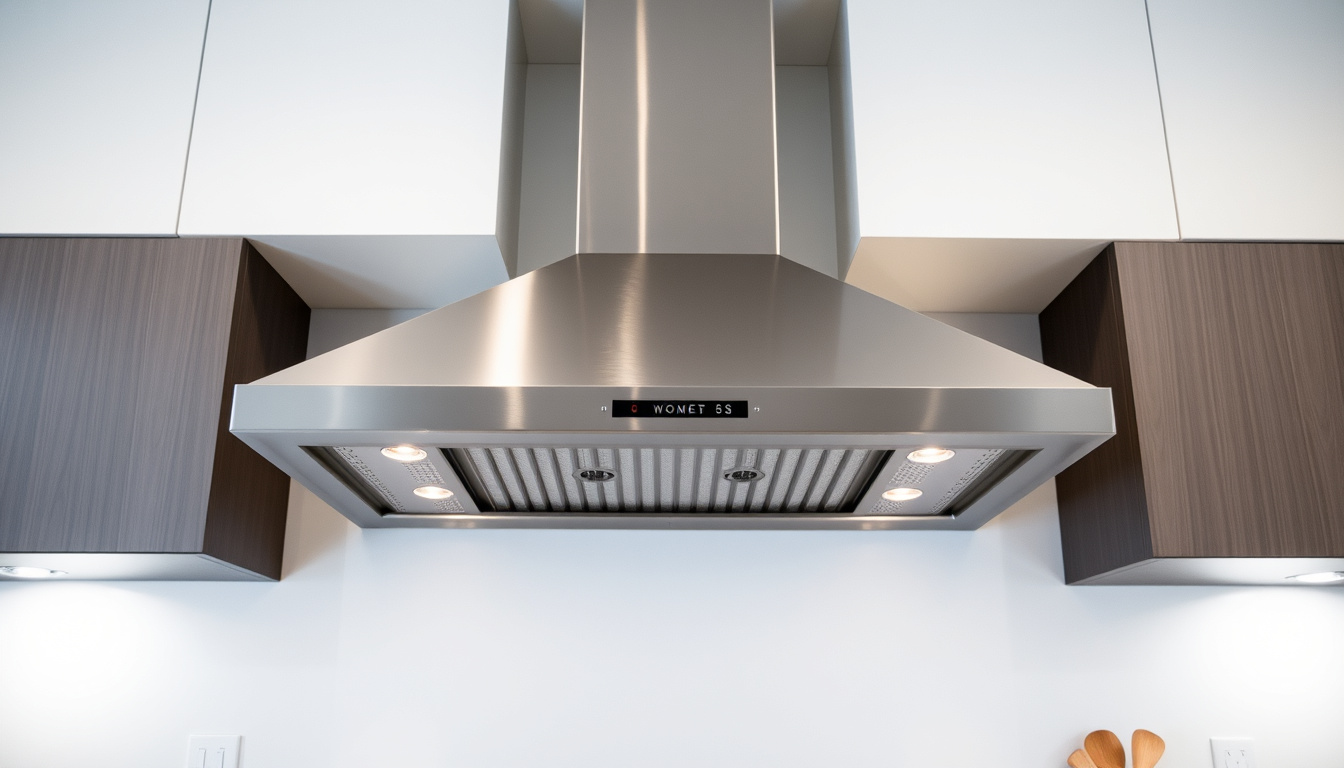
If you’ve ever cooked a stir-fry and watched the kitchen fill with steam, you already know why a cooker hood matters. This guide cuts through the marketing noise to help you match your hood’s extraction power to your kitchen size and cooking habits — covering venting, installation, and choosing between ducted and recirculating models.
Common widths: 60 cm, 90 cm ·
Typical airflow: 400 – 600 m³/h ·
Noise level: 40 – 60 dB ·
Installation height above hob: 65 – 75 cm ·
Power requirement: 230 V, 50 Hz
Quick snapshot
- Removes grease, smoke, steam, and odours (Which? (UK consumer watchdog))
- Improves kitchen air quality and reduces condensation (Bosch Home Ireland (appliance manufacturer))
- Available in ducted or recirculating models (NeutraTest (specialist testing lab))
- Ducted hoods vent outside for maximum effectiveness (Consumer Reports (US product testing organization))
- Recirculating hoods use charcoal filters (Bosch Home Ireland)
- Wall venting is a common ducted installation (NEFF installation manual (appliance manufacturer))
- Professional electrician needed for hardwiring (Which?)
- Correct height above hob: 65–75 cm (NEFF installation manual)
- Fused spur may be legally required (Appliance Reviewer (UK home appliance blog))
- Top picks: Bosch, Miele, Beko, AEG (Appliances Expert (review aggregator))
- Consider extraction power and noise level (Bosch Home Ireland)
- Warranty and filter replacement costs matter (Consumer Reports)
The table below sums up the key specifications every buyer should know.
| Specification | Typical Value / Guideline |
|---|---|
| Average extraction rate | 400 – 600 m³/h |
| Common widths | 60 cm, 90 cm |
| Noise level | 40 – 60 dB |
| Installation height | 65 – 75 cm above hob |
| Power source | 230 V, 50 Hz, hardwired or plug-in |
| Width rule | At least as wide as the hob |
| Height over gas cookers | Minimum 70 cm |
| Filter type | Grease filter (metal or mesh) + optional charcoal filter for recirculation |
What does a cooker hood do?
A cooker hood draws airborne grease, smoke, steam and odours away from your hob, improving air quality and reducing condensation on walls and cabinets. Which? explains that the hood’s fan pulls air through a grease filter, trapping particles before either venting the air outside or passing it through a charcoal filter and recirculating it.
How does a cooker hood work?
- Air enters through the bottom of the hood, passes a grease filter that captures large particles.
- In ducted mode, the air is pushed through ducting to the outside. In recirculating mode, a charcoal filter absorbs odours before the air is released back.
- The fan speed and noise vary by model; typical airflow ranges from 400 to 600 m³/h.
What are the types of cooker hoods?
- Chimney (canopy) hoods – mounted on the wall above the hob, vented or recirculating.
- Island hoods – suspended from the ceiling for cooktops on an island.
- Integrated hoods – built into the cabinet above the hob, often retractable.
- Downdraft hoods – rise from the counter behind the hob, ideal for islands without ceiling access.
Do all cooker hoods need to be vented outside?
No — but the answer depends on your kitchen. Ducted hoods are almost always preferred by building codes and appliance manufacturers because they remove moisture and odours completely. Recirculating hoods are a legitimate alternative when external ducting is impossible, such as in flats or kitchens without an outside wall.
What is the difference between ducted and recirculating hoods?
Here is a direct comparison of the two approaches.
| Feature | Ducted | Recirculating |
|---|---|---|
| Effectiveness | 100% removal of moisture and odours | Odour reduction only (charcoal filter) |
| Installation complexity | Requires ductwork and wall/roof penetration | Simpler, no external vent needed |
| Filter maintenance | Grease filter only (clean monthly) | Grease filter + charcoal filter (replace every 3–6 months) |
| Energy efficiency | Loses heated/cooled air | Retains indoor temperature |
| Cost | Higher installation cost | Higher ongoing filter cost |
Five key differences, one pattern: ducted wins on performance, recirculating wins on convenience. Consumer Reports notes that ducted hoods are “significantly more effective” for heavy cooking.
Can I vent my cooker hood through the wall?
Yes — wall venting is the most common method for ducted hoods. The NEFF installation manual describes marking a vertical centre line, drilling holes, and fixing the mounting bracket before connecting the ducting to a wall outlet. Ensure the duct is as short and straight as possible to maintain airflow.
Does a cooker hood have to be on an outside wall?
Only if you choose a ducted model. For recirculating hoods, the hood can be mounted anywhere — even on an island. However, if you later decide to convert to ducted, you’ll need access to an outside wall or roof.
If you cook often with oil or high heat, ducted is worth the extra installation cost. For occasional light cooking, a recirculating model with a quality charcoal filter can keep your kitchen fresh without major renovation.
Which is better, a cooker hood or extractor fan?
Cooker hoods and extractor fans serve the same purpose but differ in positioning and effectiveness. A cooker hood sits directly above the hob, capturing grease and smoke at the source. An extractor fan is ceiling-mounted and pulls air from the whole room, which is less targeted.
What are the pros and cons of cooker hood vs extractor fan?
Upsides
- Cooker hood: captures grease at hob level, reduces cleaning of walls and ceilings
- Extractor fan: cheaper, quieter, and simpler to install in existing homes
Downsides
- Cooker hood: can be noisy, requires ducting or filter changes
- Extractor fan: less effective at removing grease, may leave residues on surfaces near the hob
Is there an alternative to a cooker hood?
Yes. Downdraft hoods rise from the counter behind the hob and are popular for island kitchens without a ceiling mount. Another option is a combination microwave-hood, which saves space but provides less extraction power. Bosch Home Ireland notes that downdraft systems are best for light cooking due to their lower airflow.
“Cooker hoods are designed to clean up your kitchen environment by removing airborne grease, smoke, steam and odour whilst you cook.”
— DID Buying Guide (UK appliance retailer)
Do you need an electrician to fit a cooker hood?
It depends on the model. Plug-in hoods can be installed by a competent DIYer. Hardwired units require a qualified electrician to comply with UK wiring regulations. The Bosch PDF installation manual (appliance manufacturer) warns that the mains cable must not be trapped during installation.
Can I install a cooker hood myself?
- If your model has a plug and the existing socket is within reach, yes — you can mount the hood and plug it in.
- If hardwiring is required, the hood must be connected to a fused spur. Appliance Reviewer advises that only a Part P registered electrician should do this.
- Always follow the manufacturer’s height and clearance specifications.
Does a cooker hood need a fused spur?
In the UK, a cooker hood that is hardwired must be connected via a fused spur or a switched fused connection unit. This is a legal requirement under Part P of the Building Regulations. Plug-in models (with a 13A fuse) are fine as long as the socket is accessible.
Should a cooker hood touch the ceiling?
No. Most hoods have a telescopic flue that can be adjusted to meet the ceiling, but the hood itself should not touch the ceiling. The NEFF installation chart (appliance manufacturer) shows that the flue top is fixed to the ceiling bracket, leaving a small gap for ventilation and access to the ducting.
Should there be a gap between cooker hood and cupboards?
Yes — a gap of 2–5 mm is recommended to allow for slight movement and to prevent vibration. The NEFF PDF installation manual (appliance manufacturer) instructs installers to level the appliance using a spirit level before fully tightening mounting supports, ensuring clearance.
“The mains cable must not be trapped during installation.”
Which brand of cooker hood is the best?
No single brand dominates, but several stand out in the UK market. Bosch, Miele, Beko, and AEG consistently appear in retailer bestseller lists and independent reviews. The right choice depends on your budget, extraction needs, and kitchen aesthetics.
What are the top-rated cooker hood brands?
Here is how the leading brands compare on key specs.
| Brand | Typical extraction range | Noise level range | Warranty |
|---|---|---|---|
| Bosch | 400–800 m³/h | 40–60 dB | 2 years |
| Miele | 500–1000 m³/h | 35–55 dB | 2 years (extendable) |
| Beko | 300–600 m³/h | 45–65 dB | 2 years |
| AEG | 400–700 m³/h | 40–58 dB | 2 years |
Four brands, one pattern: Miele leads on noise control and maximum extraction, while Beko offers the best value. Appliances Expert ranks Bosch and Miele as the most reliable.
How to choose a brand based on extraction power, noise, and warranty?
- Calculate your kitchen volume (length × width × height). Multiply by 10 for a minimum extraction rate (m³/h). For heavy cooking, use 12 air changes per hour.
- Check noise levels: below 50 dB is quiet enough for open-plan kitchens.
- Look for a filter alarm and delay-off function — NeutraTest recommends these as useful features.
- Warranty length and filter replacement costs should be factored into the total cost of ownership.
A hood that’s too weak for your kitchen won’t clear the air, forcing you to run it at maximum speed and noise. Buying the right extraction power upfront saves frustration and energy bills.
What this means: match the spec to your kitchen volume, not the brand name.
Confirmed facts & what’s still unclear
- Cooker hoods remove grease, smoke, steam, and odours
- Ducted hoods require outside venting
- Recirculating hoods need charcoal filter replacement
- Electrical hardwiring must follow local regulations
- A hood should be at least as wide as the hob
- Actual lifespan of a cooker hood varies widely depending on usage and maintenance
- Exact noise levels differ by model and installation — ducting can amplify sound
- Whether a hood can be retrofitted to a recirculating system depends on the existing cabinetry
Step-by-step installation guide
Installing a cooker hood yourself is feasible if you’re handy with basic tools. Follow these steps for a standard wall-mounted ducted hood. Always refer to the manufacturer’s manual for your specific model.
- Switch off the power at the consumer unit.
- Mark the vertical centre line on the wall above the hob. The NEFF installation manual recommends using the supplied template.
- Drill holes for the mounting bracket (typically 5 holes of 8 mm diameter, 80 mm deep). Insert wall plugs flush with the wall.
- Fix the mounting bracket securely.
- Hang the hood onto the bracket. Bosch instructions note that the appliance is hooked from below into the support frame and secured with two screws.
- Connect the ducting to the outlet (if ducted). Use rigid or semi-rigid ducting for best airflow.
- For electrical connection: if plug-in, plug into a nearby socket. If hardwiring, call a qualified electrician to connect to a fused spur.
- Attach the telescopic flue and adjust to the ceiling height. NEFF’s chart shows fixing the flue to the support with two screws.
- Remove grease filters, fix the hood from inside using two screws and washers, then replace filters.
- Restore power and test the hood.
Never trap the mains cable during installation. If you’re unsure about any electrical step, hire a Part P registered electrician. Incorrect wiring can cause fire or electrocution.
“Cleaning or replacing dirty filters can improve a range hood that is struggling to clear the air.”
The catch: even the best ducted hood underperforms with clogged filters.
The choice between ducted and recirculating, brand and size, comes down to your kitchen’s layout and how you cook. For UK households with gas hobs and frequent frying, a ducted hood from Bosch or Miele with at least 600 m³/h extraction is the practical winner. For flat dwellers or renters, a recirculating model with a good charcoal filter — and a filter alarm — will keep the air fresh without structural changes. The trade-off is clear: performance for convenience, or vice versa. Pick the one that fits your home, not the one with the fanciest design.
media3.neff-international.com, media3.neff-international.com
Frequently asked questions
How often should I clean the cooker hood filter?
Grease filters should be cleaned every 4–6 weeks, or more often if you cook heavily. Charcoal filters (for recirculating models) need replacing every 3–6 months. Consumer Reports says dirty filters are the most common cause of poor performance.
What size cooker hood do I need for my hob?
Your hood should be at least as wide as your hob — ideally 90 cm for a 70 cm hob. Which? advises that a hood that is too narrow will not capture all the steam.
Can a cooker hood be recirculating only?
Yes — many models are designed to be used in recirculating mode with a charcoal filter. They are sold as “ductless” or “recirculation capable.” Always check the product specifications.
Does a cooker hood add value to a kitchen?
A well-chosen, properly installed cooker hood can increase a kitchen’s appeal to buyers, especially if it’s ducted. Which? notes that a quiet, powerful hood is a selling point.
What is the difference between a chimney hood and a visor hood?
A chimney hood (also called canopy hood) has a tall flue that covers the ducting, reaching up to the ceiling. A visor hood is a flat, slimmer design that sits closer to the wall — ideal for low cabinets. Both can be ducted or recirculating.
Is it safe to vent a cooker hood into the attic?
No — venting into an attic is unsafe and against building regulations. It can cause moisture buildup, mould, and structural damage. Always vent to the outside.
Do I need a cooker hood if I have an extractor fan?
An extractor fan is not a full replacement for a cooker hood. A hood captures grease at the source, while a ceiling fan only removes general air. For cleaner walls and less odour, a hood is recommended.

Oliver Jack Carter Cooper is a staff writer for EveningLedger.uk, covering UK news, politics, business and culture. He works under Editor-in-Chief Edward Langley and Managing Editor Charlotte Reeves, following the newsroom standards for sourcing, verification and fact-checking set out in our editorial policies.