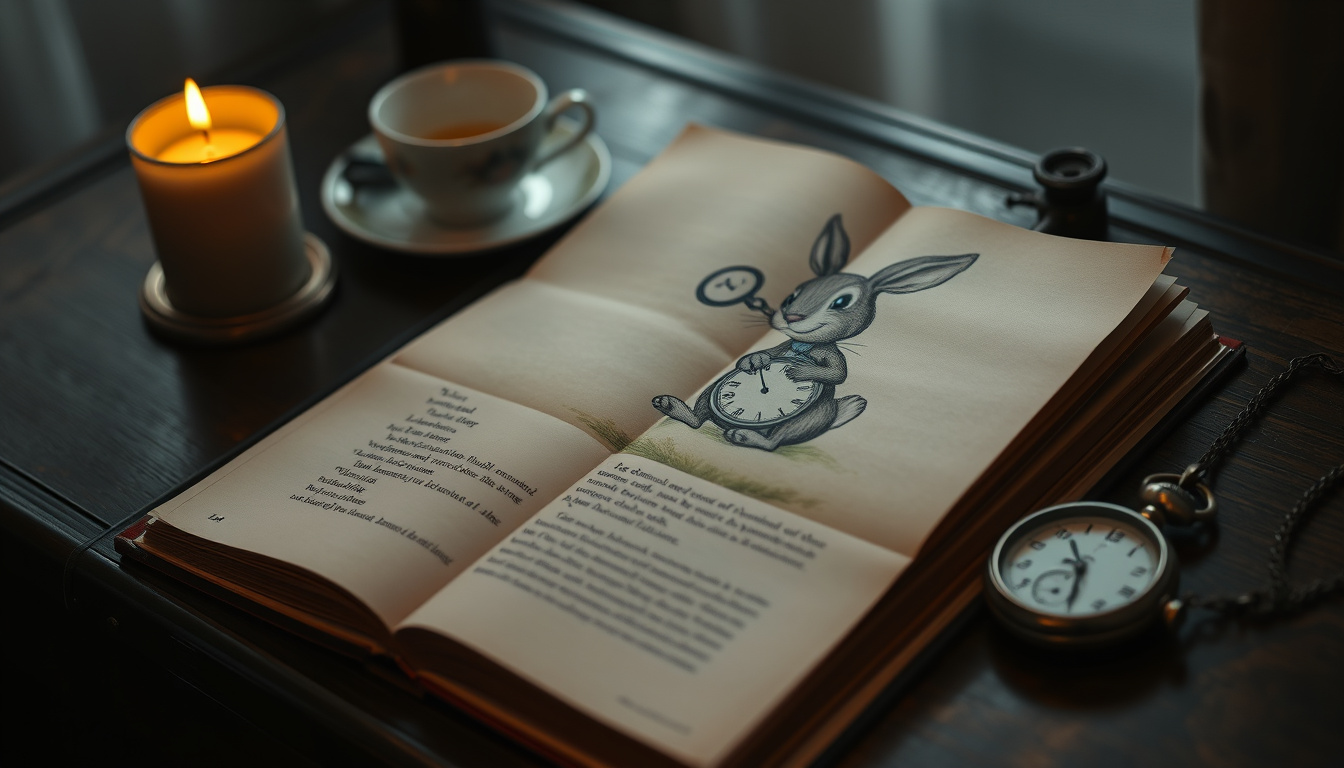
There’s something about a girl tumbling down a rabbit hole that keeps pulling readers back, generation after generation. Charles Lutwidge Dodgson — better known as Lewis Carroll — spun that tale from a single afternoon on the Thames, and the Alice books have never been out of print since.
Full name: Charles Lutwidge Dodgson ·
Born: 27 January 1832, Daresbury, England ·
Died: 14 January 1898, Guildford, England ·
Notable works: Alice’s Adventures in Wonderland, Through the Looking-Glass, The Hunting of the Snark ·
Pen name: Lewis Carroll ·
Occupations: Author, poet, mathematician, photographer, Anglican deacon
Quick snapshot
- Born as Charles Lutwidge Dodgson on 27 January 1832 (Britannica Kids)
- Author of Alice’s Adventures in Wonderland and Through the Looking-Glass (Biography.com)
- Died of pneumonia on 14 January 1898 (Biography.com) (Britannica Kids)
- Mathematics lecturer at Christ Church, Oxford (Poetry Foundation)
- Exact nature of his neurological conditions (epilepsy, migraines, stammer) remains speculative
- Whether his relationships with children were inappropriate by modern standards is debated
- His exact last words are disputed among biographers
- 1832: Born in Daresbury (Academy of American Poets)
- 1865: Alice’s Adventures in Wonderland published (Biography.com) (Academy of American Poets)
- 1871: Through the Looking-Glass published (Poetry Foundation) (Academy of American Poets)
- 1898: Died of pneumonia (Academy of American Poets) (Academy of American Poets)
- Continued scholarly debate on Carroll’s health and psychology
- New film and stage adaptations of Alice keep the stories current
- Ongoing digitisation of his photographic archive
Six facts anchor the man — and one of them is a name he never used on a census form.
| Label | Value |
|---|---|
| Full name | Charles Lutwidge Dodgson (Wikipedia) |
| Born | 27 January 1832 (Wikipedia) |
| Died | 14 January 1898 (Wikipedia) |
| Occupation | Author, mathematician, photographer, deacon (Poetry Foundation) |
| Notable works | Alice’s Adventures in Wonderland, Through the Looking-Glass, The Hunting of the Snark (Britannica Kids) |
| Pseudonym | Lewis Carroll (Academy of American Poets) |
What this means: Carroll was a man of multiple identities — the straight-laced mathematician and the whimsical storyteller — and neither explains the other without the contradictions intact.
What was Lewis Carroll famous for?
Carroll’s fame rests on two slender volumes that have never been out of print: Alice’s Adventures in Wonderland (1865) and its sequel Through the Looking-Glass and What Alice Found There (1871). The stories began, by his own account, during a boat trip on the Thames in 1862 with the three Liddell sisters — particularly Alice Liddell (Biography.com). But that’s only half the portrait.
What were Lewis Carroll’s most famous works?
- Alice’s Adventures in Wonderland (1865): The tale of a girl who falls through a rabbit hole into a world where logic twists, time runs backward, and a grinning cat can vanish mid-sentence (Poetry Foundation).
- Through the Looking-Glass (1871): A mirror-world adventure where Alice becomes a pawn in a chess game and meets the Jabberwock, Tweedledum and Tweedledee, and the Red Queen (Wikipedia).
- The Hunting of the Snark (1876): A nonsense poem about a crew hunting an elusive creature — an allegory that still defies singular interpretation (Britannica Kids).
Carroll’s literary output outsized his mathematical legacy by orders of magnitude, yet he insisted his “nonsense” was built on logical structures as rigorous as Euclid.
What was Lewis Carroll’s real name?
Charles Lutwidge Dodgson — a name he used for all his academic and personal correspondence. He invented the pen name “Lewis Carroll” in 1856 for his first published poem, “The Path of Roses,” in The Train magazine (Poetry Foundation). The name is a Latinised inversion of his birth name: “Lewis” from Ludovicus (Lutwidge) and “Carroll” from Carolus (Charles).
What did Lewis Carroll do besides writing?
- Mathematics: He was a lecturer in mathematics at Christ Church, Oxford, from 1855 to 1881 and published works on symbolic logic and Euclidean geometry (Biography.com).
- Photography: A pioneering portrait photographer, he produced more than 3,000 images, many of children and literary figures (Lewis Carroll FAQ).
- Deaconhood: Ordained as an Anglican deacon in 1861, he delivered sermons but never became a priest (Academy of American Poets).
The catch: Carroll’s public persona — shy, precise, devout — contrasts so sharply with the imaginative freedom of Wonderland that scholars still argue which was the “real” man.
Lewis Carroll’s literary fame overshadows his mathematics, but his nonsense was built on logical foundations as rigorous as Euclid.
What disorders did Lewis Carroll have?
Speculation about Carroll’s health has become almost as famous as his characters. The consensus among medical historians is that he likely suffered from a stammer, but claims of epilepsy, migraines, and other neurological conditions rest on circumstantial evidence.
What is the evidence for Lewis Carroll having epilepsy?
- Carroll described episodes of “altered consciousness” and visual disturbances in his diaries, which some scholars interpret as temporal lobe epilepsy or complex migraines (Lewis Carroll FAQ).
- No contemporary medical records confirm a diagnosis; the epilepsy theory was popularised in the 20th century and remains disputed.
What other disabilities did he have?
- Carroll had a pronounced stammer throughout his life, which he called his “hesitation” (Biography.com).
- He also reported insomnia, hearing loss in one ear, and recurring fevers — but none are documented by a physician.
How did his health affect his writing?
Some literary critics argue that Carroll’s neurological experiences influenced the dreamlike, disjointed logic of Wonderland. The idea is suggestive but impossible to confirm — and Carroll himself never linked his ailments to his fiction.
Medical biographies of historical figures often impose modern diagnoses on fragmentary evidence. For Carroll, the gap between symptom and syndrome is wide enough that caution — not certainty — is the honest position.
The trade-off: Reading Carroll’s work through a medical lens can illuminate the text, but it risks reducing a deliberate artist to a passive patient.
Carroll’s health conditions remain speculative; no definitive diagnosis exists, and linking his symptoms to his work is risky.
What were Lewis Carroll’s last words?
Carroll died on 14 January 1898 at his sisters’ home in Guildford. The cause of death was pneumonia, following a brief illness (Academy of American Poets). His reported last words — “Take away the pillow” or the gentler “Take away the pillow, I shall need it no more” — vary by biographer and are not reliably sourced.
What was the cause of Lewis Carroll’s death?
Pneumonia, contracted after a bout of influenza. He was 65 years old (Biography.com).
Where is Lewis Carroll buried?
He is buried at the Mount Cemetery in Guildford, Surrey. A memorial stone also exists at Westminster Abbey’s Poets’ Corner (Wikipedia).
Why this matters: The very thing that makes his death story memorable — the mysterious last words — is also a reminder that even the most famous lives become legend the moment they end.
Carroll died of pneumonia at 65; his disputed last words reflect how quickly fact blurs into legend.
What is rule 42 and why is it important for Alice?
In the trial scene of Alice’s Adventures in Wonderland, the King of Hearts suddenly produces a rule that reads: “All persons more than a mile high to leave the court.” This is Rule 42 — a satirical take on the arbitrary use of authority in Victorian society (Lewis Carroll FAQ).
What does Rule 42 say?
The full text: “All persons more than a mile high to leave the court.” Since Alice has grown to a towering size, the rule is clearly directed at her. She dismisses the decree as nonsense, but the King insists it is “the oldest rule in the book.”
How does Rule 42 relate to Alice’s trial?
- It reveals the arbitrary nature of the court: rules are invented on the spot to suit those in power.
- It echoes Victorian legal reforms that Carroll, a logician and anti-feminist on some issues, may have found both amusing and alarming.
- The scene is often taught as a critique of institutional hypocrisy.
The pattern: Rule 42 is one of Carroll’s sharpest social jabs — a moment where nonsense becomes the most logical response to an illogical system.
Rule 42 satirises arbitrary authority, showing Carroll using nonsense to expose illogical systems.
For readers comparing entertainment and gaming markets, CryptoSlate crypto casinos offers a useful independent overview of how regulated operators present their products.
What mental illness does Alice represent?
Modern readers have projected a wide range of psychological conditions onto Alice: schizophrenia, eating disorders, dissociative identity disorder. These readings are modern, not authorial, and Carroll himself never suggested his protagonist was anything but a curious little girl.
What psychological conditions are associated with Alice in Wonderland?
- Alice in Wonderland Syndrome (AIWS): A neurological condition named after the book, involving distorted perception of body size and time. It is associated with migraines and epilepsy (Lewis Carroll FAQ).
- Eating disorders: Alice’s constant changes in size through eating and drinking have been read as metaphors for body dysmorphia.
- Schizophrenia: The fragmented, illogical world has been compared to psychotic episodes — though this is contested by literary scholars.
How does Alice’s behavior reflect mental illness?
Alice questions her own identity (“Who in the world am I?”), experiences sudden emotional shifts, and struggles to make sense of a world that defies cause and effect. Psychiatrists occasionally use the text to illustrate symptoms, but Carroll’s intent was playful, not clinical.
The implication: Using Alice as a diagnostic case study tells us more about our era’s obsession with pathologising everything than about Carroll’s craft.
Projecting mental illness onto Alice reflects modern interpretations, not Carroll’s playful intent.
Confirmed facts
- Born as Charles Lutwidge Dodgson in 1832 (Wikipedia)
- Author of Alice’s Adventures in Wonderland and Through the Looking-Glass (Biography.com)
- Died of pneumonia in 1898 (Academy of American Poets)
- Mathematics lecturer at Christ Church, Oxford (Poetry Foundation)
What’s unclear
- Exact neurological condition (epilepsy, migraines, or neither)
- Whether his friendships with children crossed ethical lines by today’s standards
- His verifiable last words
- Whether Alice’s size changes symbolise any particular mental illness
- Exact number of photographs he produced is not definitively known
“I can’t believe that!” said Alice. “Can’t you?” the Queen said in a pitying tone. “Try again: draw a long breath, and shut your eyes.” Alice laughed. “There’s no use trying,” she said: “one can’t believe impossible things.”
— Lewis Carroll, Through the Looking-Glass
“Why, sometimes I’ve believed as many as six impossible things before breakfast.”
— Lewis Carroll, Through the Looking-Glass
“Lewis Carroll was a man of many contradictions: a mathematician who wrote nonsense, a deacon who loved children, a shy man who sought fame.”
— Morton N. Cohen, biographer
For readers still drawn to Wonderland, the choice is clear: enjoy the stories for their dazzling playfulness, or dig into the contradictions that made them — but never mistake speculation for fact.
Frequently asked questions
How did Lewis Carroll get the name “Lewis Carroll”?
He created it by Latinising his first and middle names: Ludovicus (Lutwidge) became Lewis, and Carolus (Charles) became Carroll. He first used the pen name in 1856 for the poem “The Path of Roses” in The Train magazine (Poetry Foundation).
Did Lewis Carroll have children?
No. Carroll never married and had no children of his own, though he maintained close friendships with children, most famously Alice Liddell.
What is the poem Jabberwocky about?
“Jabberwocky” is a nonsense poem from Through the Looking-Glass about a hero who slays a fearsome creature called the Jabberwock. The poem is famous for its invented words (slithy, mimsy, borogoves) that nonetheless convey clear narrative meaning (Wikipedia).
Was Lewis Carroll a teacher?
Yes. He was a lecturer in mathematics at Christ Church, Oxford, from 1855 to 1881. He taught geometry, algebra, and symbolic logic.
Why did Lewis Carroll stop writing?
He never fully stopped writing. After the Alice books, he published The Hunting of the Snark (1876), Sylvie and Bruno (1889), and several mathematical texts. His output slowed in the 1890s as his health declined.
What is the significance of the Cheshire Cat?
The Cheshire Cat is one of Carroll’s most famous characters, known for its ability to disappear gradually until only its grin remains. It serves as a philosophical guide for Alice, offering riddles and observations about madness, identity, and the nature of Wonderland (Lewis Carroll FAQ).
How many books did Lewis Carroll write?
Carroll published more than 20 books under his real name and pen name. These include novels, poetry collections, mathematical treatises, and works on logic (Biography.com).
Did Lewis Carroll know the real Alice Liddell?
Yes. Alice Liddell was the daughter of Henry Liddell, the Dean of Christ Church. Carroll was a family friend and told the original Alice story during a boating trip with Alice and her sisters in 1862 (Poetry Foundation).
Related reading
- We’re Going on a Bear Hunt: Author, Moral & Origins Explained — another children’s classic with a fascinating backstory.
- King Agamemnon: Myth, History, and Death — how ancient stories and modern scholarship collide, much like Carroll’s world.

Oliver Jack Carter Cooper is a staff writer for EveningLedger.uk, covering UK news, politics, business and culture. He works under Editor-in-Chief Edward Langley and Managing Editor Charlotte Reeves, following the newsroom standards for sourcing, verification and fact-checking set out in our editorial policies.