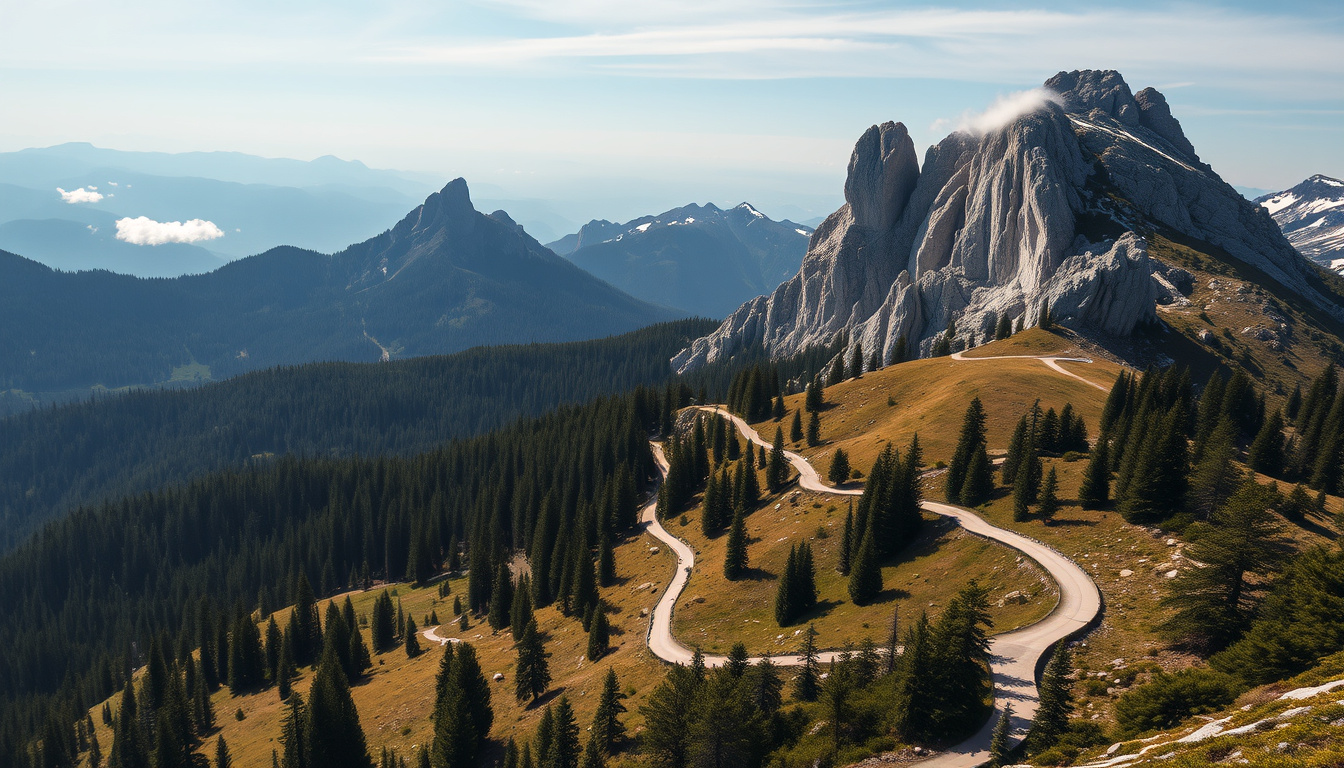
Every hiker knows the difference between a place and its story, and Mount Olympus is both: one of Europe’s most biologically rich national parks and, in Greek imagination, the home of gods who never existed. This guide sorts the geography from the legend, then gets practical about routes, difficulty, and what to pack.
Elevation: 2,917 meters (9,570 feet) ·
Location: Greece, on the border of Thessaly and Central Macedonia ·
Highest peak: Mytikas ·
National park established: 1938 ·
UNESCO designation: Biosphere Reserve (1981)
Quick snapshot
- Mount Olympus is a real mountain in Greece, with Mytikas as its highest peak at 2,917 meters (Visit-Greece.info)
- Olympus National Park was established in 1938 and is a UNESCO Biosphere Reserve (Visit Greece)
- The exact location of Zeus’ mythological palace is unknown; no physical evidence exists (Visit Greece)
- Some commercial sources claim “more than 80 marked routes,” but official guidance does not confirm a unified count (The Mount Olympus)
- First recorded summit ascent: 1913 by Christos Kakkalos, Frédéric Boissonnas, and Daniel Baud-Bovy (Visit Greece)
- National park status since 1938; UNESCO Biosphere Reserve since 1981 (Discover Greece)
- Summit season runs June through September; shoulder months bring snow and unstable weather (PeakVisor)
- Guided multi-day climbs from Litochoro are the standard approach for first-time summiters (Visit Greece)
Key facts at a glance: five data points that separate the real mountain from the myth.
| Attribute | Detail |
|---|---|
| Elevation | 2,917 m (9,570 ft) |
| Country | Greece |
| First recorded ascent | 1913 (Christos Kakkalos, Frédéric Boissonnas, Daniel Baud-Bovy) |
| National Park | Olympus National Park established 1938 |
| Mythological significance | Home of the Greek gods |
Where is the actual Mount Olympus?
- Northern Greece, on the border of Thessaly and Central Macedonia (Visit Greece (national tourism authority))
- Part of Olympus National Park, established in 1938 (Discover Greece)
- The mountain has 52 peaks, with Mytikas the highest at 2,917 m (Visit-Greece.info)
Geographic location in Greece
Mount Olympus rises about 80 kilometers southwest of Thessaloniki, Greece’s second city. The mountain massif is compact but steep: it covers roughly 500 square kilometers, and its base sits close to sea level before climbing abruptly to nearly 3,000 meters.
The mountain is not remote wilderness — it is within two hours of Thessaloniki and about four hours from Athens, which is why the park draws a steady stream of one-day visitors alongside serious summit climbers.
Mount Olympus National Park boundaries
The park protects the mountain’s core, including the gorge of Enipeas, the Muses Plateau, and the upper slopes above the treeline. Litochoro, the town most climbers use as a base, sits at the eastern foot of the massif, and its Myli area at roughly 400 meters is one of the main entrances to the park (Visit Greece).
Park boundaries stretch across three regional units — Pieria, Larissa, and Grevena — and include several distinct trailheads. The most important access point for summit routes is Prionia, the highest point reachable by paved road, where most overnight ascents begin (Mount Olympus Refuge A).
Why this matters: knowing which entrance you are using changes your hike by hours. Myli gives you a full gorge walk of 12 km to the trailhead; Prionia skips the gorge and puts you directly on the mountain’s flank.
What is the myth of Mount Olympus?
- In Greek mythology, Mount Olympus was the residence of the twelve Olympian gods (Visit Greece)
- The ancient Greeks believed it was a divine realm unreachable by mortals (Discover Greece)
Home of the Greek gods
The Olympians — Zeus, Hera, Poseidon, Demeter, Athena, Apollo, Artemis, Ares, Aphrodite, Hephaestus, Hermes, and Hestia or Dionysus — were said to hold court in a palace complex above the clouds. The real mountain’s frequent cloud cover made the metaphor easy to believe: the summit is hidden for much of the year, and ancient Greeks had no practical reason to climb it.
Zeus and the Olympian deities
Zeus ruled from the highest throne, and his authority was tied to the mountain’s physical dominance over the surrounding plains. Thunderstorms on Olympus were read as divine activity, which gave the mountain a sacred status that persists in Greek cultural memory.
Modern mythological references
The image of Olympus as a heavenly court survives in everything from astronomy (the moons of Jupiter named after Zeus’ lovers) to popular entertainment. But the gap between myth and mountain is stark: no palace, no temple complex, and no archaeological evidence of worship on the summit has ever been found (Visit Greece).
The pattern: the more people climb Olympus, the more the myth recedes — the summit is a rocky, windy, treeless place that rewards effort but reveals no gods.
How difficult is Mount Olympus to climb?
- Summiting Mytikas requires good fitness, some scrambling, and a head for heights (PeakVisor)
- The E4 trail offers a moderate-to-challenging hike suitable for most fit hikers (Visit Olympus)
- Half-day and guided family options exist in the lower park (Visit Greece)
Hiking routes and difficulty levels
Olympus is not a walk-up mountain. The standard summit route from Prionia to Mytikas typically takes two to three days, and the final stretch from Skala peak to Mytikas involves exposed scrambling over a ridge called the Kakoskala (“bad steps”) (Visit-Greece.info).
The most common itinerary starts at the Prionia trailhead at roughly 1,100 meters, climbs to Refuge A (Spilios Agapitos) at 2,100 meters, and then ascends to Skala and Mytikas the following dawn (Mount Olympus Refuge A). The climb from Prionia to the refuge is about 6 km with roughly 1,000 meters of elevation gain — a solid day’s work before the summit attempt (GigSky).
The Skala–Mytikas ridge is the crux: only 3 km from refuge to summit, but steep, exposed, and demanding on the descent. Climbers who are comfortable with exposure rate it as a highlight; those who are not find it genuinely frightening.
Preparation and gear needed
Boots with good ankle support, trekking poles, warm layers, rain protection, and a headlamp for the pre-dawn summit start are non-negotiable. The mountain is subject to sudden weather shifts even in summer, and the upper zone above 2,000 meters has alpine conditions.
Day hikers who skip the summit can still experience the mountain properly. The Enipeas Gorge route from Myli to Prionia covers 12 km with about 700 meters of elevation gain over 6-8 hours, moving through dense forest, waterfalls, and the dramatic gorge walls (Visit Greece). It gives you the mountain’s atmosphere without summit risk.
Family-friendly options
The Prophet Elias Church route is one of the easier scenic walks on Olympus, and the lower forest trails around Litochoro and the Enipeas gorge are suitable for families with reasonable fitness (Visit-Greece.info). The key distinction is altitude: below 1,000 meters, the park feels like a gentle alpine forest; above 2,000 meters, it is serious mountain terrain.
What this means: families and casual visitors have good options, but the summit is not one of them — and it is worth respecting that line.
Does Zeus live in Mount Olympus?
- According to Greek myth, Zeus and the other Olympians lived in a palace atop the mountain (Visit Greece)
- No physical evidence of a palace exists; it is a purely mythological location (Discover Greece)
Zeus in mythology versus historical belief
The ancient Greeks treated Olympus as a real place that existed in this world, not in an afterlife or a parallel realm. The gods were believed to reside there, but the mountain’s physical summit was considered forbidden — not because anyone had tried and failed, but because the cultural frame said mortals had no business there. That taboo, more than any physical barrier, kept the summit unclimbed for millennia.
The concept of Olympus as a heavenly realm
Olympus functioned as a heavenly realm in Greek thought, but it was a heavenly realm with geographic coordinates. This is a meaningful difference from later monotheistic traditions, where the divine residence is typically outside the material world.
The implication: when someone asks whether Zeus lives on Mount Olympus, the honest answer is “in the myth, yes — in reality, there is no evidence of any divine residence, only a mountain that happens to look like one.”
Who came first, Zeus or god?
- In Greek mythology, the primordial deities (Chaos, Gaia, Tartarus) came before Zeus (Visit Greece)
- Zeus was the youngest son of the Titans Cronus and Rhea (Discover Greece)
Greek creation myth and theogony
Greek mythology begins not with Zeus but with Chaos, the void, followed by Gaia (Earth) and Tartarus (the abyss). Zeus enters the story later as the third generation of divine rulers, after Uranus and then his own father Cronus, whom he overthrew. The gods of Olympus came last, not first.
Comparison with monotheistic traditions
Comparing Zeus to a singular “God” is anachronistic. Greek polytheism predates Christianity and operates on different logic: the Olympians are powerful but not omnipotent, eternal but not uncreated, and morally complex in ways that a monotheistic deity is not.
Why this matters: readers who assume Zeus and “God” are parallel concepts will misread both traditions. Zeus is a character with a family history, not a creator figure.
Climbing Mount Olympus: Step-by-step plan
- Step 1: Choose your route
- Two-day summit via Prionia: start at the trailhead, sleep at Refuge A, summit at dawn, descend the same day (Mount Olympus Refuge A)
- Three-day traverse: overnight at both Refuge A and a mountain hut near the Muses Plateau, allowing acclimatization and a gentler summit-day pace (Visit-Greece.info)
- Gorge day hike: Enipeas Gorge from Myli to Prionia, 12 km one-way (Visit Greece)
- Step 2: Plan the approach – From Litochoro, drive or take a taxi to the Prionia trailhead. The road is paved but narrow and winding; parking fills early in summer. Hikers using the Myli entrance can walk from the town itself along the gorge path.
- Step 3: Book refuge beds in advance – Refuge A (2,100 m) is the main overnight stop on the summit route, and beds are limited. Bookings are essential in July and August. The refuges have basic mattresses, blankets, food, and water; you do not need a tent.
- Step 4: Prepare for the summit day – Start around 4:00-5:00 a.m. to reach the summit before afternoon clouds build. The climb from Refuge A to Skala (2,866 m) takes roughly 2-3 hours; from Skala to Mytikas, the exposed ridge adds 30-60 minutes. Plan for an early descent back below the treeline by late afternoon.
- Step 5: Know when to turn around – If weather moves in, if you are slower than planned, or if the ridge feels unsafe, Skala is the responsible turnaround point. The summit will be there on another trip; the rescue statistics on Olympus are a warning, not a myth.
What’s clear, what’s not
Confirmed facts
- Mount Olympus is a real mountain in Greece (Visit Greece)
- Mytikas is the highest peak at 2,917 m (Visit-Greece.info)
- Olympus National Park was established in 1938 (Discover Greece)
- The mountain is a UNESCO Biosphere Reserve (Visit Greece)
What’s unclear
- The exact location of any mythological palace of Zeus is unknown and unverifiable (Visit Greece)
- Trail counts vary by source; some claim “more than 80 routes” while official guides list a smaller set (The Mount Olympus)
Quotes on Olympus
Olympus National Park is a place where nature and myth meet — a protected refuge that preserves both the biodiversity of the mountain and the cultural memory of the gods.
Greek Ministry of Culture and Sports, on the park’s dual heritage
The designation of Mount Olympus as a Biosphere Reserve recognizes its global importance as a site of ecological diversity and sustainable human coexistence.
UNESCO, Biosphere Reserve designation rationale
Olympus hosts about 1,700 types of plant and animal life on its slopes, a concentration of biodiversity that makes every hike a naturalist’s journey.
Discover Greece, on the mountain’s ecological richness
The ascent to Mytikas is not a walk in the park — it demands respect for altitude, weather, and your own limits.
PeakVisor route analysis, on summit conditions
Plan your visit
The mountain offers a clear choice. For serious climbers, the summit of Mytikas is one of the great European objectives — a two-day push with real exposure, real weather, and real satisfaction. For everyone else, the lower park is no compromise: the Enipeas Gorge alone rivals many alpine destinations, with waterfalls, forest, and a trailhead that puts you at the foot of the gods without requiring you to climb to their doorstep.
Frequently asked questions
What is the best time of year to climb Mount Olympus?
The standard season is June through September. June offers snow patches and wildflowers at altitude; July and August are warmest and most reliable; September brings fewer crowds and stable weather, but evenings are cooler. Outside this window, snow, ice, and storm risk are significant (PeakVisor).
Do I need a guide to climb Mount Olympus?
No, but many hikers use one. The route to Refuge A and the summit via Skala is well-marked, and experienced hikers can manage independently. A guide is strongly recommended for first-time visitors, solo hikers, or anyone uncomfortable with exposed scrambling on the Skala–Mytikas ridge (Visit Greece).
How long does it take to hike Mount Olympus?
A two-day ascent is standard: Day 1 from Prionia to Refuge A (4-5 hours), Day 2 summit and descent (6-8 hours). A three-day itinerary adds an overnight at the Muses Plateau and spreads the climbing. The Enipeas Gorge day hike from Myli to Prionia takes 6-8 hours (Visit Greece).
Is there an entrance fee for Olympus National Park?
No entrance fee is charged for the park itself. Costs come from parking, refuge stays (roughly 15-25 euros per night), and guided tour services. Refuge beds require advance booking in summer (Mount Olympus Refuge A).
What should I bring for a Mount Olympus hike?
Hiking boots, trekking poles, warm layers, rain shell, headlamp, sunscreen, at least 2 liters of water, and high-energy food. For the summit attempt, add gloves, a hat, and a buff — the wind at 2,900 meters is cold even in July. Retain your receipt-free gear list: this is a mountain, not a theme park (GigSky).
Are there any restrictions for climbing Mount Olympus?
No permits are required for day hikes or refuge-based summit climbs. Camping is restricted to designated areas, and open fires are prohibited. Staying at any refuge requires a reservation, and the refuges close outside the main season (Mount Olympus Refuge A).
Can I see Mount Olympus from Athens?
No. Athens is roughly 400 kilometers from Olympus, and the mountain is not visible from the city. It is, however, visible from Thessaloniki and along the coast of Pieria on clear days. The drive from Athens to Litochoro takes about four hours (Visit Greece).
Related reading

Oliver Jack Carter Cooper is a staff writer for EveningLedger.uk, covering UK news, politics, business and culture. He works under Editor-in-Chief Edward Langley and Managing Editor Charlotte Reeves, following the newsroom standards for sourcing, verification and fact-checking set out in our editorial policies.