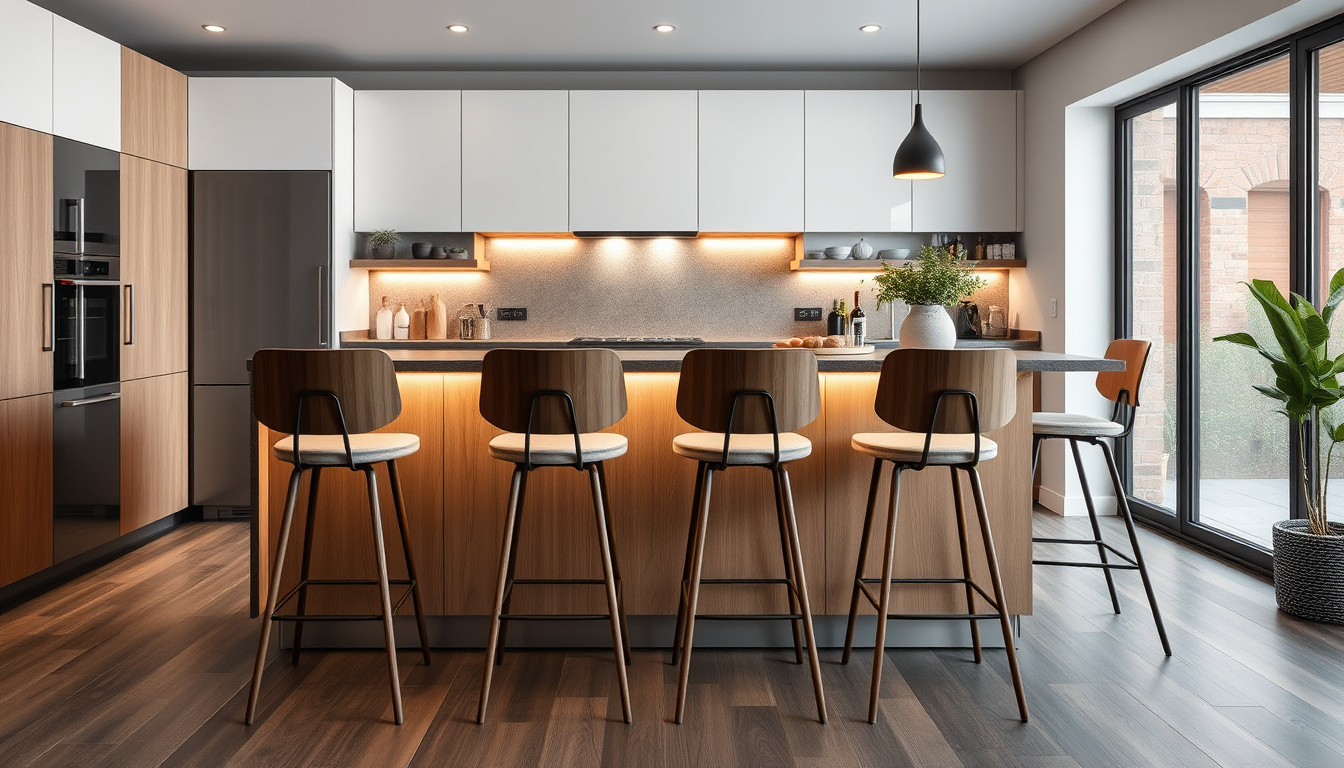
Anyone who has fitted out a kitchen knows the moment a bar stool either matches the counter or becomes an expensive leaning post. UK retailers treat “stool bar” as its own category, and the first useful fact is also the simplest: backless stools generally offer a slimmer profile and can slide fully beneath a counter, which is why compact kitchens keep buying them (Wayfair UK (furniture marketplace)).
Top 5 organic results: 5 UK commerce category pages ·
Largest stock claim: 30,000+ items ·
Biggest retailer claim: “UK’s biggest bar stool retailer” ·
Common set sizes: 2 and 4 ·
Delivery claim: Free UK delivery
Quick snapshot
- Backless stools generally offer a slimmer profile and can slide fully beneath a counter (Elystra Living (UK furniture specialist))
- Stools with backs provide additional support and are generally better suited to longer sitting periods (Choice Furniture Superstore (UK furniture retailer))
- The fit rule across UK guides: seat height tracks worktop height (Elystra Living (UK furniture specialist))
- Whether B&M currently stocks bar stools — unconfirmed
- The full 2026 bar stool trend list — not defined in the available data
- Whether “biggest” and “luxury” retail claims are independently verified
- Since 2006 — Danetti has positioned itself as a UK bar stool specialist (Danetti (UK bar stool specialist))
- 2026 — “Bar stools 2026 trends UK” is already an active related search (Google search data)
- Today — five of the top five “stool bar” results are live UK shop pages (Google search data)
- Measure the real counter height before you order
- Decide session length first: quick perch or meal-length sitting
- Check delivery costs and load capacity before checkout
Key facts at a glance
Seven signals, one pattern: UK bar stool retail runs on specialism and stock claims more than on consistent spec sheets.
| Fact | Detail | Evidence |
|---|---|---|
| Specialist since | 2006 | Danetti |
| Stock scale | 30,000+ items | Simply Bar Stools |
| Delivery claim | Free UK delivery | Barstools.co.uk |
| Common set sizes | 2 and 4 | UK retailer listings |
| Material signals | Velvet, faux leather, wood, metal | Cult Furniture, Sterling Home |
| Back options | Backless, low-back, with back | UK retailer ranges |
| Active search signals | “Stool bar clearance” and “bar stool IKEA UK” | Google related searches |
What is a bar stool?
A bar stool is a tall seat designed for bar-height or counter-height surfaces. UK retailers describe it as seating for kitchen islands, breakfast bars, and entertaining spaces — which is why the category lives inside kitchen furniture, not living room furniture.
Bar stool vs breakfast bar stool
- “Bar stool”, “breakfast bar stool”, and “counter stool” are retail labels, not standard measurements.
- The real distinction is height: seat height must track the height of the surface it serves.
- UK buyer guides agree on the fit rule even when their names differ.
The label matters less than the tape measure. A “bar stool” sold for a standard kitchen worktop will feel wrong at a raised breakfast bar, because the seat-to-worktop gap changes with the counter height. The two most common UK pairings are 60–65 cm seats under 90 cm worktops and 71–81 cm seats under 105–110 cm breakfast bars — both detailed in the spec table later in this guide.
Common materials in UK retail ranges
- Cult Furniture’s range spans velvet, faux leather, wood, and more.
- Sterling Home’s kitchen stools pair wooden legs with metal bases.
- UK Picks’ roundup notes that PU or faux-leather upholstery is easier to wipe clean in food-preparation areas than many fabric finishes, and that velvet designs suit lower-mess living spaces unless the cover is removable (UK Picks (UK product roundup)).
Material choice should follow placement. A stool that lives where toast crumbs and coffee spills land needs a wipe-clean surface; a stool in a living corner can carry softer fabric without the same risk.
Typical heights and uses
- Kitchen islands and breakfast bars are the main UK home uses.
- Entertaining spaces and dining corners account for a large share of buyer searches.
- Measure the actual counter before buying: fitted islands and freestanding breakfast bars vary by several centimetres.
The pattern across UK guides is consistent: seat height tracks worktop height, and the gap between seat and worktop is the number that decides comfort.
The label on the listing matters less than the distance between seat and worktop. Get that wrong and even a well-reviewed stool becomes an awkward lean instead of a seat.
Is barstool still a thing?
Yes — and the evidence is commercial, not nostalgic. UK retailers still run entire product lines around bar stools, and the search behaviour around them looks like shoppers fitting out a room, not browsing a trend.
Why bar stools remain a distinct UK category
- All five of the top five organic results for “stool bar” are UK commerce category pages.
- Danetti has marketed itself as a UK bar stool specialist since 2006.
- Simply Bar Stools claims 30,000+ items in stock.
- Barstools.co.uk claims to be the UK’s biggest bar stool retailer, with free UK delivery.
Those claims are the retailers’ own positioning, not independently verified numbers. What matters for buyers is that the category has enough commercial gravity to support specialist shops at all — a signal that demand is steady, not seasonal.
What to put instead of bar stool?
- Counter stools — shorter seat heights for standard worktops.
- Tall chairs — a dining-room alternative for casual seating.
- Benches — a compact fit for breakfast nooks and tight islands.
The alternative depends on the surface height. A bench suits a snug corner; a counter stool suits a 90 cm worktop; a tall chair works where a stool feels too casual. If the room has a breakfast bar, a bar stool remains the natural fit.
Signals of ongoing demand: IKEA UK and clearance searches
- “Bar stool IKEA UK” is an active related search.
- “Bar stool clearance” and “stool bar clearance sale” are regular shopping paths.
- Set of 2 and set of 4 searches show whole-kitchen buying intent.
These are practical signals. People search for bar stools when they are planning a kitchen, not when they are following a fad.
What this means: bar stools remain the default seating for British kitchen islands, and the retailer landscape is built around that single piece of furniture.
What are the trends for bar stools in 2026?
The full 2026 trend list is still taking shape, but the retail and search signals already point in four directions: mixed materials, height adjustability, upgrade buyers, and value buyers.
Material signals: velvet, faux leather, wood, and metal
- Cult Furniture’s category copy leads with velvet, faux leather, and wood.
- Sterling Home’s range pairs wooden legs with metal bases.
- The shared pattern is soft upholstery on top and hard frames below.
The 2026 material story is a split personality: warm, upholstered seats for comfort, and wood or metal frames for structure and weight. Buyers get the softness they want where they sit and the durability they need where the stool takes the wear.
Height-adjustable and luxury kitchen bar stools
“Stool bar luxury kitchen with backs” is already a live related search — the upgrade buyer is searching before the trend list is written.
Retailers have responded with adjustable gas-lift stools — UK Picks (UK product roundup) points to gas-lift designs as useful when the exact counter height is uncertain or when users have different height requirements. For households where two people cook at the same island, that adjustability is the practical answer to “one stool, two heights”.
Set sizes and clearance demand
- Sets of 2 and 4 are the standard purchase units in UK listings.
- “Luxury kitchen bar stools with backs” is an active related search.
- “Bar stool clearance sale” shows a strong value-buying stream.
Two buying behaviours show up in the search data: whole-kitchen upgrades and replacement buys. Retail ranges already cater to both, which is why the same category page will happily sell a velvet set of 4 and a clearance backless pair.
The pattern: 2026 demand divides between upgrade buyers and value buyers, and the winning stool is the one that fits the counter as well as the budget.
Should I get bar stools with backs or without?
The honest answer is use-case, not fashion. A stool you sit on for an hour while friends cook needs different geometry than a perch for a quick coffee.
Backless bar stools: pros and cons
- Backless stools are easier to move around and can slide under counters.
- They suit compact kitchens and short perching sessions.
- With no back, the body carries more load during long sits.
Backless designs buy floor space and flexibility. The trade-off appears after about 20 minutes, when your lower back starts doing the work a backrest should be doing.
Bar stools with backs: pros and cons
- The main benefit of a back is support: longer sitting sessions stay comfortable (Choice Furniture Superstore (UK furniture retailer)).
- Full-back designs function more like dining seats.
- A low-back stool splits the difference: support without losing the tuck-under fit.
The case for a back gets stronger the longer the session. For meals, work-from-kitchen tasks, or anything past half an hour, the backrest earns its place.
What’s the most comfortable bar stool?
- Comfort comes from seat height, padding, footrests, and back support — not upholstery depth alone.
- Footrests are particularly important at bar height because a seated user’s feet may not reach the floor (Elystra Living (UK furniture specialist)).
- Gas-lift adjustment helps when more than one person uses the same stool.
The most comfortable stool is the one that lets your feet rest, your back lean, and your knees bend at a relaxed angle. Everything else is styling.
Is sitting on a bar stool bad for your back?
- Prolonged sitting on an unsupported stool can increase lower back strain.
- The higher the seat, the less your feet help carry weight — hips and lower back take over.
- Short sessions on a correctly fitted stool are a different case from all-day use.
The simple rule: if you use a stool like a chair, it needs chair-like support. That means a back, a footrest, and a seat height matched to the counter.
A stool that leaves your feet dangling and your lower back unsupported turns a 30-minute breakfast into a 30-minute strain. The fix is a footrest and a back — not a thicker cushion.
The trade-off: backless buys space and flexibility; a back buys comfort and posture. Which one is right is decided by how you use the kitchen, not by what the showroom looks like.
The implication: the backs-vs-backless decision is driven by how you use the kitchen, not by showroom trends.
How much should I spend on bar stools?
There is no single “right” price, because the right bar stool is the one that fits the counter and your sitting habits. Price only matters once those two things are settled.
What are the best-priced bar stools in the UK?
- “Best-priced” means lowest cost per comfortable year, not lowest ticket price.
- Furniture360’s UK roundup places a basic backless pair around £40–£50, which sets the low end of the market (Furniture360 (UK furniture retailer)).
- Price climbs with backs, gas-lift mechanisms, and upholstered finishes.
A low price is only a bargain if the seat height matches your worktop. A correctly fitted stool at a higher price beats a cheap one that gets replaced next year.
Set of 2 vs set of 4 pricing
- Sets of 2 fit breakfast bars and smaller kitchens.
- Sets of 4 fit larger islands and family seating.
- Barstools.co.uk offers free UK delivery, which changes the real total.
Buying a set is the standard UK pattern, and set pricing is how most buyers compare. Delivery terms matter more than a few pounds of difference between two stools.
Clearance and sale routes
- “Stool bar clearance sale” is an active UK search path.
- Clearance stock is where set-of-2 buyers often find a set-of-4 deal.
- Check load capacity and back support before buying on price alone.
Clearance shopping is a legitimate route, but it only works if you already know the seat height, session length, and support you need. Otherwise the discount decides the purchase.
The catch: a cheap stool that strains your back is not cheap. Decide the seat height, session length, and support first — then look for the best price in that category.
Where’s the best place to buy bar stools?
The practical answer for UK buyers: the best place is the retailer that publishes fit details and honest delivery terms, not the one with the prettiest grid of photos.
Do B&M sell bar stools?
- The current search data does not confirm B&M bar stool stock.
- Check B&M’s website or local store before making a trip.
- High-street stock changes seasonally.
B&M may well sell bar stools — but “may” is the operative word. The available evidence doesn’t confirm it, so treat the assumption as unverified until you see the stock in person.
Top UK online bar stool retailers
- Danetti — UK bar stool specialist, trading since 2006.
- Barstools.co.uk — claims the UK’s biggest bar stool retailer title, with free UK delivery.
- Simply Bar Stools — claims 30,000+ items in stock.
- Cult Furniture — spans velvet, faux leather, wood, and more.
- Sterling Home — kitchen stools with wooden legs and metal bases.
The consistent signal is specialisation: these retailers sell bar stools as a category, not a side aisle. Their claims are marketing statements, but the depth of range is real — and that depth makes it easier to compare fit, finish, and back styles in one place.
“UK’s biggest” is a retailer claim, not a verified fact — the same applies to “30,000+ items”. Judge retailers on fit specs and delivery terms instead.
IKEA UK and high-street options
- “Bar stool IKEA UK” is an active related search.
- IKEA serves as a reference point for price and simplicity.
- High-street availability depends on store-level stock.
The search pattern suggests buyers use IKEA as a benchmark, then shop around for the specific back style and finish they want. That is a sensible route — the flat-pack price is useful context even if you buy elsewhere.
Why this matters: every top organic result for “stool bar” is a shop page, not a guide. The retailer that publishes fit specs, load capacity, and honest delivery terms is the one worth your money.
Bar stools with backs vs backless: side by side
Three questions, one pattern: space pushes buyers to backless, time pushes them to backs.
| Consideration | Backless | With back | Evidence |
|---|---|---|---|
| Can slide fully under a counter | Yes | Rarely | Wayfair UK (furniture marketplace) |
| Support for longer sitting | Less | Yes | Choice Furniture Superstore (UK furniture retailer) |
| Typical home role | Quick breakfasts, small kitchens | Meals, work, long sits | Editorial read |
The read: if you routinely sit for more than half an hour, buy the back. If space is the constraint, backless with a footrest is the compromise.
Bar stool sizes and specs at a glance
Eight specs, one pattern: the counter decides the seat, and the seat decides the comfort.
| Spec | Typical value | Evidence |
|---|---|---|
| Seat height for a 90 cm worktop | 60–65 cm | Elystra Living (UK furniture specialist) |
| Seat height for a 105–110 cm breakfast bar | 71–81 cm | Furniture360 (UK furniture retailer) |
| Seat-to-counter clearance | ~25–30 cm | Elystra Living (UK furniture specialist) |
| Bar length per stool | ~60 cm | Furniture360 (UK furniture retailer) |
| Max load capacity | Look for a stated limit — some listings omit it | UK Picks (UK product roundup) |
| Common set sizes | 2 and 4 | UK retailer listings |
| Material options | Velvet, faux leather, wood, metal | Cult Furniture, Sterling Home |
| Back options | Backless, low-back, with back | UK retailer ranges |
The practical takeaway: the clearance band and the per-stool length are the numbers most buyers ignore — and the ones that cause most returns. Get the two of them right and the styling decision becomes safely cosmetic.
The upsides and downsides of bar stools
Upsides
- Bar stools take up less floor space than dining chairs.
- They suit kitchen islands, breakfast bars, and entertaining spaces.
- Sets of 2 and 4 make seating flexible for different room sizes.
- Gas-lift models adapt to mixed-height households.
Downsides
- Prolonged sitting on backless models can strain the lower back.
- Height mismatches are common when buyers ignore the counter measurement.
- Footrests matter at bar height, and not all stools include them.
- Load capacity is not always stated by retailers.
The balance: bar stools are a space-efficient way to seat people at a counter. The downsides are real, but each one is solvable with the right spec.
How to choose the right bar stool in five steps
- Measure the counter. Measure from the floor to the top of the worktop or breakfast bar. Fitted islands vary by several centimetres, so use the actual number, not a label.
- Match the seat height. Use the fit ranges above: 60–65 cm seats for 90 cm worktops, 71–81 cm seats for 105–110 cm breakfast bars.
- Decide the session. Quick coffee and breakfasts tolerate backless; meals and work sessions call for a back.
- Choose materials by room. Wipe-clean covers near food preparation, fabric or velvet in lower-mess spaces.
- Check the small print. Confirm the load capacity, the set size, and the delivery terms before checkout.
Follow the list in order and the visual choice becomes the last decision, not the first one.
Timeline: a durable UK category
- Since 2006: Danetti has traded as a UK bar stool specialist, one of several dedicated sellers.
- Today: all five top organic results for “stool bar” are UK commerce category pages.
- 2026: “Bar stools 2026 trends UK” is already an active related search question.
The signal here is continuity. Bar stools have been a distinct UK retail category for nearly two decades, and the search data suggests 2026 will extend that run rather than end it.
What’s confirmed and what’s still unclear
Confirmed facts
- The top five organic results for “stool bar” are UK commerce category pages.
- Danetti has positioned itself as a bar stool specialist since 2006.
- Barstools.co.uk claims the “UK’s biggest” title and offers free UK delivery.
- Simply Bar Stools claims 30,000+ items in stock.
- UK retailer guides agree that seat height tracks worktop height.
What’s unclear
- Whether B&M currently stocks bar stools — not confirmed in the available data.
- The exact contents of the 2026 bar stool trend list — not defined yet.
- Whether “biggest”, “30,000+”, and “luxury” retail claims are independently verified.
- Whether retailer comfort claims have been tested by buyers or labs.
- Recommended price ranges by quality tier — not published in the material reviewed.
- Search volume for “stool bar” — unknown.
The honest read: treat scale claims and “luxury” labels as marketing until a spec sheet or a tape measure proves them.
What the retailers say
Danetti frames the bar stool as seating that brings comfort and conversation to kitchen islands, breakfast bars, and entertaining spaces.
Danetti — UK bar stool specialist
Barstools.co.uk presents itself as the UK’s biggest bar stool retailer, backed by a free UK delivery promise.
Barstools.co.uk — home page positioning
Simply Bar Stools claims more than 30,000 bar stools and tables held in stock for commercial and domestic use.
Simply Bar Stools — category page
Cult Furniture describes its range as spanning velvet, faux leather, wood, and more.
Cult Furniture — category page
All four are marketing statements, not lab results — which is exactly why the measurement advice in this guide matters more than the adjectives.
What this means for UK buyers
The UK bar stool market is not short on choice — it is short on clarity. Every leading retailer sells the same promise of comfort, but the only claims you can verify without sitting down are the centimetres: seat height, clearance, and bar length per stool. For UK kitchen buyers, the choice is clear: let the tape measure pick the seat height and the sitting session pick the back — or buy the same set twice.
Frequently asked questions
How do I measure the right bar stool height?
Measure from the floor to the top of your worktop or breakfast bar, then look for a seat that sits roughly 25–30 cm below that line. For a 90 cm worktop, that means a 60–65 cm seat; for a 105–110 cm breakfast bar, a 71–81 cm seat.
What is the standard bar stool height?
There is no single standard height. UK retailer guides pair a 90 cm worktop with a 60–65 cm seat, and a 105–110 cm breakfast bar with a 71–81 cm seat. Match the seat to your counter, not to a generic number.
Are leather or faux leather bar stools easier to clean?
Yes. PU or faux-leather upholstery is easier to wipe clean in food-preparation areas than many fabric finishes. Velvet and fabric look softer, but they suit lower-mess rooms unless the cover is removable or the cleaning instructions are clear.
Can bar stools fit under a kitchen island?
Backless stools with straight legs can slide fully under a counter, which is their main space advantage. Stools with backs rarely tuck fully underneath.
Do bar stools need a footrest?
At bar height, a seated user’s feet may not reach the floor, so UK guides treat a footrest as an important comfort feature. If you buy a stool without one, your legs and lower back take the extra load.
How many bar stools fit at a 6-foot counter?
At roughly 60 cm of bar length per stool, a 6-foot (183 cm) counter fits about three stools. Allow more space if the stools have arms or if you prefer extra personal room.

Oliver Jack Carter Cooper is a staff writer for EveningLedger.uk, covering UK news, politics, business and culture. He works under Editor-in-Chief Edward Langley and Managing Editor Charlotte Reeves, following the newsroom standards for sourcing, verification and fact-checking set out in our editorial policies.