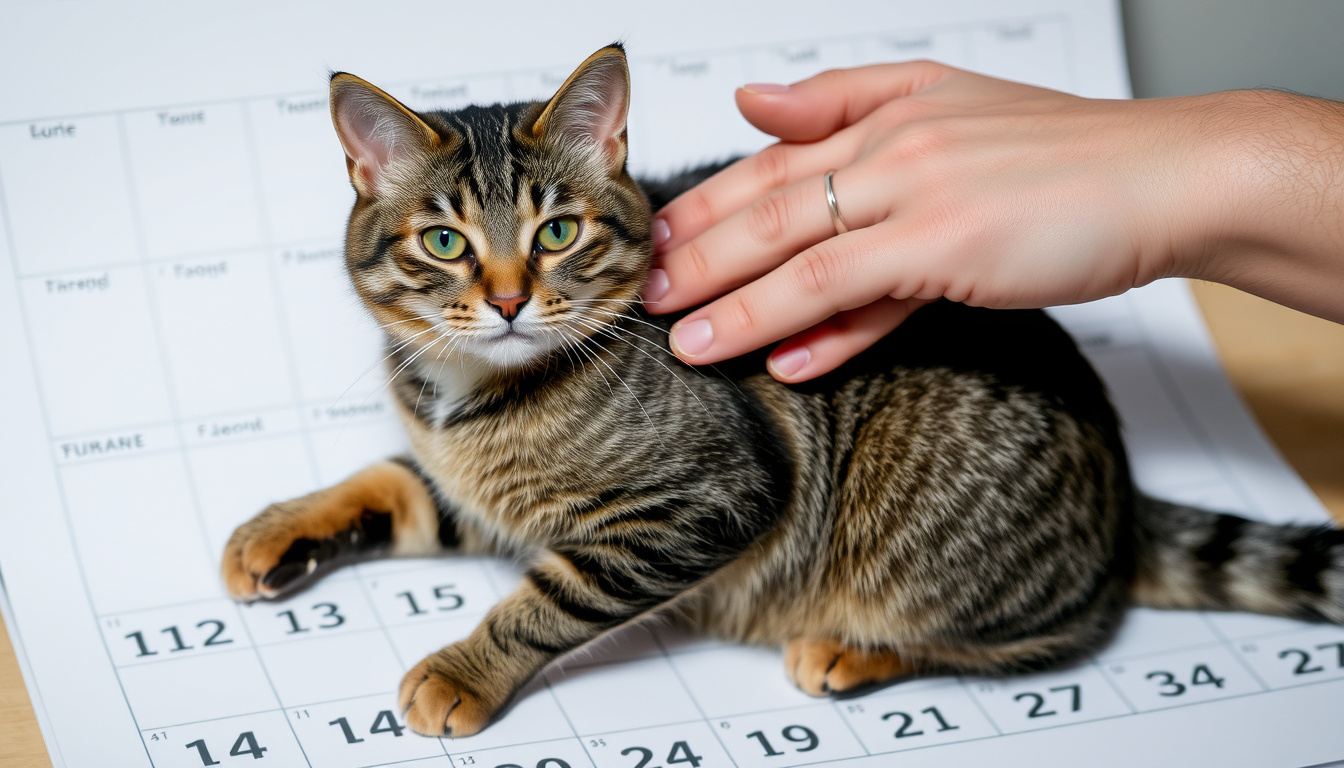
You’ve probably heard the old “one cat year equals seven human years” rule, but it’s not quite right. The truth is more precise—and more useful for tracking your cat’s life stages. We’ll walk through the veterinary-backed formula that converts cat years to human years, clear up common myths, and show you exactly what your cat’s age means for their health and care.
First cat year in human years: 15 ·
Second cat year in human years: 9 additional (24 total) ·
Each subsequent cat year in human years: 4 ·
Cat considered senior at age (cat years): 11 ·
20 cat years in human years: 96
Quick snapshot
- First cat year = 15 human years (PetMD (veterinary editorial))
- Second cat year adds 9 human years (IAMS (pet nutrition brand))
- Each subsequent year = 4 human years (AAHA (veterinary association))
- Exact conversion for mixed-breed cats may vary slightly (Chewy (pet retailer))
- Individual cat health can affect aging rate (AAHA (veterinary association))
- The 15-9-4 rule has been the standard veterinary guideline for decades (CareCredit (pet care finance))
- Regular vet checks become critical after age 11 cat years (iCatCare (feline charity))
The core conversion numbers are summarized below.
| Label | Value |
|---|---|
| First year conversion | 15 human years |
| Second year conversion | 9 additional human years (24 total) |
| Each year after second | 4 human years |
| Senior cat threshold | 11 cat years (60 human years) |
| Maximum recorded cat age | 38 cat years (approx 168 human years) |
How old is my cat in human years?
The most widely accepted veterinary formula is the 15-9-4 rule, endorsed by the American Veterinary Medical Association (AVMA) and used by pet health experts. Here’s how it breaks down.
The first two years formula
- First cat year = 15 human years (PetMD (veterinary editorial))
- Second cat year adds 9 human years, bringing total to 24 (AAHA (veterinary association))
This rapid aging in the first two years reflects a cat’s quick journey from kitten to fully mature adult. The AAHA feline age chart labels its framework “my pet’s physiological age,” confirming it’s a life-stage planning tool, not a precise biological clock.
Year-by-year conversion chart
Twenty entries, one pattern: after age 2, each cat year adds 4 human years.
| Cat Age (Years) | Human Age Equivalent | Life Stage |
|---|---|---|
| 1 | 15 | Kitten |
| 2 | 24 | Young adult |
| 3 | 28 | Adult |
| 4 | 32 | Adult |
| 5 | 36 | Adult |
| 6 | 40 | Adult |
| 7 | 44 | Mature adult |
| 8 | 48 | Mature adult |
| 9 | 52 | Mature adult |
| 10 | 56 | Mature adult |
| 11 | 60 | Senior |
| 12 | 64 | Senior |
| 13 | 68 | Senior |
| 14 | 72 | Senior |
| 15 | 76 | Senior |
| 16 | 80 | Senior |
| 17 | 84 | Senior |
| 18 | 88 | Senior |
| 19 | 92 | Senior |
| 20 | 96 | Senior |
The pattern: cats mature incredibly fast early on, then settle into a steady, predictable aging pace. For owners, this means the first two years demand the most developmental attention—after that, the clock ticks more slowly.
Cat owners who use the old 1:7 rule often underestimate their cat’s maturity. A 2-year-old cat is already a fully grown adult at 24 human years—not a teenager. Recognizing this changes how you approach nutrition, training, and health care from day one.
How to tell your cat’s age in human years
If you don’t know your cat’s exact birth date, you can estimate their age using physical clues—and then apply the conversion formula.
Using a cat age chart
- Start with the 15-9-4 rule and compare your cat’s behavior and appearance to the chart above (IAMS (pet nutrition brand))
- Veterinarians can refine the estimate by examining teeth, eyes, and coat (Blue Grass Veterinary (veterinary practice))
Signs of aging in cats
- Dental wear: yellowing and tartar buildup become more common after age 3–5 (cat years) (iCatCare (feline charity))
- Eye clarity: lenses may become slightly cloudy as cats enter their senior years (11+ cat years) (PetMD (veterinary editorial))
- Coat condition: older cats often have coarser, thinner fur, especially around the face and shoulders (iCatCare (feline charity))
The catch: physical signs can vary widely based on genetics, diet, and whether your cat lives indoors or outdoors. A veterinary exam is the most reliable way to pin down an age estimate.
Is 7 considered old for a cat?
No—a 7-year-old cat is in the mature adult stage, roughly equivalent to a human in their mid-40s.
7 cat years in human years
- 7 cat years = 44 human years according to the AAHA chart (CareCredit (pet care finance))
- That puts a 7-year-old cat in the “mature adult” life stage, not senior (iCatCare (feline charity))
When cats become seniors
- Cats are classified as seniors at 11 cat years, equivalent to 60 human years (iCatCare (feline charity))
- At 7, a cat is middle-aged—still active but may benefit from preventive health checks (AAHA (veterinary association))
What this means: a 7-year-old cat doesn’t need senior care yet, but it’s a good time to start monitoring weight, dental health, and kidney function. Catching issues early can add years to their life.
A 7-year-old cat has the energy and curiosity of a younger adult, but their metabolism slows. Owners who adjust their cat’s diet at this stage—reducing calories to match lower activity—can prevent obesity and the joint problems that come with it.
The pattern: adjusting care at this middle-age stage can have a significant impact on long-term health outcomes.
When is a cat considered a senior?
The veterinary consensus is clear: a cat enters the senior stage at 11 years in cat years, which converts to about 60 human years.
Senior cat age definition
- 11 cat years = 60 human years according to the AVMA-endorsed formula (CareCredit (pet care finance))
- iCatCare uses seven life stages: kitten, mature kitten, junior, adult, mature, senior, super-senior (PetMD (veterinary editorial))
What to expect with senior cats
- Veterinary check-ups are recommended twice a year instead of once (PetMD (veterinary editorial))
- Common senior health issues: arthritis, kidney disease, hyperthyroidism, dental problems, vision loss (iCatCare (feline charity))
- Dietary changes: senior cats often need more easily digestible protein, fewer carbs, and joint-supporting nutrients (IAMS (pet nutrition brand))
The implication: senior cat care is not just about treating illness—it’s about proactive monitoring. Blood and urine tests every six months can catch kidney and thyroid issues before they become crises.
How old is a 20 year-old cat in human years?
Under the 15-9-4 rule, a 20-year-old cat is about 96 human years old. Reaching that age is rare—most cats live 12–18 years—but it shows exceptional care and genetics.
20 cat years conversion
- 20 cat years = 96 human years using the formula (first year 15 + second 9 + 18 years × 4) (CareCredit (pet care finance))
- This aligns with common pet-health publisher charts (CareCredit (pet care finance))
Longevity in cats
- Indoor cats generally live longer—average 12–18 years versus 2–5 years for outdoor cats (iCatCare (feline charity))
- Regular vet care, quality nutrition, and a stress-free environment are the three pillars of feline longevity (Chewy (pet retailer))
Why this matters: a 20-year-old cat needs specialized care—soft diets, ramps to reach furniture, and frequent gentle handling. Owners of super-senior cats should work closely with a veterinarian to maximize comfort and quality of life. For additional tips on creating a safe home environment, see our guide on Man’s Cave.
Confirmed facts
- First cat year = 15 human years (PetMD (veterinary editorial))
- Second cat year adds 9 human years (AAHA (veterinary association))
- Each subsequent year = 4 human years (AAHA (veterinary association))
- Cats are seniors at 11 cat years (iCatCare (feline charity))
What’s unclear
- Exact conversion for mixed-breed cats may vary slightly (Chewy (pet retailer))
- Individual cat health affects aging rate (AAHA (veterinary association))
- Some sources suggest cats age at 4-6 human years per cat year after age 2 (Chewy (pet retailer))
- The senior threshold may be placed at 8 cat years by some veterinary practices (Blue Grass Veterinary (veterinary practice))
“The 15-9-4 rule is a veterinary guideline designed for life-stage planning, not an exact biological equivalent.”
— American Veterinary Medical Association (AVMA), via PetMD (veterinary editorial)
“Knowing your cat’s age in human years helps you adjust their care—from kitten nutrition to senior health screenings—at the right time.”
— Purina cat care experts, via IAMS (pet nutrition brand)
For cat owners, the choice is straightforward: use the 15-9-4 formula to understand where your cat is in their life journey. A 7-year-old cat isn’t old—they’re middle-aged and still full of life. A 15-year-old cat deserves gentle, attentive care. And a 20-year-old cat is a rare gift that needs every comfort you can provide. For the average cat owner reading this, the implication is clear: schedule that senior screening at age 11, or risk missing the window for early intervention. For more on managing pet health issues like fleas, check out our guide on Flea Bites.
reddit.com, litter-robot.com, petsplusus.com, facebook.com, akc.org, icatcare.org, castvan.nl
For a detailed breakdown of the AVMA formula and a conversion chart, see this guide on cat age in human years.
Frequently asked questions
How do I calculate my cat’s age in human years?
Use the 15-9-4 rule: first year = 15 human years, second year adds 9 (total 24), then each year after adds 4. For example, a 5-year-old cat is 15 + 9 + (3×4) = 36 human years.
What is the average lifespan of a cat?
Indoor cats typically live 12–18 years; outdoor cats average 2–5 years due to risks like traffic and predators. The oldest recorded cat lived 38 cat years (about 168 human years).
Do indoor cats live longer than outdoor cats?
Yes, indoor cats live significantly longer—12–18 years on average—because they are protected from accidents, fights, and infectious diseases. Outdoor cats face many hazards that shorten their lives.
How can I tell if my cat is a senior?
A cat is considered senior at 11 cat years (60 human years). Physical signs include dental wear, cloudy eyes, reduced activity, and changes in coat condition. A vet can confirm with an exam.
What health issues are common in senior cats?
Common issues include arthritis, chronic kidney disease, hyperthyroidism, dental disease, and vision or hearing loss. Regular twice-yearly vet visits are recommended to catch these early.
How often should I take my senior cat to the vet?
Senior cats (11+ cat years) should see the vet every six months for a thorough check-up, including blood work and urine analysis. This can detect problems before symptoms appear.
Can a cat live to 20 human years?
Yes—a 20-year-old cat is about 96 in cat years. While rare, with excellent indoor care, diet, and veterinary attention, some cats reach this milestone. It requires dedicated senior care.

Oliver Jack Carter Cooper is a staff writer for EveningLedger.uk, covering UK news, politics, business and culture. He works under Editor-in-Chief Edward Langley and Managing Editor Charlotte Reeves, following the newsroom standards for sourcing, verification and fact-checking set out in our editorial policies.