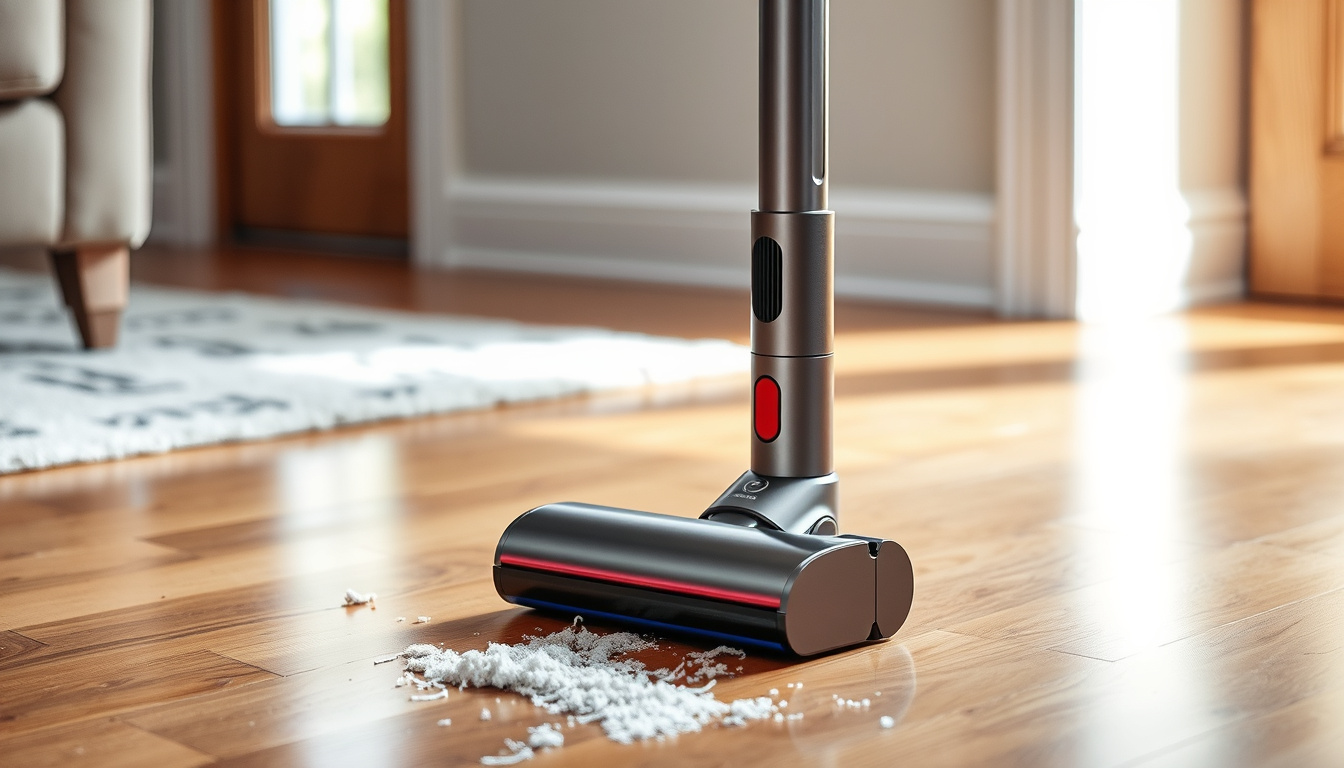
Anyone who has watched a cordless vacuum fade halfway through a hallway knows the real spec sheet isn’t the one on the box. Dyson and Shark both advertise around 70 minutes for their flagship cordless models, but TechRadar’s testing measured 75 minutes on the Dyson Gen5Detect and 67 on the Shark PowerDetect (TechRadar, consumer tech testing lab). The real question is which model fits your home, how long the battery will genuinely last, and when a replacement cell beats a whole new machine.
Advertised max runtime: up to 70 min (Gen5Detect) · Tested runtime, low power: 75 min Dyson vs 67 min Shark · Tested runtime, Boost: 15 min Dyson vs 14 min Shark · Charge time: 4.5 h Dyson vs 4 h Shark · UK warranty: 2 years, parts and battery
Quick snapshot
- In TechRadar’s low-power test, the Dyson Gen5Detect ran 75 minutes and the Shark PowerDetect 67 (TechRadar, consumer tech testing lab). (Dyson, manufacturer’s V8 product page)
- The V8 Cyclone quotes up to 60 minutes in Eco/handheld mode, charges in about four hours, and has a swappable battery (Dyson, manufacturer’s V8 product page).
- The standard UK warranty covers the machine, parts, and battery for two years (Dyson, manufacturer’s official battery-care page).
- Real-world runtime shifts with maintenance, storage, power mode, attachments, and battery condition.
- Exact lifespan varies widely with usage and cleaning habits.
- Dyson’s trade-in terms change, so current offers need checking before you rely on them.
- Lithium-ion cells degrade with use, and a drop in runtime outside Max or Boost mode is the usual first signal.
- Dyson puts its batteries through more than 2,000 hours of testing before release.
- Plan around the two-year warranty window: after it ends, battery issues are owner-paid.
- A replacement battery typically costs £50–£100 and can add about two years of service if the rest of the machine is healthy.
- If the brush bar or motor is already failing, replacement is usually not worth it.
- Check current trade-in offers before committing to a new model.
Ten facts explain most Dyson cordless buying decisions, one pattern: the battery, not the motor, decides when a machine retires.
| Fact | Value |
|---|---|
| Brand | Dyson |
| Product type | Cordless stick vacuum |
| Key models | V8, V10, V11, V15, Gen5Detect |
| Battery technology | Lithium-ion, up to 60–70 min runtime depending on model |
| Weight range | 2.6 kg (V15) to 2.8 kg (V11) |
| Advertised max runtime | 60 min (V8 Eco/handheld) to 70 min (Gen5Detect) |
| Charge time | 4 h (V8 and Shark PowerDetect) to 4.5 h (Gen5Detect) |
| UK warranty | 2 years, parts and battery |
| Battery testing | Over 2,000 hours per Dyson |
| Battery replacement | Typically £50–£100 |
Which is the best cordless Dyson to buy?
Best overall: Dyson V15 Detect
- Laser dust-detection head reveals fine dust on hard floors.
- Suction rated at 230 AW, Dyson’s headline V-series figure.
- Sits below the newer Gen5Detect in Dyson’s current line-up.
The V15 Detect is the model most buyers compare first. It carries Dyson’s green laser head, which makes invisible dust visible on hard floors, and its 230 AW suction rating tops the rest of the V-series. The newer Gen5Detect refines that design and adds meaningful run time headroom, but for most homes the V15 is the more rational top-of-range choice.
Best value: Dyson V8
The V8 Cyclone is Dyson’s entry point, and its 60-minute Eco runtime keeps it competitive with much newer rivals.
Dyson positions the V8 Cyclone as the affordable cordless stick. It is the oldest model still in the range, with a removable battery pack, a four-hour charge time, and a headline figure that comes with a footnote: 60 minutes in Eco mode with the handheld configuration, not with the floor head attached. For budget-led buyers, the V8 is the rational place to start.
Best for pets: Dyson V11 Animal
- Torque-drive cleaner head handles embedded pet hair.
- Sits between the V8 and the V15 in Dyson’s line-up.
- Mid-range price between the budget V8 and the premium V15.
The V11 Animal is the model Dyson points pet owners toward, and the torque-drive cleaner head is the reason. It sits one step below the V15 in the current range, which makes it the pick for households that want dedicated pet-cleaning capability without paying a flagship premium.
The pattern: every step up the Dyson ladder buys more suction, more run time, and a smarter cleaner head — and the biggest single jump is battery capacity.
What is better, Dyson or Shark?
This is the comparison that dominates the cordless category, and the honest answer is that it depends on what you weight: peak suction, run time, or price. Homes & Gardens frames the market simply: leading Dyson and Shark models generally advertise around 60 minutes, with some top models reaching 70 (Homes & Gardens, home-care advice outlet).
Suction power comparison
Dyson top-rated suction: 230 AW (V15, advertised) · Shark top-rated suction: 150 AW (advertised)
Dyson quotes higher air-watt figures on its top model, and that advantage matters most on carpets and in high-power mode. Shark’s counter is value: similar run time, a removable battery, and a lower price on most comparable models.
Battery life comparison
- Advertised figures converge: Dyson Gen5Detect and Shark PowerDetect both quote up to 70 minutes in low-power mode.
- Independent testing favored Dyson on low-power runtime; both machines have removable batteries.
- In Boost mode, both flagships fall to roughly a quarter of their low-power runtime.
The marketing figures are nearly identical, but the measured results are not. Dyson’s low-power advantage matters because low-power mode is the setting people actually clean with day to day. In Boost, both machines fall toward 15 minutes, which is why a removable battery is more practical than a bigger marketing number.
Price and value comparison
Dyson charges a premium for suction and brand cachet; Shark charges less for similar run time and adds an auto-empty base on its top model.
Dyson models tend to be pricier than comparable Sharks, and the premium buys stronger suction plus a two-year warranty that covers parts and battery. For budget-led buyers, Shark is the rational choice; for performance-led buyers, Dyson still has the edge in measured runtime.
The pattern: Dyson and Shark quote nearly identical run times, yet measured low-power performance favors Dyson by a solid margin — the kind of difference that shows up in weekly use, not in the spec sheet.
How many years should a Dyson cordless vacuum last?
Expected lifespan
The motor can outlast the rest of the machine; the battery is the component that sets the retirement date.
The typical lifespan sits at three to five years before battery degradation takes hold. Dyson’s battery-care guidance says lithium-ion cells degrade over time, that runtime varies with maintenance, storage, power mode, and battery condition, and that a noticeable drop in runtime outside Max or Boost mode may signal a replacement is due (Dyson, manufacturer’s official battery-care page). The same page notes more than 2,000 hours of battery testing and a two-year UK warranty covering parts and battery.
Factors affecting lifespan
- Power mode: heavy Boost use drains the battery faster in daily life.
- Maintenance: washing the filter and clearing the brush bar keeps airflow and runtime healthy.
- Storage and charging habits also shape how quickly lithium-ion cells lose capacity.
- Heavy usage accelerates the clock; occasional light cleaning stretches it.
A replacement battery is the standard fix, and Homes & Gardens notes that spare batteries can be bought for some Dyson and Shark cordless models to extend time between charges (Homes & Gardens, home-care advice outlet). Looking after filters and clearing the brush bar keeps the vacuum running at full airflow, which protects battery efficiency.
Looking after filters and clearing the brush bar keeps the vacuum running at full airflow, which protects battery efficiency.
What this means: a Dyson cordless vacuum is a motor with a consumable battery wrapped around it. Factor a £50–£100 battery swap into the ownership cost and the realistic lifespan extends to roughly five years.
What is the common problem with Dyson vacuums?
Battery issues
- Most common: battery failure or capacity loss after two to three years.
- Sign to watch: runtime drops noticeably even after a full charge.
- Warranty note: the battery is covered by the two-year UK warranty.
The battery is the most-replaced part on any Dyson cordless vacuum. The Gen5Detect and V8 both use removable packs, which makes replacement straightforward once the fault is diagnosed.
Brush bar problems
- Hair and thread wrap around the brush bar and stop it spinning.
- Carpet fibres can jam the cleaner head if the bar is blocked.
- Most jams clear once the wrapped debris is cut away.
A jammed brush bar is the most common non-battery fault. When the bar stops, the vacuum sounds different and suction drops, but the fix is usually simple: clear the wrap, remove the blockage, and restart the machine.
Loss of suction
- Blocked filters are the first cause of weak suction.
- A full bin or dock reduces airflow.
- Blockages in the wand or floor head mimic filter problems.
Dyson’s filter is washable, and the maintenance routine is short: rinse, dry fully, and refit. Suction loss almost always traces back to airflow — a clogged filter, a full bin, or a blocked wand — rather than a failing motor.
The trade-off: the parts that fail on Dyson cordless vacuums are the cheap parts. A £50–£100 battery replaces the most common failure, and a filter clean costs nothing.
Is it worth replacing a Dyson battery?
Cost of replacement vs new vacuum
Replacement battery: typically £50–£100 · New cordless Dyson: roughly £200–£700 · Potential added life: about 2 years
The arithmetic is simple: a battery pack costs a fraction of a new machine, and if the motor, brush bar, and bin mechanism are healthy, it adds years of service. The catch is that a new battery only makes sense when the rest of the vacuum is sound.
When to replace battery
- Runtime no longer covers a full cleaning session.
- A full charge produces no improvement in run time.
- The vacuum cuts out on carpet even with a fresh charge.
The practical test is Dyson’s: if the machine only runs briefly outside Max or Boost mode, the battery is the prime suspect. If the brush bar is noisy or the motor sounds strained, put the money toward a new model instead.
Why this matters: a £50–£100 battery buys two more years of service on a machine that already cost hundreds — the best-value repair in the cordless category. The moment the motor or brush bar joins the failure list, replacement wins.
Dyson vs Shark: the numbers that count
Six rows separate Dyson’s Gen5Detect from Shark’s PowerDetect, and one pattern stands out: the adverts agree, but the test results don’t. Both flagships advertise up to 70 minutes; TechRadar’s side-by-side testing produced the measured figures below (TechRadar, consumer tech testing lab).
| Specification | Dyson Gen5Detect | Shark PowerDetect |
|---|---|---|
| Advertised max runtime (low power) | Up to 70 minutes | Up to 70 minutes |
| Tested runtime (low-power mode) | 75 minutes | 67 minutes |
| Tested runtime (Boost mode) | 15 minutes | 14 minutes |
| Charge time | 4.5 hours | 4 hours |
| Battery | Removable | Removable |
| Dust bin capacity | 0.8 litres | 0.7 litres |
The takeaway: in the mode that matters for everyday cleaning, the Dyson out-ran both its own 70-minute claim and the Shark’s tested time. In Boost, both flagships drop to around a quarter of that, which makes mode choice the real user error.
Dyson cordless specifications at a glance
Ten specifications separate the Dyson line-up, and the pattern is consistent: the advertised figure is the Eco-mode ceiling, not the floor-head reality.
| Aspect | Specification |
|---|---|
| Current key models | V8, V10, V11, V15, Gen5Detect |
| Product type | Cordless stick vacuum |
| Battery technology | Lithium-ion, removable on most models |
| Advertised max runtime (V8 Eco/handheld) | Up to 60 minutes |
| Advertised max runtime (Gen5Detect, low power) | Up to 70 minutes |
| Charge time (V8) | 4 hours |
| Charge time (Gen5Detect) | 4.5 hours |
| Tested runtime (Gen5Detect, low power) | 75 minutes |
| Warranty (UK) | 2 years, parts and battery |
| Battery replacement cost (typical) | £50–£100 |
What this means: battery specs dominate every decision. The V8’s 60-minute Eco claim and the Gen5Detect’s 70-minute claim are both real, but both depend on low-power mode — so match the model to the cleaning mode you will actually use.
Dyson cordless vacuums: pros and cons
Upsides
- Measured low-power runtime beat the advertised figure in TechRadar’s test.
- Two-year UK warranty covers parts and battery.
- Swappable batteries on most models make the £50–£100 replacement route viable.
- Laser dust detection on the V15 makes fine dust visible on hard floors.
Downsides
- Premium pricing versus comparable Sharks.
- Boost mode drains the battery in roughly 15 minutes.
- Headline run times assume Eco mode and, on the V8, handheld configuration.
The trade-off: Dyson’s strengths show up in the modes people actually use, but only if buyers understand the Eco-mode small print before purchase.
What we know and what we don’t
Confirmed facts
- Dyson’s two-year UK warranty covers the machine, parts, and battery.
- The V8 Cyclone quotes up to 60 minutes in Eco/handheld mode and takes about four hours to charge.
- Dyson says lithium-ion batteries degrade over time and that falling runtime outside Max or Boost mode may signal a replacement is due.
What’s unclear
- Exact lifespan varies widely with usage, floor type, and maintenance habits.
- Dyson’s trade-in availability and terms can change.
- Whether Dyson or Shark is the better brand depends on budget and on which modes you actually use.
- Headline runtime figures assume Eco mode and, on some models, handheld configuration rather than whole-vacuum floor cleaning.
The balance of evidence: the confirmed list is short because Dyson’s real-world battery behavior is only patchily documented — the marketing claims are consistent with tests, but the variance between homes is large enough to matter.
What the experts say
Battery runtime varies with maintenance, storage, power mode, and battery condition.
Dyson — official battery-care guidance
Leading Dyson and Shark cordless models generally advertise around 60 minutes of runtime, with some top models reaching 70 minutes.
Why this matters: the people who own the data — Dyson, TechRadar, and Homes & Gardens — all point the same direction: battery care and battery replacement decide how long a cordless vacuum stays useful.
The takeaway
Most cordless Dyson failures are battery failures, and most battery failures are predictable. Dyson’s own warranty and battery data make the trade-off explicit: two years of cover, more than 2,000 hours of battery testing, and a predictable degradation curve after that. For UK households replacing a tired cordless in 2025, the decision is clear: choose a V8 or V11 and budget a £50–£100 battery swap around year three, or buy the Gen5Detect and treat its 70-minute claim as a low-power ceiling, not a daily guarantee.
Frequently asked questions
What is the difference between Dyson V8 and V10?
The V8 is Dyson’s entry-level cordless model, quoted at up to 60 minutes in Eco/handheld mode. The V10 sits one step higher in the line, between the V8 and the V11, and is no longer Dyson’s headline model. For most budget buyers, the V8 is the practical starting point.
How often should I clean the Dyson vacuum filter?
Dyson’s filter is washable, and the simple rule is to clean it whenever suction drops. Filter maintenance directly affects airflow and runtime, so a blocked filter is the first thing to check before assuming a battery problem.
Does Dyson offer a warranty on cordless vacuums?
Yes. The standard UK warranty covers the machine, parts, and battery for two years from purchase. Battery degradation after that window is the most common reason owners pay for a replacement cell.
Can a Dyson cordless vacuum pick up pet hair effectively?
Yes, especially the V11 Animal, which uses a torque-drive cleaner head designed for embedded hair. The V15 also handles pet hair well in normal floor-cleaning mode.
Is the Dyson V15 Detect worth the extra cost?
The V15 adds the laser dust-detection head and a higher suction rating than the V11. If you clean mostly hard floors and want to see fine dust, the V15 is the model to pay for; if you clean mostly carpet, the V11 is the value pick.
What does the Dyson V15 Detect detect?
The V15’s laser head illuminates fine dust particles on hard floors so you can see the dust the vacuum is about to pick up. It is the headline feature that separates the V15 from the V11 and V8.
Related reading

Oliver Jack Carter Cooper is a staff writer for EveningLedger.uk, covering UK news, politics, business and culture. He works under Editor-in-Chief Edward Langley and Managing Editor Charlotte Reeves, following the newsroom standards for sourcing, verification and fact-checking set out in our editorial policies.