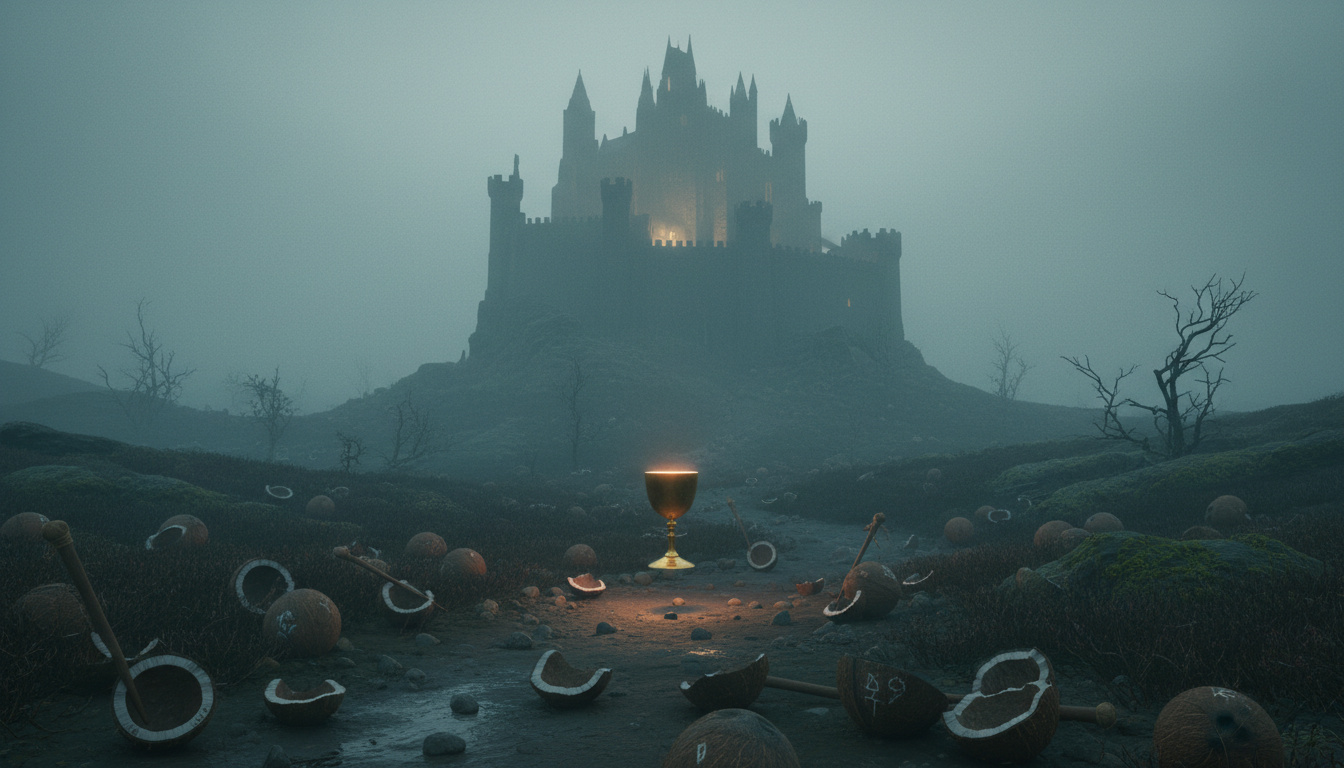
Monty Python and the Holy Grail stands as a defining cinematic achievement in British comedy, transforming the Arthurian legend into a surrealist landscape of bureaucratic absurdity and existential dread. Released in 1975, this independent production emerged from the collective imagination of the Monty Python troupe, featuring Graham Chapman as an earnest King Arthur leading a dysfunctional Round Table through territory beset by argumentative peasants, Killer Rabbits, and French soldiers hurling livestock from castle ramparts.
Co-directed by Terry Gilliam and Terry Jones, the film deliberately rejected the polished aesthetic of historical epics in favor of gritty Scottish locations and stark production ingenuity. Rather than staging grand battles with thousands of extras, the production relied on the comedic precision of its six core performers, each juggling multiple roles that blurred the boundaries between nobility and buffoonery.
Nearly five decades later, the film maintains its status as a cultural landmark, its quotable dialogue and anarchic narrative structure continuing to influence comedy filmmakers while remaining immediately accessible to new audiences discovering its unique alchemy of medieval parody and Python-esque philosophy.
What Is Monty Python and the Holy Grail About?
1975
Terry Gilliam & Terry Jones
91 minutes
Comedy / Fantasy
The narrative follows King Arthur as he recruits knights—including Sir Bedevere the Wise, Sir Lancelot the Brave, Sir Galahad the Pure, and Sir Robin the Not-Quite-So-Brave-as-Sir-Lancelot—to seek the Holy Grail on divine command. After rejecting Camelot as “a silly place,” the company faces taunting French soldiers who repel them with livestock and a failed Trojan Rabbit ploy. The knights subsequently separate: Sir Robin flees a three-headed giant; Sir Galahad escapes seductive women at Castle Anthrax; and Sir Lancelot massacres a wedding party after mistaking a prince for a damsel in distress.
- Produced without a traditional orchestral musical score, relying instead on diegetic sound and silence
- Financed partially by rock musicians including members of Led Zeppelin and Pink Floyd through producer Tony Stratton-Smith
- Parodies Arthurian legend through absurdist subversion rather than direct adaptation
- Features an abrupt meta-textual conclusion involving modern police intervention
- Utilized coconut shells clapped together to simulate equine hoofbeats due to budget constraints
- Each of the six principal performers portrayed between three and twelve distinct characters
| Original Budget | Approximately £229,000 (figure remains unconfirmed in available sources) |
| Directorial Approach | Co-directed by Terry Jones and Terry Gilliam with documented creative tensions |
| Release Year | 1975 (United Kingdom and United States) |
| Primary Locations | Scotland, including Castle Stalker and Doune Castle |
| Source Material | Arthurian legend (satirical interpretation) |
| Casting Structure | Six Python members in multiple roles; no external leading actors |
| Notable Prop | Hand puppet portraying the Killer Rabbit of Caerbannog |
| Narrative Device | Fourth-wall breaking conclusion involving contemporary law enforcement |
Who Made Monty Python and the Holy Grail? Production Details
Who Directed Monty Python and the Holy Grail?
Terry Jones and Terry Gilliam shared directorial duties, marking their first major cinematic collaboration. Creative tensions emerged during production, with the Python collective reportedly favoring Jones’s approach to comedic performance while Gilliam focused on visual aesthetics. This dichotomy resulted in a distinctive style that juxtaposed muddy historical realism with sudden animated interludes.
When Was Monty Python and the Holy Grail Released?
The film premiered in 1975, entering British cinemas before expanding to international markets. Its release coincided with the troupe’s rising global recognition following the conclusion of their television series, allowing the production to capitalize on established fan anticipation while attracting new audiences through word-of-mouth marketing.
How Was Monty Python and the Holy Grail Made on a Low Budget?
Financial constraints dictated nearly every production decision. Without funds for live animals, the crew employed coconut shells clapped together to mimic horse sounds—a technique borrowed from existing Python sketches. The Killer Rabbit of Caerbannog appeared as a hand puppet rather than a trained animal or optical effect. Sets remained minimal, often consisting of actual Scottish castles and landscapes rather than constructed soundstages.
The film’s iconic coconut sound effect—created by clapping two shell halves together—replaced actual horses entirely due to budget limitations. Terry Gilliam, portraying Arthur’s servant Patsy, performed these sounds live during takes, establishing a low-fidelity aesthetic that became the film’s visual signature.
Where Was Monty Python and the Holy Grail Filmed?
Primary photography occurred in Scotland, utilizing Castle Stalker for the climactic Castle Aaargh sequences and Doune Castle for multiple interior scenes. These authentic medieval locations provided atmospheric texture that compensated for the production’s inability to afford elaborate set construction.
Cast and Characters in Monty Python and the Holy Grail
Who Are the Main Actors in Monty Python and the Holy Grail?
The Monty Python ensemble—Graham Chapman, John Cleese, Terry Gilliam, Eric Idle, Terry Jones, and Michael Palin—assumed all principal roles. Chapman anchored the narrative as King Arthur, while simultaneously providing the voice of God and appearing as minor guards. Cleese portrayed Sir Lancelot alongside the indefatigable Black Knight and the pyrotechnic Tim the Enchanter.
What Multiple Roles Did Each Performer Play?
Gilliam appeared prominently as Patsy, the coconut-clapping squire, while also serving as Bridgekeeper and Sir Bors. Idle inhabited Sir Robin, the cowardly minstrel’s squire Concorde, and the shrubbery merchant Roger. Jones doubled as Sir Bedevere and Prince Herbert, the reluctant bridegroom. Palin covered Sir Galahad, the leader of the Knights Who Say “Ni!”, and the Swamp Castle lord. Supporting appearances included Neil Innes as musical minstrels and Connie Booth as the accused witch.
Iconic Quotes and Where to Watch Monty Python and the Holy Grail
What Are Some Famous Quotes from Monty Python and the Holy Grail?
The screenplay generated numerous phrases that entered common vernacular. The French Taunter’s insult—”Your mother was a hamster and your father smelt of elderberries!”—remains widely recognized. The plague cart scene’s refrain of “Bring out your dead!” and the Knights Who Say “Ni!” demanding “It’s only a model” when viewing their required shrubbery demonstrate the film’s linguistic inventiveness.
While the complete screenplay is not available in public digital archives, detailed scene breakdowns and verified dialogue transcripts remain accessible through encyclopedic repositories and official Monty Python historical records.
Where Can I Watch Monty Python and the Holy Grail?
Distribution rights currently circulate through various streaming platforms, though specific availability shifts periodically between services. Physical media editions remain in circulation through major retailers, often including supplementary documentary material regarding the production’s financial constraints.
What Does the Ending of Monty Python and the Holy Grail Mean?
The quest culminates at Castle Aaargh against entrenched French defenders, but rather than staging the anticipated climactic battle, the film severs mid-conflict. Contemporary police officers arrive to arrest King Arthur and Sir Bedevere for the murder of a documentary historian killed earlier by the Black Knight. This collision of medieval narrative with 1970s reality creates an anti-climactic dénouement that rejects traditional heroic closure.
The abrupt police ending was not merely stylistic subversion but a practical necessity arising from budget exhaustion. The production lacked funds to complete the scripted large-scale battle sequence, forcing the troupe to devise the anachronistic arrest scene as an alternative conclusion.
When Was Monty Python and the Holy Grail Produced?
- : Script development completed by the Monty Python collective, establishing the episodic quest structure Source
- : Principal photography commenced in Scotland utilizing Castle Stalker and Doune Castle locations Source
- : British theatrical premiere introduced the coconut sound effect and killer rabbit to audiences Source
- : United States release distributed by Michael White Productions Source
- : Achieved cult classic status through midnight screenings and home video circulation Source
What Are the Verified Facts Versus Uncertainties?
| Established Information | Information Remaining Unclear |
|---|---|
| Co-directed by Terry Jones and Terry Gilliam with documented creative tensions regarding visual versus performance priorities | Precise final budget figures, with various sources citing approximately £229,000 without definitive confirmation |
| Filmed primarily at Doune Castle and Castle Stalker in Scotland | Current streaming availability subject to regional licensing agreements and platform rotation |
| Financed through rock industry investors including Led Zeppelin and Pink Floyd associates | Specific contractual details regarding rock star investment percentages |
| Released in 1975 to immediate critical and commercial success | Whether additional deleted scenes exist beyond the documented budget-related cuts |
How Did Monty Python and the Holy Grail Change Comedy?
The film established a template for anachronistic historical satire that influenced subsequent decades of comedy filmmaking. By treating medieval iconography with modern bureaucratic logic—where witches are weighed against ducks and divine quests require proper documentation—it dismantled the epic gravitas typically associated with Arthurian narratives.
Its influence extends beyond cinema into theatrical performance, with the source material adapted into the Tony Award-winning musical “Spamalot.” The film’s DIY production ethos demonstrated that comedic precision could outweigh visual spectacle, a lesson that resonated with independent filmmakers working under similar constraints. Last Voyage of the Demeter – Plot, Cast and Full Guide represents a different approach to period filmmaking, utilizing contemporary horror conventions rather than absurdist deconstruction.
What Do Critics and Original Sources Say?
“It’s only a model.”
— Knights Who Say “Ni!”, Monty Python and the Holy Grail
The film “satirizes the Arthurian legend of King Arthur’s quest for the Holy Grail” through a lens of absurdist Python humor.
— Rotten Tomatoes editorial summary
The production utilized “low-budget innovations” including minimal sets and the abrupt ending necessitated by financial exhaustion.
— Official Monty Python archives
Why Does Monty Python and the Holy Grail Remain Essential?
Monty Python and the Holy Grail endures as a masterclass in constraint-driven creativity, demonstrating how budget limitations can generate iconic cultural artifacts. The film’s dismantling of heroic mythology through bureaucratic absurdity maintains its relevance in contemporary discussions about institutional logic and historical narrative. The Mandalorian and Grogu – Release Date, Cast, Trailer Guide illustrates modern franchise filmmaking, offering contrast to the Holy Grail’s rebellious independence.
Frequently Asked Questions
Why do the knights use coconuts in Monty Python and the Holy Grail?
The production lacked funding for live horses, requiring Patsy (Terry Gilliam) to clap coconut shell halves together to simulate hoofbeats. This technique originated from previous Monty Python sketch comedy.
Which musicians helped finance Monty Python and the Holy Grail?
Rock bands including Led Zeppelin and Pink Floyd contributed funding through concert producer Tony Stratton-Smith, enabling the film’s production despite initial financing difficulties.
Was Monty Python and the Holy Grail filmed at a real castle?
Yes. The production utilized authentic Scottish locations including Castle Stalker for the Castle Aaargh climax and Doune Castle for interior sequences.
Why does Monty Python and the Holy Grail end with police?
Modern police officers arrest Arthur and Bedevere for murdering a historian (killed earlier by the Black Knight). This ending replaced an unfilmed battle scene due to budget exhaustion.
Is there a full script available for Monty Python and the Holy Grail?
Complete screenplay transcripts are not publicly archived; however, detailed scene breakdowns and verified dialogue appear in encyclopedic sources and official Monty Python repositories.
Is Monty Python and the Holy Grail based on Arthurian legend?
The film parodies Arthurian legend elements including the Grail quest, Camelot, and the Knights of the Round Table, but subverts them with absurdist humor rather than faithful adaptation.
Was the Killer Rabbit a real animal?
The Killer Rabbit of Caerbannog was portrayed using a hand puppet rather than a trained animal or special effects, reflecting the production’s low-budget constraints.

Oliver Jack Carter Cooper is a staff writer for EveningLedger.uk, covering UK news, politics, business and culture. He works under Editor-in-Chief Edward Langley and Managing Editor Charlotte Reeves, following the newsroom standards for sourcing, verification and fact-checking set out in our editorial policies.