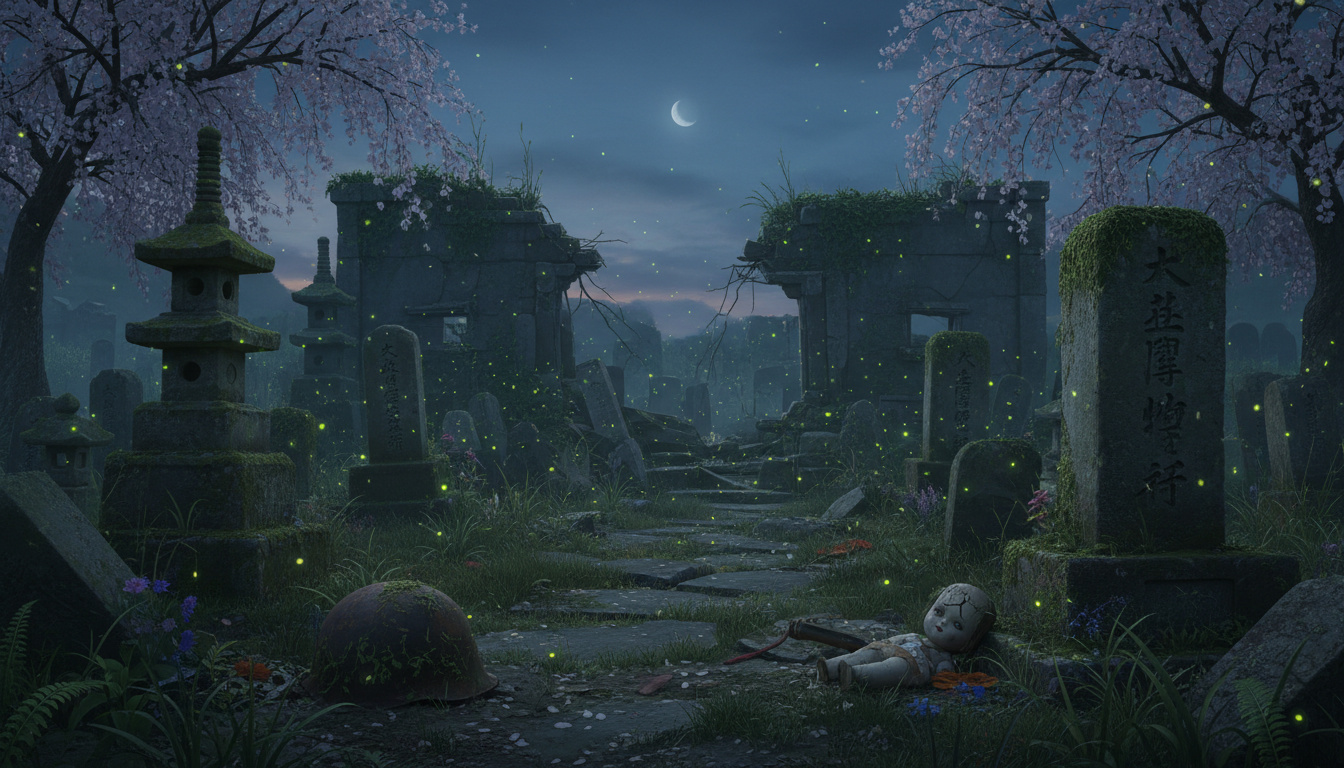
Grave of the Fireflies stands as one of cinema’s most devastating portrayals of war’s civilian toll. Released in by Studio Ghibli, the animated film depicts two siblings struggling to survive after the firebombing of Kobe, Japan.
The narrative derives from a semi-autobiographical short story by Akiyuki Nosaka, who drew from his own childhood experiences during World War II. Unlike typical animated features of its era, the work embraces unflinching realism, presenting starvation, loss, and societal collapse through the eyes of fourteen-year-old Seita and his four-year-old sister Setsuko.
Decades after its release, questions persist regarding the story’s factual basis, current streaming availability, and the distinctions between various film adaptations. This examination separates verified history from common misconceptions while tracing the work’s evolution from personal memoir to international cinematic landmark.
What Is Grave of the Fireflies Anime?
Isao Takahata
Studio Ghibli
1988
Semi-autobiographical novel by Akiyuki Nosaka
- Semi-autobiographical story based on the Kobe firebombing witnessed by author Akiyuki Nosaka at age 14
- Original novel won the prestigious Naoki Award in Japan
- Second feature film produced by Studio Ghibli, establishing the studio’s range beyond fantasy
- Author Nosaka endorsed the animation after reviewing storyboards, considering it the ideal medium
- Contains creative liberties: protagonist Seita dies in the narrative, though Nosaka survived the war
- Two live-action adaptations exist: a television film and a theatrical release
- New English translation by Ginny Tapley Takemori published by Penguin Classics in
| Aspect | Details |
|---|---|
| Original Title | Hotaru no Haka (火垂るの墓) |
| Director | Isao Takahata |
| Studio | Studio Ghibli |
| Release Date | |
| Runtime | 89 minutes |
| Source Material | short story by Akiyuki Nosaka |
| Genre | Animated War Drama |
| Language | Japanese |
| Setting | Kobe, Japan, |
| Adaptation Status | Approved by original author |
Where to Watch Grave of the Fireflies?
Current streaming availability for the anime remains unspecified in recent sources. Licensing agreements vary significantly by region, and carriage rights shift between platforms without extensive public documentation.
While some viewers report historical availability on Netflix, no sources confirm active streaming rights on that platform or others. Regional variations apply; the film may appear on subscription services in some territories while requiring rental or purchase in others.
Check Netflix and other regional streaming platforms directly before planning to view, as licensing agreements change frequently and may differ from one country to another.
Is Grave of the Fireflies Based on a True Story?
The narrative draws directly from Akiyuki Nosaka’s experiences during the final months of World War II. As a 14-year-old boy living in Kobe, he survived the firebombing by the USAAF while his adoptive family perished in separate incidents related to the attack.
The Real Events Behind the Story
Nosaka’s adoptive father died during the Kobe firebombing, while his adoptive mother was killed in an air raid. His younger adoptive sister, Keiko, died of malnutrition at 16 months old in after the family structure collapsed. These events mirror the film’s plot, in which siblings Seita and Setsuko lose their mother to bombing and struggle against starvation and societal indifference.
The author was adopted by an aunt injured in the bombings after his biological mother died shortly after giving birth to Keiko. The Kobe firebombing formed part of a larger campaign of incendiary attacks that caused approximately 300,000 civilian deaths across Japan, exceeding the immediate fatalities of the atomic bombings according to World Literature Today.
Nosaka wrote the story as a direct apology to his deceased sister Keiko. He carried guilt for not being as kind to her as the fictional Seita is to Setsuko, specifically regretting that he did not pet or comfort her enough during their final months together as documented in archival interviews.
Creative Liberties and Idealization
While grounded in historical events, the narrative contains deliberate idealizations. Nosaka portrayed the older brother as significantly more caring and devoted than he felt he had been in reality. The author survived the war, unlike his protagonist Seita, whose death in the story serves as the narrative’s framing device Collider reports.
The anime adaptation tones down the graphic descriptions of suffering present in the original novel while using visual metaphors—particularly the fireflies themselves—to depict war’s brutality. Nosaka approved this approach after viewing Takahata’s storyboards, agreeing that animation could convey the emotional weight without the visceral horror of live-action reconstruction Wikipedia notes.
The acclaimed animated feature differs significantly from the live-action television film and theatrical version. The Studio Ghibli production remains the definitive international version, while the live-action adaptations offer alternative interpretations of Nosaka’s source material.
Grave of the Fireflies Reactions and Discussions
Critical and Audience Reception
The anime deviates from Studio Ghibli’s typical fantasy output to present unvarnished wartime devastation. By revealing the siblings’ deaths in the opening scenes, director Isao Takahata shifts focus from suspense to empathy, forcing viewers to engage with the process of loss rather than its outcome Esquire Philippines details.
Written during Japan’s post-war “Sengo” era emphasizing peace and national coping, the work resonated with audiences seeking to understand civilian suffering without glorifying conflict. The emotional impact generates widespread grief responses and anti-war reflection, distinguishing it from escapist cinema.
Common Misconceptions
No verified photographs of Nosaka’s mother or sister Keiko appear in available sources; the story draws from personal memories without referenced imagery. This absence of visual documentation leads some viewers to search for “real photos” of the characters, though none exist in the public record.
Confusion persists between the anime and subsequent live-action versions. The television adaptation and film represent distinct productions with different casts and directorial approaches, neither involving Studio Ghibli or Takahata.
Grave of the Fireflies Timeline: From Kobe 1945 to 1988
- : USAAF firebombing of Kobe incinerates sections of the city, killing Nosaka’s adoptive father and injuring his aunt. Wikipedia documents.
- : Nosaka’s adoptive sister Keiko dies of malnutrition at 16 months old; his adoptive mother dies in an air raid.
- : Nosaka publishes “Hotaru no Haka” as a personal apology to Keiko; the work wins the Naoki Award.
- : Studio Ghibli releases the animated adaptation directed by Isao Takahata in Japanese theaters.
- : Japanese television network broadcasts live-action TV film adaptation.
- : Theatrical live-action film adaptation premieres in Japan.
- : Penguin Classics publishes new English translation by Ginny Tapley Takemori in the United Kingdom.
Separating Fact from Fiction in Grave of the Fireflies
| Established Information | Uncertain or Unverified Details |
|---|---|
| Story is semi-autobiographical based on Nosaka’s childhood | Current streaming platform availability in specific regions |
| Keiko died of malnutrition at 16 months in | Specific visual appearance of real family members (no photos exist) |
| Adoptive father died in Kobe firebombing; mother in air raid | Precise circumstances of adoptive mother’s death beyond general “air raid” classification |
| Nosaka survived the war (unlike character Seita) | Specific licensing terms for international distribution |
| film is animated; is live-action TV | Current Netflix carriage status as of |
Cultural Context and the Sengo Era
Nosaka composed the narrative during Japan’s “Sengo” period—the decades following surrender characterized by national reflection on peace and civilian suffering. The story avoids militaristic glorification, focusing instead on systemic collapse and the failure of community safety nets during total war.
The firebombing campaigns, including the attack on Kobe, resulted in approximately 300,000 civilian deaths across Japan, a figure exceeding the immediate casualties of the atomic bombings. This context frames the siblings’ struggle not as anomalous tragedy but as representative of widespread civilian devastation. World Literature Today analyzes.
Unlike Monty Python and the Holy Grail – Plot, Cast, Production Guide, which approaches historical material through absurdist comedy, Grave of the Fireflies represents the antithesis of escapist cinema, offering no narrative relief from its central tragedy.
The Creator’s Perspective
I wrote the story as an apology to my sister Keiko. In reality, I was not as kind to her as Seita is to Setsuko. I could not even pet her enough.
— Akiyuki Nosaka, on the autobiographical nature of the work
When I saw the storyboards, I understood that animation could show what live-action could not—the internal world of children facing starvation while the fireflies glow around them.
— Akiyuki Nosaka, on approving the Studio Ghibli adaptation
Final Takeaways
Grave of the Fireflies endures as a document of civilian wartime suffering filtered through personal guilt and memory. The Studio Ghibli adaptation preserves Akiyuki Nosaka’s apology to his deceased sister while introducing the story to international audiences. For viewers interested in historical survival narratives with supernatural elements, Last Voyage of the Demeter – Plot, Cast and Full Guide offers a different perspective on doomed voyages, though the animated film remains unique in its unflinching grounding in documented historical atrocity.
Frequently Asked Questions
Who wrote the original Grave of the Fireflies story?
Japanese author Akiyuki Nosaka wrote the semi-autobiographical short story in . He based it on his experiences as a 14-year-old survivor of the Kobe firebombing, during which his adoptive father died in the bombing and his younger sister succumbed to malnutrition.
Did Seita survive in real life?
No. While protagonist Seita dies in both the novel and film, author Akiyuki Nosaka survived the war. The story represents an idealized apology to his deceased sister Keiko, who died at 16 months old, with Nosaka portraying the brother as more caring than he felt he had been.
Is there a 2005 version of Grave of the Fireflies?
Yes. A live-action television film adaptation aired in Japan in , followed by a theatrical live-action version in . These should not be confused with Isao Takahata’s acclaimed anime film produced by Studio Ghibli.
Are there real photographs of the characters?
No verified photographs of Nosaka’s adoptive mother or sister Keiko appear in available sources. The story draws from personal memories without referenced imagery, making the visual representations in adaptations purely interpretive rather than documentary.
Did Akiyuki Nosaka approve the anime adaptation?
Yes. Nosaka endorsed the animated film after reviewing storyboards from director Isao Takahata. He considered animation the ideal medium for the story, as it could depict the harsh realities of war while tempering the graphic suffering described in his original novel.
Is Grave of the Fireflies currently on Netflix?
Current streaming availability on Netflix or other platforms remains unconfirmed in recent sources. Licensing agreements vary by region and change frequently. Viewers should check Netflix or regional streaming services directly for current carriage status.

Oliver Jack Carter Cooper is a staff writer for EveningLedger.uk, covering UK news, politics, business and culture. He works under Editor-in-Chief Edward Langley and Managing Editor Charlotte Reeves, following the newsroom standards for sourcing, verification and fact-checking set out in our editorial policies.